Posted on 08 Jun 2026
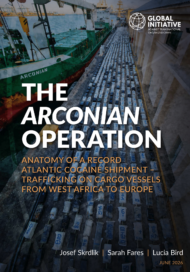
On 1 May 2026, Spanish authorities seized more than 30 tonnes of cocaine from the Arconian, a Comoros-flagged dry bulk vessel intercepted off the coast of Western Sahara — the largest single cocaine seizure in recorded history. The shipment, most likely loaded in Freetown, Sierra Leone, was destined for transfer to smaller speedboats near the Canary Islands before onward distribution across Europe. Hidden aboard alongside a Filipino crew were six armed men — five Dutch, one Surinamese — several with prior charges for cocaine trafficking and money laundering in the Netherlands.
The Arconian was not an isolated event. Investigation into the vessel’s movements reveals a broader and sustained pattern: since at least 2024, multiple small cargo ships departing from Freetown or nearby West African waters have followed near-identical routes toward North African ports, loitering off Morocco, the Canary Islands, and the Spanish coast before completing their journeys. At least eight such voyages have been identified. The likely coordinator is Jos Leijdekkers, a major Dutch cocaine trafficker resident in Sierra Leone since mid-2022, whose network appears to provide logistics services — and probably owns part of the consignments — for multiple pooled shipments.
The scale of the Arconian seizure forces a reassessment of how cocaine is moving from West Africa to Europe. Bulk cargo vessels operating from secondary West African ports, acquired through companies with no shipping history, have enabled consignments of this magnitude to transit largely undetected. Understanding this modus operandi — its vessel acquisition patterns, crew structures, and transfer mechanics — is critical to disrupting what the evidence suggests is a well-established, high-volume trafficking corridor.