Posted on 25 Sep 2026
North Africa and the Sahel have long been central to migrant movement, human smuggling and trafficking, with their importance growing steadily since the late 1990s. Today, the two regions are critical corridors for migrants from sub-Saharan Africa, South Asia and the Middle East seeking to reach Europe, while also serving as origin points and destination areas in their own right.
Over the course of 2025 and early 2026, the dynamics of human smuggling and trafficking across these regions changed considerably. In Libya, departures to Europe surged in 2025 to the highest levels recorded since 2017. Then, in 2026, departures from western Libya collapsed, pushing the centre of the country’s human smuggling economy east to the Cyrenaica, and routes from that region to Greece, and reorienting the politics of migration enforcement in the process.
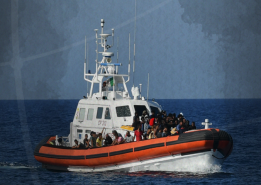
A similar dynamic has played out in Tunisia, where three years of tightening government control have sharply curtailed human smuggling towards Italy. The illicit market has not abated, however: smugglers and migrants are instead turning to more clandestine, and often more dangerous, tactics to reach Europe.
Further south, conflict dynamics are reshaping the industry in Niger, Chad and Sudan. The growing power of insurgent groups continues to redraw the geography of smuggling routes, with emergent fighting in northern Niger, for example, sharply limiting movement there in 2026. Conflict is also affecting who moves along regional routes. Economically driven migrants continue to travel through the region but are joined by growing numbers of Sudanese refugees, displaced first by war at home, and then again by worsening security and living conditions in camps along the border with Chad.
Finally, in the far west of the continent, human smuggling networks have redirected departure points towards Spain’s Canary Islands, following a crackdown by regional governments. While successful in driving down movement, the enduring impact of this enforcement is as yet unclear. It may ultimately push major departure hubs further south, into Senegal’s Casamance region and Gambia.
Since 2016, the Global Initiative Against Transnational Organized Crime has monitored the political economy of human smuggling and trafficking in North Africa and the Sahel. This work was expanded and formalized in 2018 with the establishment of the Observatory of Illicit Economies in North Africa and the Sahel. Through regular country reports and regional studies, the Observatory has provided a detailed understanding of the actors, routes and dynamics shaping mobility and exploitation in the region. The 2026 series features country reports on Tunisia, Libya, Niger, Chad and Sudan, as well as a regional study on human smuggling from West Africa towards the Canary Islands.