Posted on 07 Aug 2026
Since the early 2000s, the central Sahel–Libya corridor has been an important cocaine trafficking route linking West Africa and North Africa with European consumption markets. Although most cocaine shipped from Latin America to West Africa and on to Europe is transported by sea, overland corridors across the Sahel and through Libya account for a notable minority of the trade. These routes are linked to long-standing trading networks, conflict economies and protection systems, which make them resilient to enforcement pressure, shifts in the conflict landscape and political disruption.
Since 2019, cocaine trafficking across West Africa has increased substantially, driven by myriad factors including surging production in Latin America, growing demand in Europe, heightened law enforcement pressure on direct routes from Latin America to Europe, and West Africa’s improved transport connectivity. This super-charging of cocaine trafficking routes – particularly into Europe – has led traffickers to explore every possible method of transporting large quantities of the drug, including navigating complex conflict landscapes of the Sahel and Libya.
Cocaine trafficking along these corridors is affected by political authority, armed control and patterns of insecurity. Historically, periods of relative stability, predictable territorial control and consolidated protection arrangements have historically enabled high-volume trafficking. Conversely, moments of acute violence, political ruptures or shifts in military alliances have disrupted established routes, forcing traffickers to renegotiate protection, extend corridors and adopt new operational methods. However, the trade is never abandoned altogether.
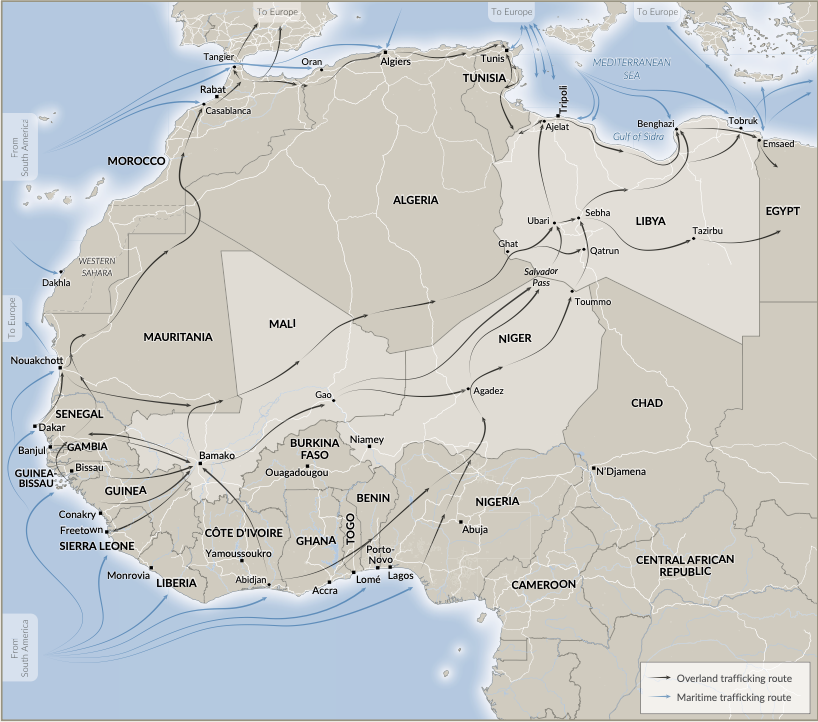
This report examines the development of the cocaine trade across the central Sahel–Libya corridor, mapping current dynamics, including pivotal trends and key actors.
The focus is on Mali, Niger and Libya, analyzing how shifting conflict dynamics and political change have reshaped trafficking patterns and the implications for governance, security and regional stability across the Sahel and North Africa. By situating cocaine trafficking within the region’s conflict economies and protection systems, the report highlights how overland routes are pivotal to the region’s conflict landscape, despite carrying smaller volumes than maritime flows. Overland cocaine trafficking provides an enduring source of financing for a wide range of armed groups, state-embedded actors and resilient criminal entrepreneurs.
Key Findings
- While overland trans-Sahelian routes carry smaller volumes of cocaine than maritime trafficking, they play a critical role in the region’s conflict and political economy.
- Cocaine trafficking in the central Sahel and Libya is deeply entangled with conflict dynamics. Trafficking revenues reinforce protection economies, distort security institutions and create incentives for armed and political actors to maintain the status quo.
- State-linked actors continue to dominate the most lucrative segments of the cocaine trade. Across Mali, Niger and Libya, the ability to move large consignments remains dependent on access to political protection.
- Armed groups, whether state-aligned or not, are key actors in the trade. They play an operational role in cocaine trafficking by providing armed escorts, route security and access to territory. Their involvement is primarily transactional, as they extract revenues from high-value convoys rather than managing the trade directly.
- Violent extremist organizations (VEOs) are not primary organizers of cocaine trafficking, but they benefit indirectly from it. The Islamic State Sahel Province (IS Sahel) in particular has increased its access to resources linked to cocaine trafficking since late 2023.
- Many high-level traffickers operate across multiple licit and illicit markets, including cocaine, cannabis resin, gold, cigarettes and fuel. This polycriminal profile allows them to shift activities during periods of disruption while retaining networks that facilitate re-entry into the cocaine trade.
- Some large-scale, high-level traffickers have stayed resilient over long periods of time, operating in bulk since the cocaine trade first expanded in the early 2000s, and remaining consistent, and extremely well-connected, nodes in the system.
- Trafficking ecosystems linking the Sahel and coastal West Africa are interconnected and multidirectional. Overland routes connect maritime entry points, including by linking non-containerized imports through porous coastal areas to larger ports for export to Europe.