Posted on 06 Mar 2026
For nearly three years, the fighting in Sudan has largely remained within its borders, even as the conflict has drawn regional support. But the effects have been more far-reaching, with millions of refugees displaced to neighbouring countries and cross-border flows of mercenaries and weapons reshaping security and criminal economies across the region.
Now, the war has begun projecting violence across the Chad border, turning crucial smuggling and supply corridors into flashpoints and putting pressure on N’Djamena’s ability to contain the situation. Since April 2023, Chad has tried to keep the Sudan war at arm’s length while avoiding steps that would make it a direct party to the conflict. But the border economy that underpins mobility and trade in the east has also become a logistical hinterland for Darfur’s armed actors: as rival coalitions try to disrupt one another’s access, violence has followed the smuggling and supply corridors that feed the war. With Chad the only Sahelian state not engulfed in internal armed conflict, further spillover risks triggering a wider regional escalation.
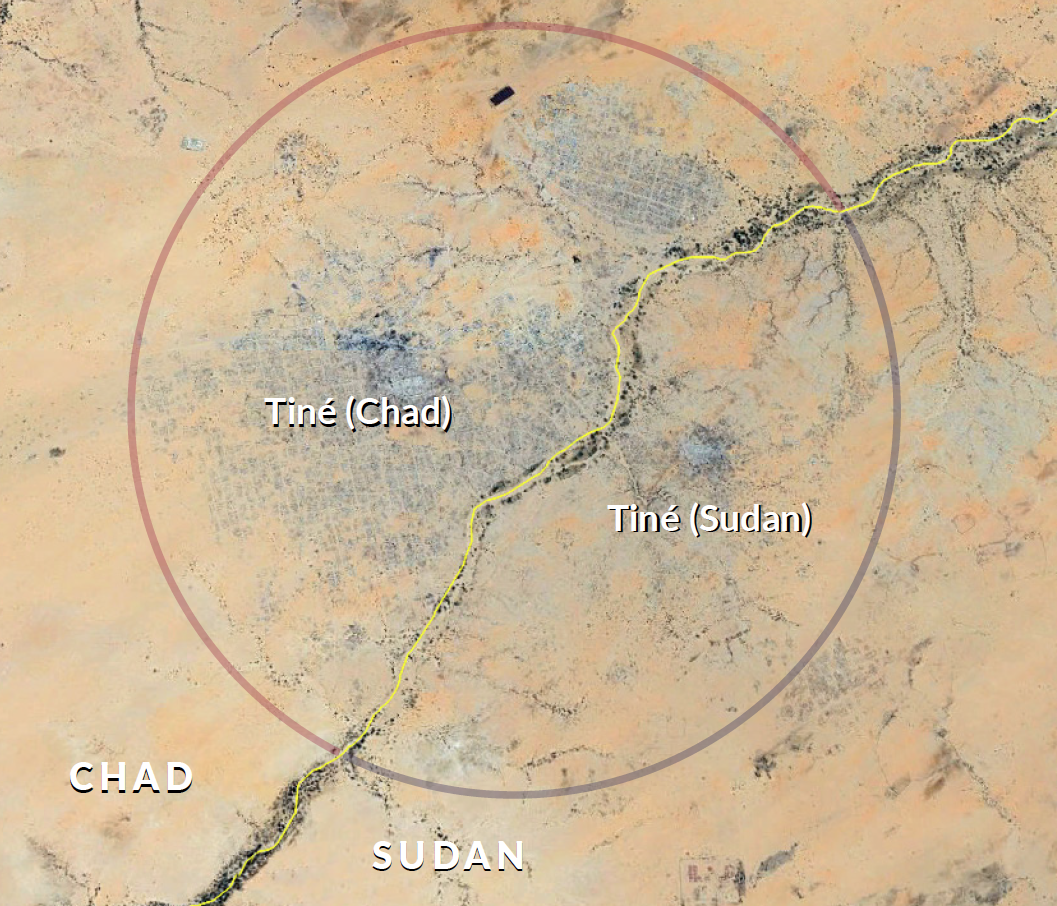
Cross-border violence reached a new level on 21 February, when clashes between armed groups aligned to the Rapid Support Forces (RSF) and the Sudanese Armed Forces (SAF) in the border town of Tiné spilled over into Chad. Five Chadian soldiers and three civilians were killed, and several others wounded. In response, N’Djamena announced the indefinite closure of its eastern border, citing ‘repeated incursions and violations by forces involved in Sudan’s conflict’ – an implicit admission that informal deconfliction mechanisms were no longer sufficient. The Tiné incident followed earlier cross-border drone strikes and incursions by the RSF targeting Chadian border forces in late 2024 and early 2025. RSF drone strikes have reportedly continued since then, marking a shift from incidental spillover to deliberate projection of force into Chadian territory.
Much of this escalation is concentrated around the supply routes that sustain Sudan’s war economy. These routes run across a vast, largely ungoverned desert frontier, linking oasis towns and market nodes that are hubs for people, goods and weapons. They are not state-controlled infrastructure but hybrid ecosystems, run by smugglers, transporters and armed brokers, often organized or tacitly enabled by state-linked actors, including the Libyan Arab Armed Forces (LAAF) in eastern and southern Libya and the RSF. In Chad, many of these routes pass through Zaghawa-dominated areas with ties to anti-RSF coalitions in Darfur, intensifying internal tensions as armed groups weigh war-economy incentives against political allegiances and pressure from N’Djamena to avoid escalation.
The recurring clashes between Sudanese and Chadian forces along the border illustrate how competition over these routes and the revenue systems they generate is drawing frontier regions into the conflict. As anti-RSF forces increasingly target RSF supply lines from Chad, the economic stakes of controlling border access have risen. Violence also raises the value of protection services, attracting more armed actors to the frontier and making volatility more likely.
The implications extend beyond bilateral tensions. If Chad’s relative insulation from sustained internal armed conflict erodes – whether through direct RSF incursions, intensified domestic strains linked to the war economy along the border, or cycles of retaliatory violence – a continuous belt of instability would stretch from Mali to Sudan’s Red Sea coast. A critical brake would be removed from cross-border flows, allowing conflict dynamics between Sudan, Libya and the Sahel to merge and amplify one another at a scale not yet seen.
Borders as criminal ecosystems
The Chad–Sudan boundary is a movement economy: whoever controls routes and crossings can charge for access. The core commodity is permission itself, sold through checkpoint fees, escort arrangements and informal taxation. Cross-border conflict is therefore not only a sovereignty violation but a contest over who sets the rules and collects the tariffs of mobility.
Sudan’s war has built supply lines that blur the distinction between state-facilitated transfers and informal smuggling, relying on freelance armed labour. Fighters escort convoys, manage access, enforce payments and stabilize flows when front lines shift, intensifying competition between the RSF and SAF-aligned forces over border access and logistics infrastructure.
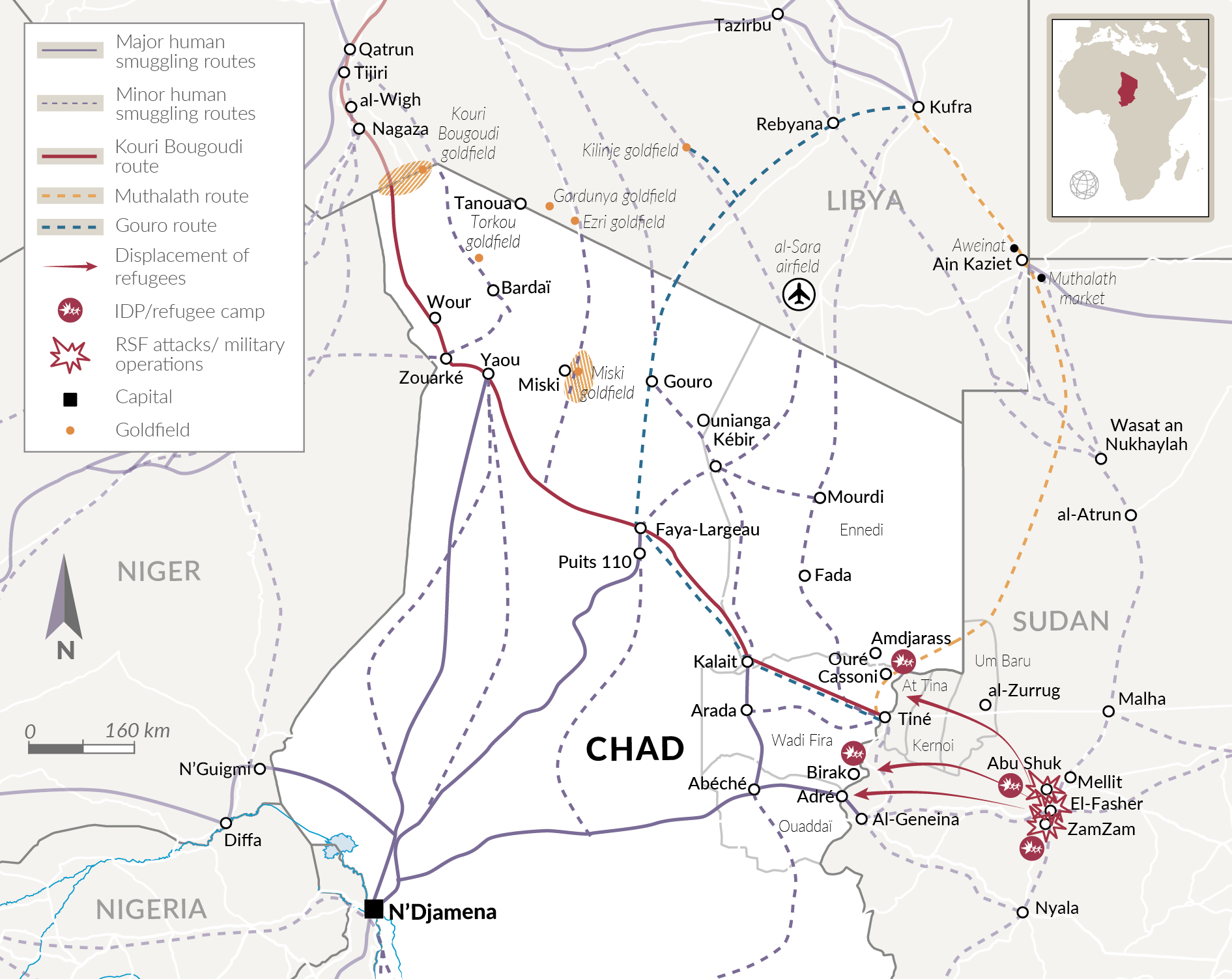
From mid- to late 2023, a base that hosted RSF-linked brokers developed in eastern Chad around Amdjarass, with supplies (notably arms) moving through Bao and Kariari into Darfur. By mid-2024, anti-RSF coalitions were targeting these supply chains, with Bir Mazza, Kulbus and Sayah becoming ambush sites in Sudan. As pressure mounted, RSF logistics adapted by dispersing transfer points, including a hub closer to Libya in Bir Mirgui. These adaptations show how the war economy reorganizes under constraint, and how economic competition over routes is now driving armed confrontations at the border.
The fuel trade is particularly illustrative. A high-volume smuggling operation in contraband fuel from eastern Libya to Sudan emerged in the year before the war, controlled by LAAF and RSF actors. The conflict’s disruption of licit fuel supplies increased the value of this trade. Another corridor emerged in 2024 between LAAF-controlled south-western Libya, northern Chad and Darfur in response to disruptions in eastern Chadian supply routes. It aimed to provide a more direct and secure pathway for arms and supplies from Libya to Darfur, offsetting interdictions in eastern Chad. These are the same pathways along which violence is now erupting.
Sahelian conflicts have also been shaped by a cross-border market for armed labour: fighters move to wherever conflict creates income opportunities. Weeks after Sudan’s war began, Chadian fighters, including many who served as rebels against Chad, entered Sudan seeking to earn money, acquire weapons and cultivate new patrons. These assets could later be converted into bargaining capital in Chad’s political and security marketplace, or into coercive power against N’Djamena. Among those who joined the fighting alongside the RSF were members of Arab and Gorane networks – groups with histories of rivalry against Zaghawa-dominated security structures in both Chad and Sudan. In this sense, the war economy converts existing grievances into revenue streams, weapon access and political leverage.
When border dynamics drive state escalation
For Chad, the Tiné clashes and subsequent border closure pose a dilemma with no clean solution. N’Djamena must respond to breaches of its territory, but sustained confrontation would strain elite units and risk pulling it deeper into the frontier political economy, diverting scarce security resources and exposing its other flanks to threats from actors in Libya, Nigeria and the Central African Republic.
Command and control over Chad are also uneven: the east is a sensitive arena of patronage, brokerage and cross-border ties, where some actors (including soldiers nominally under formal military command) operate as security entrepreneurs with semi-autonomous interests. Local incentives therefore diverge significantly from state priorities: violence raises the value of escort markets and checkpoint controls, while officials and commanders with kinship ties to Darfuri communities or political stakes in cross-border ethnic alliances carry competing loyalties that complicate N’Djamena’s ability to enforce restraint. Those financially vested in the conflict may be disinclined towards containment, but so too may those whose authority rests on managing – or selectively enabling – flows that benefit allied communities or undermine rival factions.
The war economy’s adaptability also complicates Chad’s internal dynamics and options for containment. As routes through eastern Chad became riskier in 2024, pathways to Sudan through southern Libya gained importance, reconfiguring who profits from cross-border smuggling and sharpening competition among local armed groups. One corridor ran from Kalait through Faya in northern Chad to Ma’aten al-Sarah, a Libyan airbase around 110 kilometres north of the Chadian border that served as an aggregation point for weapon transfers to RSF units entering Sudan. The base, disused since 2011, was reportedly refurbished in 2024 by the LAAF with external backing, enabling a corridor that bypassed interdictions in eastern Chad and helped secure RSF supply lines.
Chad has not been passive as these corridors have shifted. By late 2024, authorities had deployed military units near the tri-border zone and conducted selective enforcement in the Tibesti region, aimed less at dismantling trafficking entirely than at preventing weapons from reaching rebel factions. However, N’Djamena’s approach is selective: it tolerates some RSF-linked commerce, while preventing weapon flows reaching Chadian rebels and preserving crucial Zaghawa alliances on the Sudan border.
The Tiné clashes and the border closure that followed represent a new standing pattern. Closing the border signals resolve but does not seal off the frontier economy. Instead, it raises the value of the routes that remain open and strengthens the hand of actors who know how to navigate them. The risks are threefold: direct confrontation along contested corridors; the consolidation of armed and criminal networks that profit from illicit cross-border flows, whose growing logistical and financial clout increasingly rivals state authority in peripheral zones; and the amplification of internal Chadian tensions linked to these pathways. These tensions could destabilize the Sahel’s last non-conflict state, with cascading regional consequences.