Posted on 27 Oct 2026
For more than a decade, Syria has been at the centre of the global Captagon trade. The amphetamine-type stimulant, which is cheap to produce, easy to transport and in high demand across the Gulf, was not only tolerated by the Assad regime, but deeply embedded in the political and economic structures surrounding it.
The trade in Captagon is widely regarded as having been a key source of funding for Syria’s state budget and war economy throughout years of conflict and sanctions. Several influential members of the Assad family were sanctioned by Western governments for their alleged involvement, including Maher al-Assad, the younger brother of former president Bashar al-Assad. Between 2019 and 2025, Syria was identified as the country of origin in 80% of Captagon seizures reported across the region. In effect, Captagon became a weaponized criminal market, providing a source of hard currency under sanctions and serving as a bargaining chip in Syria’s relations with neighbouring states.
When the Assad government collapsed in December 2024, attention quickly turned to the future of the trade. Over a year later, the situation is becoming clearer, and it is proving to be more complex than a simple supply-shock narrative.
State-backed criminality under Assad
Over the course of three editions, the Global Organized Crime Index has consistently documented Syria’s position at the centre of the regional illicit Captagon economy. And as the 2025 edition reflects conditions up to the end of 2024, it offers a final snapshot of the situation before the fall of the Assad regime. In every edition of the Index, Syria’s synthetic drug trade score, which tracks Captagon, has remained at or near the maximum: 9.50 in 2021, 10 in 2023 and 9.50 in 2025. The country’s sustained position at the top of the scale is the signature of a market run from inside the state itself.
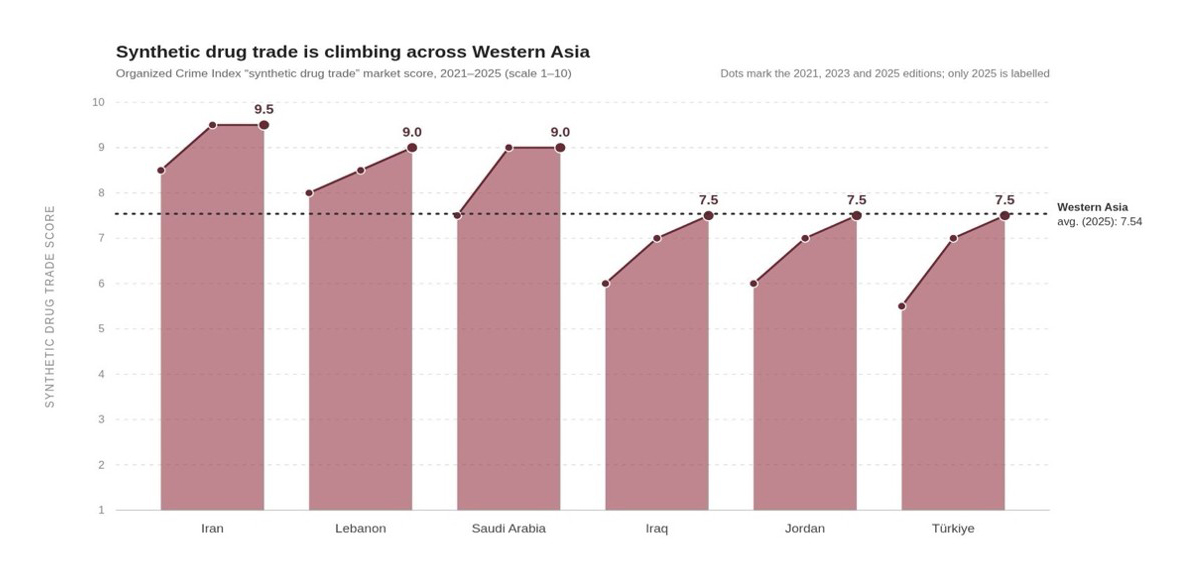
The Captagon trade was never confined to Syria’s borders, however, and the Index has captured its growing reach across the region. Synthetic drug trade scores in Jordan, Türkiye, Lebanon and Iraq have increased steadily since 2021, while Saudi Arabia and Iran, itself a longstanding parallel hub, also recorded rises over the period. Overall, the average synthetic drug trade score in the 14 countries of Western Asia rose from 6.71 in 2021 to 7.54 in 2025, making synthetics the region’s third most pervasive criminal market by 2025, behind financial crime (7.89) and human trafficking (7.82).
After the fall
Syria’s transitional authorities, led by interim president Ahmed al-Sharaa, moved quickly against the Captagon trade as part of a broader effort to rebuild international ties, which contributed to the easing of some international restrictions. By mid-2025, the United States, European Union and United Kingdom had all taken steps to amend or lift their sanctions on Syria. One year after the end of Assad’s rule, the United Nations Office on Drugs and Crime (UNODC) reported that large-scale manufacturing within the country had been disrupted, and that these efforts had significantly reshaped the regional market.
The scale of the crackdown was substantial. According to the UNODC, 16 industrial-scale laboratories and 15 smaller storage facilities were dismantled in 2025. Regional cooperation against Captagon production and trafficking, including through shared intelligence and coordinated responses, also increased. At least 177 million tablets – roughly 30 tonnes – were intercepted across the Arab region in the year from December 2024, with several of the largest seizures resulting from joint operations. Syria’s own authorities put the figure even higher, at around 365 million pills seized. The UNODC also noted signs of Captagon shortages in some destination markets, as well as rising prices in parts of the Gulf and countries bordering Syria.
Despite these advances, the drug has not disappeared. Before December 2024, production may have reached several million pills a day, and existing stockpiles could sustain the regional supply for years. Smaller-scale manufacturing is also likely to persist inside Syria and in neighbouring countries, and traffickers have adapted by shifting routes, using balloons and drones to transport pills across land borders.
One of the clearest signs of the trade’s relocation can be seen in Syria’s south. The Druze-majority province of Suwayda has largely remained outside Damascus’s control, and after the dominant armed faction consolidated its hold in July 2025, it became the main manufacturing and distribution hub for Captagon. Trafficking from Suwayda towards Jordan reportedly surged by over 325% following the July takeover. Jordan intercepted 21 drug trafficking attempts between January and July 2025, and 128 between July 2025 and April 2026. More recent reporting indicates that pressure on Jordan’s borders has continued, with authorities recording 231 smuggling attempts during the first half of 2026. Amman has responded with force, striking alleged drug ‘factories and laboratories’ in Suwayda at least five times, most recently during Operation Jordanian Deterrence in May 2026.
Lebanon is another key node in this transformed landscape. Captagon seizures in Syria have repeatedly been traced back to Lebanon, where remnants of the Assad regime’s networks and Hezbollah-linked actors continue to operate. This dynamic was identified well before the regime’s fall, but has since become more visible. In the six months to April 2026, Syrian authorities intercepted almost 33 million pills arriving from Lebanon, accounting for around 77% of their seizures totals during that period. Further south, Houthi-linked manufacturing has emerged in Yemen, targeting the same Saudi consumer market that once sustained the Syrian trade.
The disruption may also be reshaping patterns of synthetic drug consumption. In its latest World Drug Report, the UNODC reported that traffickers were exploiting global instability to diversify drug markets and push into new markets. Since the Captagon squeeze, the price of a tablet in Lebanon has more than doubled, from US$2–3 to US$5–7. Supply constraints have also coincided with growing methamphetamine use across Western Asia. Methamphetamine is thought to have taken root among former Captagon users in Saudi Arabia, where it now ranks among the country’s three most-used substances. It has also become the primary drug associated with treatment admissions in Iraq and Türkiye, and has been linked to a rise in overdoses across the Gulf.
Most of the methamphetamine consumed in the region is produced further east, and trafficked through Iran. But it shares a precursor chemical with Captagon, meaning the same facilities can make both. In September 2025, a raid on an industrial lab in Al Mahrah, Yemen, found the two drugs being produced side by side, suggesting that some Syria-linked operators had relocated there after the fall of Assad.
The limits of disruption
From today’s vantage point, the findings of the 2025 Index and subsequent reports on Syria’s Captagon problem lead to the same conclusion. At the end of 2024, the country remained at the centre of the trade, but rising synthetic drug scores across Western Asia indicated that production, trafficking and distribution networks were becoming increasingly regionalized. While a market concentrated in one country can be dismantled when power changes hands, an economy embedded across a region is far harder to disrupt.
The seizures, laboratory closures and emergence of new hubs since 2025 appear to bear this out. Eliminating the main producer simply pushed activity towards the closest weak points, such as Suwayda, the Lebanese border and Yemen, while demand from the Gulf remained intact.
The next edition of the Index will capture the longer-term effects of these changes, but the trajectory is already clear. Under Assad, Captagon was a regional market with a Syrian core. Although the core has disintegrated, the demand persists. The trade has scattered, with new producers and routes, and methamphetamine is moving in behind it. While defeating the world’s largest Captagon producer was a genuine achievement, curbing the regional market for synthetic stimulants will be a different and altogether more difficult task.
This analysis is part of the GI-TOC’s series of articles delving into the results of the Global Organized Crime Index. The series explores the Index’s findings and their effects on policymaking, anti-organized crime measures and analyses from a thematic or regional perspective.