Posted on 23 Oct 2026
With a population of around 4.86 billion people, Asia accounts for almost 60% of the world’s population. Owing to its vast geographic, political and economic diversity, patterns of organized crime and state resilience vary considerably across the continent’s regions. According to the 2025 Global Organized Crime Index, Asia records the highest average criminality score of any continent, yet ranks only fourth globally in terms of resilience to organized crime.
Many of the major trends identified in the 2025 Index are particularly pronounced in Asia. These include the continued growth of synthetic drug markets, the surge in financial and cyber-dependent crimes, the proliferation of counterfeit goods, and the increasing influence of foreign and private-sector actors in criminal economies. At the same time, the drivers, manifestations and impacts of organized crime vary substantially from one region to another.
This report focuses on Eastern and South-Eastern Asia, home to around 2.32 billion people – almost half of Asia’s population and around 28% of the global total. Despite their geographical proximity, the two regions have markedly different organized crime profiles. South-Eastern Asia experiences levels of criminality significantly above the global average, driven by entrenched illicit economies and the rapid expansion of cyber-scam industries. By contrast, Eastern Asia combines comparatively low levels of criminality with some of the highest resilience scores in the world.
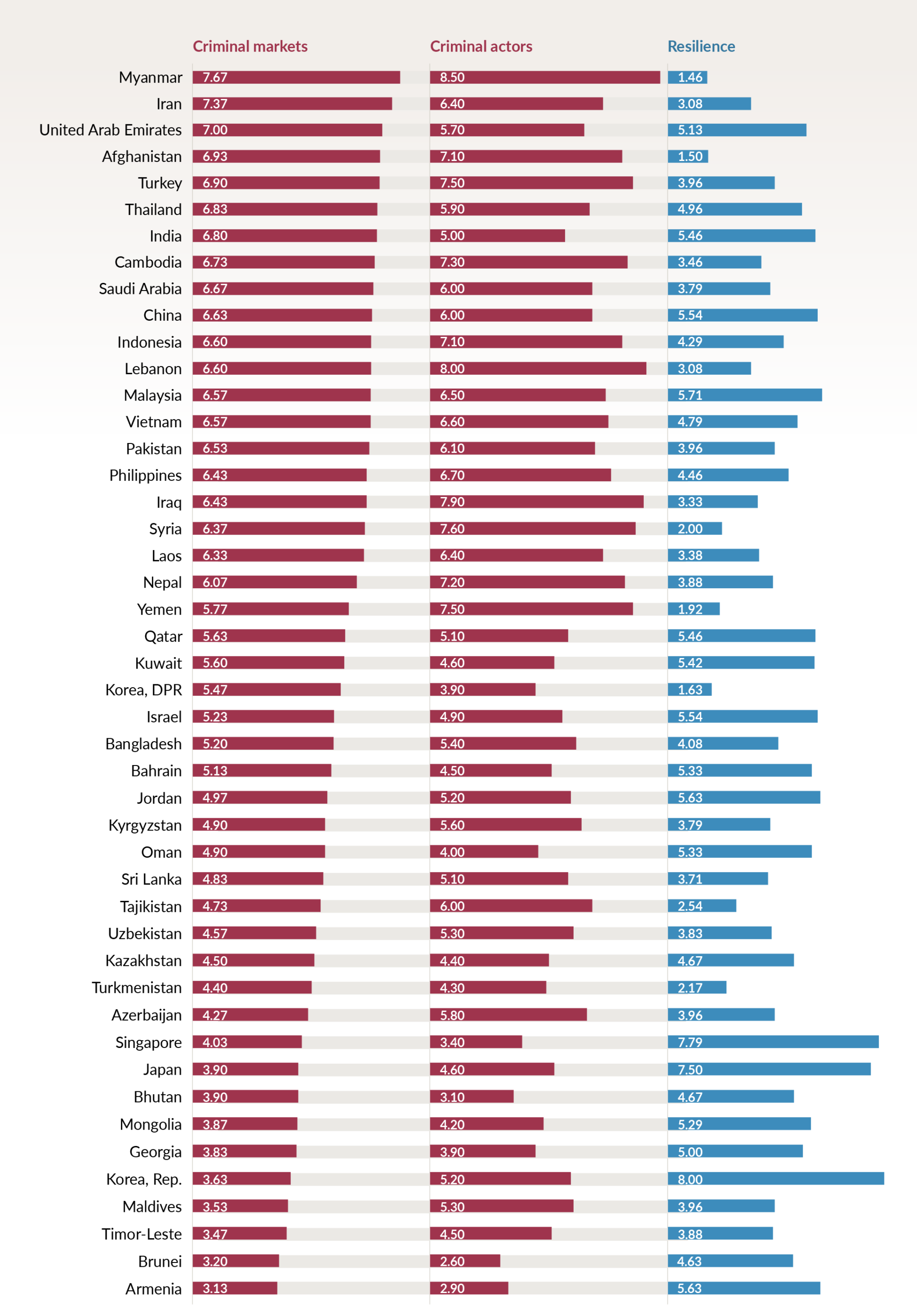
The regions also encompass some of the world’s most striking national contrasts. Japan, Singapore and the Republic of Korea, for example, rank among the global leaders in resilience and maintain relatively low levels of organized crime. At the other end of the spectrum, Myanmar has the highest criminality score and lowest resilience score of any country assessed in the Index, while the Democratic People’s Republic of Korea (DPRK) combines moderate criminality with one of the world’s weakest resilience frameworks.
This report examines developments in criminality and resilience in Eastern and South-Eastern Asia, highlighting key regional trends, major criminal markets, the actors driving illicit economies, and the factors shaping countries’ capacity to respond to organized crime. A forthcoming companion report will examine trends in Western Asia, Southern Asia, and Central Asia and the Caucasus.