Posted on 09 Jul 2026
Oceania has vast maritime zones and limited enforcement capacity, coupled with weak regulatory oversight and vulnerable economies that are highly dependent on natural resources. These conditions have created fertile ground for illicit markets. Illegal, unreported and unregulated (IUU) fishing thrives; drug trafficking exploits the challenges of policing expansive maritime areas; and financial crimes and human trafficking are fuelled by economic fragility and regulatory gaps.
In addition, foreign actors such as Asian syndicates, Latin American cartels and outlaw motorcycle gangs have established themselves in local networks that connect Oceania to illicit activities globally. The Global Organized Crime Index’s assessment of criminality and resilience dynamics in Oceania over five years illustrates the convergence of persistent vulnerabilities, external pressures and internal governance gaps that threaten resilience, security and continental stability.
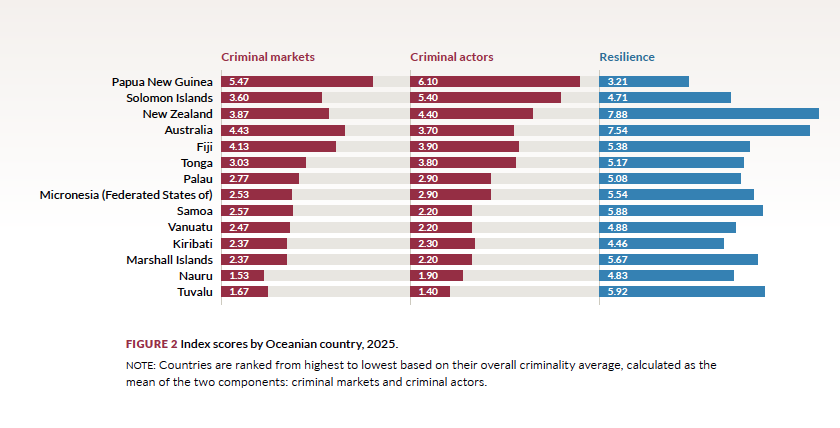
Oceania: main findings
- Oceania’s criminality average stands at 3.15, the lowest globally. Indeed, it is striking that all countries in the region, with the exception of Papua New Guinea, are characterized by low levels of criminality. At the same time, some, such as Australia and New Zealand, have recorded significant increases in criminality since 2021.
- Oceania’s biggest criminal markets include fauna crimes, financial crimes, human trafficking, the synthetic drugs trade and the cannabis trade. Cyber-dependent crimes are becoming increasingly prominent, particularly in Australia and New Zealand.
- The pervasiveness of criminal actors in Oceania is below the global average, at 3.24. In contrast to global trends, where state-embedded actors are the most prevalent criminal actor group, foreign actors dominate in Oceania.
- Oceania’s resilience average is 5.44, the second highest globally, but there are significant disparities among countries on the continent.