Event Details
Where
Zoom Webinar
Posted on 30 Sep 2026
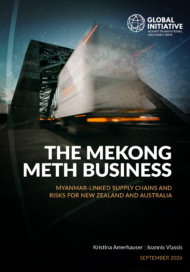
Myanmar’s methamphetamine economy sits at the centre of one of the most significant illicit synthetic drug markets in the world. Production linked to Shan State and adjoining areas has supplied markets across South East Asia for decades, while also feeding consumer markets globally through maritime, air and overland routes.
Myanmar-origin methamphetamine is the analytical anchor of the report, particularly its Mekong supply chains and market dynamics. But the research also considers production elsewhere in the region as well as new or emerging substances, in Cambodia, Laos, Thailand and Vietnam. The report does not attempt to provide an exhaustive account of the Mekong methamphetamine economy or the scale of production, trafficking and consumption. Rather, it analyzes the trafficking flows and the actors involved to understand the implications for downstream markets, such as New Zealand and Australia.
This report finds that over the past two decades, the role of the Mekong region in the broader global methamphetamine market has grown in scale and complexity. Cambodia, Laos, Thailand and Vietnam may not be where most of the methamphetamine stemming from the Mekong is produced, but they are where it is moved and stored, and from where it is exported. The region functions as a layered business environment in which production, storage, transport, protection, brokerage, concealment, payment and retail distribution are often handled by different actors operating with plausible deniability.
The Mekong methamphetamine market is a global illicit business that generates, moves and repackages synthetic drugs through adaptable supply chains. Changes in precursors, production mix, routing, concealment and supply chain organization all have an impact on the global methamphetamine market, including two of the principal destination markets for Mekong methamphetamines: New Zealand and Australia. North America may be the largest source of methamphetamine reaching New Zealand and Australia, but the size, proximity and adaptability of the Mekong methamphetamine market mean that it should not be treated as a secondary concern. The Mekong methamphetamine market remains a serious strategic risk, particularly given the region’s complex maritime, parcel and transit connections to downstream markets.
Key findings
- The Mekong drug economy is undergoing important changes: a more diversified product mix is moving into a market once dominated by methamphetamine. Other synthetic substances appear inherently linked to Mekong methamphetamine, and developments in one commodity signal adaptation across the wider criminal economy.
- Methamphetamine production and trafficking are not conducted by a single criminal network. They are part of a layered and decentralized business environment in which a range of actors offer their services and often only know their immediate counterparts.
- Corruption is fundamental for the running of the methamphetamine economy. It is structural and deeply embedded in the functioning of the market. However, its existence varies: available data suggests that officials working at or close to border areas may be particularly compromised.
- Methamphetamine trafficking draws on the same enablers as the industrial-scale cyber scam industry: protection providers, corrupt officials, border brokers, logistics routes, informal finance and money movement systems, front businesses, and permissive special economic zones. Growing knowledge of scam centres and the transnational nature of organized crime in the Mekong is therefore enabling better understand the systems that sustain the regional drug economy.
- The size and adaptability of the Mekong methamphetamine market make it a primary concern for downstream destinations. New Zealand and Australia are lucrative destination markets because of their comparative proximity, strong consumer demand and high retail prices, which have long made them attractive markets for traffickers capable of managing long-range supply chains. Mekong methamphetamine is a serious strategic risk for New Zealand and Australia, particularly given the region’s complex maritime, parcel and transit connections to downstream markets.