Posted on 06 Oct 2026
Click here to download the report
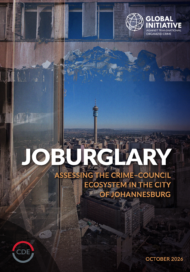
Corruption and organised crime intersect in the City of Johannesburg in ways that exploit the machinery of local government for illicit ends. A new report from the Global Initiative Against Transnational Organized Crime (GI-TOC), Joburglary: Assessing the crime–council ecosystem in the City of Johannesburg, shows how corrupt officials and criminal actors are exploiting the city and contributing to its decline.
Joburglary identifies three overlapping tracks:
- Institutional capture is the process by which government officials influence tender processes and appointments and circumvent and undermine accountability mechanisms to steal municipal funds. This money is sometimes reinvested in the political arena.
- Hybrid collusion between municipal officials, criminals and businesspeople facilitates access to emergency tenders and the identification of potential buildings for hijacking and sometimes underpins extortion in construction.
- Direct predation describes how municipal employees and contractors engage in bribery and extortion.
The report finds that the City’s decline can itself become a profit motive. Corrupt and criminal actors may capitalise on service-delivery failures to win lucrative emergency contracts, and in some cases are alleged to sabotage infrastructure or deliberately underdeliver to sustain demand. One example is water provision: the city has spent R650 million on water tanker contracts in the past five years, creating lucrative opportunities for what the report describes as “water mafias”.
At the same time, the City’s accountability mechanisms have been undermined. In June 2023, the council adopted a report declaring all previous corruption probes and forensic findings conducted by Group Forensics and Investigation Services (GFIS) “unlawful, null and void”. GFIS had investigated more than 6 000 cases involving transactions worth R35 billion. This figure represents the value of transactions investigated, rather than established losses or corrupt expenditure.
The research does not attribute all of Johannesburg’s problems to corruption and organised crime – incompetence, inertia and the long shadow of apartheid also form part of the picture. However, the crime–council ecosystem is causing significant harm, especially in service delivery, and is a fundamental reason why purely technocratic reforms will fail.
GI-TOC’s research was commissioned by the Centre for Development and Enterprise (CDE) to inform its report Time for Action – Corruption in Joburg, the fifth in CDE’s series Johannesburg Matters: Fixing South Africa’s Growth Engine. It draws on fieldwork conducted between April and June 2026, open-source desk research and historical research by GI-TOC. Dozens of people were interviewed, including current and former councillors, mayoral committee members, municipal employees, Johannesburg Metropolitan Police Department (JMPD) officers, Hawks investigators, journalists and affected residents.