Posted on 30 Sep 2026
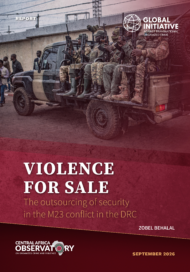
In the eastern Democratic Republic of Congo (DRC), the March 23 Movement (M23) conflict has fuelled a self-reinforcing criminal ecosystem in which the outsourcing of violence serves as cover for economic exploitation. State forces, foreign armies, private military companies (PMCs), proxy groups and militias benefit from the violence, operating under the cover of security in pursuit of their own interests in territorial control, resource capture, taxation, profiteering and patronage. By leveraging instability to generate profit, they blur the lines between public authority, private interests and criminal activity, weakening Congolese institutions and undermining prospects for peace.
The DRC government, hampered by structural weaknesses within its military, has implemented a similar approach, outsourcing its security to several actors, including local Wazalendo armed groups, the Ugandan military and numerous PMCs for whom the emergence of a ‘business-as-security’ model has blurred the boundaries between private security, state authority and regional geopolitical interests, particularly in the context of evolving US–DRC cooperation on critical minerals. Like M23, many of the DRC’s security partners have demonstrated economic motives, yet have nevertheless found themselves empowered to act on behalf of a state that has relinquished control.
In this context marked by weak governance, limited state presence, chronic insecurity and inadequate oversight, conflict actors are unrestrained. They are able to pursue their own ends, with security concerns being increasingly supplanted by geopolitical rivalries and illicit economic interests. M23 and the Wazalendo have established illegal parallel administrations with robust taxation systems. M23 has also secured control of key mining sites, including the lucrative Rubaya coltan mines, as well as vital transport corridors. The Ugandan military has worked to secure arteries necessary for the trafficking of gold – an activity that some of its members have been alleged to participate in. Most of these groups, as well as Congolese troops, have sought to benefit from the illicit timber trade.
The deliberate outsourcing of the state’s monopoly on coercive force in eastern DRC has enabled the entrenchment of conflict economies that have the potential to prolong instability and undermine state sovereignty and prospects for lasting peace. As it stands, many parties to the conflict have been accused of committing gross human rights violations; these have included torture, sexual violence, summary executions, child soldier recruitment and pillage. The result is a shared criminal ecosystem that conflict actors are incentivized to maintain, with violence becoming the primary tool.
Key findings
- The privatization and outsourcing of security services is not a solution to the conflict but a driver of violence and instability. M23 and the armed actors supposed to contain it are part of the same criminal ecosystem, structured around the illegal exploitation of resources, corruption among elites and gradual state capture.
- The resurgence of M23 has introduced exceptional technological sophistication into the conduct of the war. This increase in capabilities – made possible by documented Rwandan support in violation of UN Security Council resolutions – is reshaping the balance of power on the ground, increasing the vulnerability of Congolese forces and strengthening M23’s ability to consolidate areas under its control.
- The outsourcing of security services has become a mechanism for elite exploitation. PMC contracts are awarded through patronage networks at the highest levels of the Congolese state, with commissions estimated to be worth tens of millions of dollars redistributed throughout political networks.