Event Details
Where
Zoom Webinar
Posted on 27 Apr 2026
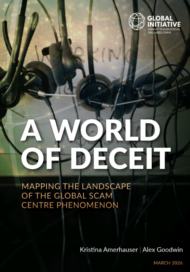
Scam centres have emerged as one of the most sophisticated, lucrative and pervasive forms of organized crime in the world today. Enabled by information and communications technology, social engineering, crime-as-a-service tools and money laundering infrastructure, these operations can target victims across borders while remaining rooted in local political, economic and criminal ecosystems.
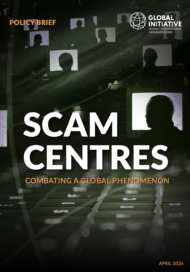
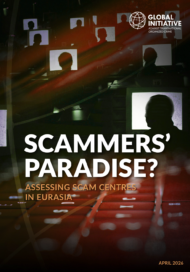
This collection brings together GI-TOC research on the global scam centre phenomenon and its evolution in Eurasia. At its centre is a policy brief that provides a concise, policy-oriented overview of the nature and scope of the issue, and sets out focused recommendations for a more holistic, strategic and coordinated response. The brief examines how scam centres function, why they have become so difficult to disrupt, and how governments, law enforcement agencies, technology firms, financial institutions and civil society can address the enabling environment in which they flourish.
The accompanying report on Eurasia provides a regional assessment of scam call centres in Ukraine, Russia, Belarus, Georgia, Armenia, Kazakhstan, Kyrgyzstan and Uzbekistan. It shows that, while scam centres across the region draw on a common toolbox of deception, social engineering and digital infrastructure, their scope, scale and sophistication are shaped by local conditions. These include corruption, political protection, law enforcement cooperation, access to technology and geopolitical faultlines.
The report also highlights how recent geopolitical developments have affected the regional scam economy. Russia’s full-scale invasion of Ukraine has created new opportunities for scammers, contributed to the decline of law enforcement cooperation between Russia and the West, and intensified the ways in which criminal actors exploit political divisions. In this context, Eurasia has become an important region for understanding how scam centres adapt to instability, weak oversight and fragmented international cooperation.
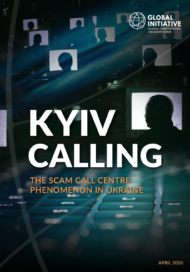
A further case study on Ukraine examines one of the region’s most significant scam call centre ecosystems. It traces the development of a highly networked illicit industry, its links to organized crime actors and corrupt protection, and the ways in which technology and crime-as-a-service may reshape the model in the years ahead. Read alongside the global and Eurasian analyses, the Ukraine report illustrates how locally embedded scam operations can acquire global reach.
Together, these publications show that scam centres should not be treated solely as a cybercrime or consumer fraud issue. They are part of a broader organized crime ecosystem, connecting online deception, illicit finance, corruption, technological innovation, geopolitical fragmentation and, in some contexts, workforce exploitation. Effective responses will require more than raids on individual call centres. They will depend on disrupting networks, reducing impunity, strengthening international cooperation and addressing the legal, financial and technological gaps that allow scam economies to flourish.