Posted on 04 Aug 2026
States parties to the UN Convention against Transnational Organized Crime (UNTOC) will attend the 13th session of the UNTOC Conference of Parties (COP13) in October. As they gather in Vienna, it will be more than a quarter of a century since the convention was adopted. The review mechanism was established six years ago, and if it were on track it would be completed in five years’ time. In reality, it has been paralyzed: the review mechanism lacks both resources and political will, and it is highly unlikely that it will be able to fulfil its mandate. Worryingly, the lack of progress in the review mechanism is a threat to the very aims of the UNTOC itself and points to a concerning lack of interest and support from states.
As states assemble for COP13, will they and the UN Office on Drugs and Crime (UNODC), the guardian and secretariat for the convention, grasp the nettle of reform or will the review mechanism be left to stagnate further?
A stalled review mechanism
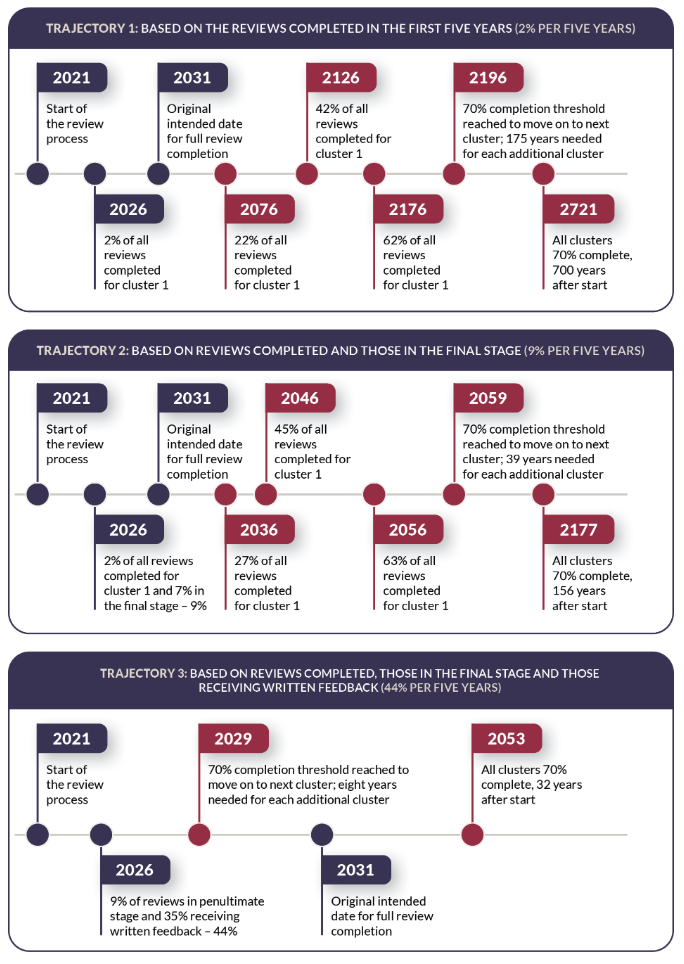
COP13 will take place amid existential funding, resourcing and political crises for the UN in general. The UNTOC review mechanism is facing a particularly dire situation, if one compares its mandate and the target timelines with what has actually been achieved. For several years, there has been a clear lack of progress in the review mechanism, with direct impact on the ability of states and researchers to assess the implementation of the convention’s core purpose. Member states can no longer ignore how behind schedule and lacking in impact it is. The timeline sets out a series of deadlines, all of which will be missed, based on the workplan adopted by states under resolution 9/1 (see the diagram). The diagram below shows the progress that should be made by all three groups of approximately 60 countries each, to review all four clusters of the convention, with an envisaged completion date of 2031.
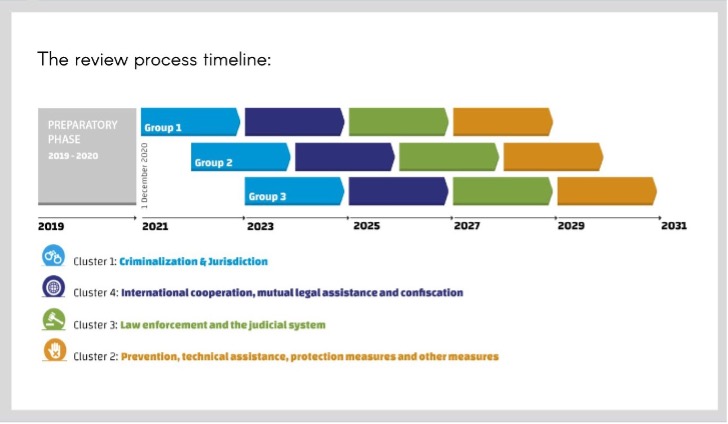
Ahead of COP12 in 2024, the GI-TOC presented an update on the progress of the review mechanism. Although some headway has been made since then, the process remains far behind schedule.
In reality, only four states have completed their reviews for the criminalization and jurisdiction cluster: Estonia, Israel, Italy and Canada. As 70 per cent of any group of states parties must have completed their reviews to move on to the next cluster, no group has come anywhere close to this percentage, and thus all groups are stalled in Cluster 1, with no prospect of moving forward within sight. At this rate, the cluster on international cooperation, the core of the convention, will not be reviewed for decades or even centuries to come, with the final cluster on prevention (what is needed to prevent the proliferation of transnational crimes), ironically, following after.
The timeline below envisages the estimated completion times for the review phases based on the current trajectory. The worst-case scenario is based on the reviews completed in the first five years (2%), and suggests that the review process could take 700 years to reach just 70% completion. Another scenario is based on the reviews already in the final stage (9%), and indicates that the review process would take just over 150 years. The best-case scenario is based on the reviews in the penultimate phase of completion (44%), and would still mean that the process takes over 30 years to achieve a 70% completion rate across all clusters. While this calculation is crude and exact timings cannot be predicted, the main point is that there is no scenario in which the review mechanism will be complete anywhere near on time, and it will certainly take generations under the current model.
Despite the lack of analysis from the mechanism, states do have access to the UNODC’s Digest of Cases, which contains examples of how the UNTOC has been used in matters of international cooperation. However, the digest itself admits that there is no clear picture of how often countries rely on the convention when working across borders. A report prepared by the secretariat for COP13 confirms this gap, noting that review of the convention’s international cooperation provisions, originally intended to start in November 2022, has been delayed because too few country reviews have been completed. The report also identifies a lack of consistent data on how effectively these provisions are being implemented, the low levels of reporting by some regions, and the need for a more reliable way of collecting information on how the convention supports international cooperation against organized crime.
If the review mechanism process had been carried out at its intended pace, the international community would now have access to dozens of country reports outlining observations and analysis produced by the secretariat drawing conclusions from those reports. As it stands, with only four reviewed sets of county observations available, and only 18 of the pre-reviewed questionnaires published voluntarily, there is precious little data upon which to make observations regarding the implementation of the UNTOC.
Subsequently, the component of the review mechanism that fully includes civil society, the Constructive Dialogues, now convenes without any evidential basis from the review process. Its meetings have morphed into general discussions on topics selected to align with the member state-only working groups (which also meet with almost no outcomes from the review mechanism to discuss). What’s more, the Constructive Dialogues now take place online due to lack of funding, reducing their value as a forum for engagement and exchange. The move to an online format has led to declining interest from member states and less interaction, despite resilient civil society interest.
But the problems of the review mechanism go much deeper than lack of funding and pace. The GI-TOC has long emphasized that itsuffers from serious design flaws, and the fundamental weaknesses canno longer be ignored.
Most concerning is what this scenario means for political commitment to the convention. Organized crime is now more clearly linked to state elements than it was at the time of the UNTOC’s adoption, meaning that more states than ever have a clear interest in avoiding scrutiny of how they apply the convention. But there are also states that seem to be comfortable with the convention’s stagnation, or have simply lost interest. What is required is not just an injection of additional resources, but a recommitment from those who support the convention’s aims.
What was the review mechanism supposed to achieve?
The convention, agreed upon at the height of its political influence, states that its COP should focus on facilitating information exchange, reviewing the implementation of the convention and making recommendations, while cooperating with relevant international organizations and NGOs.
It also states that, for the purposes of review, the COP ‘shall acquire the necessary knowledge of the measures taken by States Parties in implementing this Convention and the difficulties encountered by them in doing so through information provided by them and through such supplemental review mechanisms as may be established by the Conference of the Parties’.
However, the review mechanism was not adopted until 18 years after the convention came into force, reflecting the declining political will and investment. The ‘principles and characteristics’ of the mechanism agreed to by states produced a process that prioritizes the rights of states to mark their own homework, shuts out uncomfortable evidence, and glosses over the open and honest sharing of information that is needed. At the same time, it created a bureaucratic and time-consuming process, with no incentives (e.g. resources or site visits) for states to commit themselves to, nor sanctions imposed on those that miss schedules.
The effectiveness of the UNTOC itself is open to debate, but what cannot be contested is that the failure of its review mechanism has deprived the international community of the very tool intended to measure states’ compliance and implementation.
As states meet in October, now is the time to go back to the convention’s aims, and think again about what an impactful review mechanism could look like. Otherwise, the very credibility of the convention, and not just its review mechanism, is at stake.
The key elements for an effective outcome at COP 13 need to include the following:
- The new executive director of the UNODC and the secretariat need to strategize on how to create high-level political momentum to reinvigorate the UNTOC, which is the UN’s central platform and mandate on organized crime.
- This should be supplemented by options for reform the review mechanism in practical terms, recognizing that the current format is not working. Ideas for reform should include how to make better strategic use of the resources allocated to the current annual calendar of meetings to raise the level of political interest.
- Commitment needs to be sought from a broad cross-section of member states to renew their dedication and action (for example, by forming a fast-moving group to review one another).
- The secretariat should consider how best to utilize external information, evidence and stakeholders to supplement the data gaps in the current process, and make a renewed, politically supported UNTOC more relevant and fit for the challenges it needs to address.
This analysis forms part of a series focusing on the UNTOC in the run-up to COP13, 19–23 October 2026.