Posted on 22 Dec 2025
In China’s luxury goods market, swim bladders from the totoaba fish are sold at prices that rival the cost of gold. This extraordinary value has turned the endangered species, found only in Mexico’s Gulf of California and protected under international law, into one of the most sought-after commodities in transpacific wildlife crime.
The totoaba swim bladder, or maw, is highly prized in Chinese cuisine and traditional medicine, as it is believed to improve fertility and vitality. Its trade is driven by cultural prestige and investment-like speculation, pushing prices to extraordinary levels. Totoaba maw can sell for US$20 000 to US$81 000 per kilogram, and demand has surged in recent years. This immense profit potential makes Latin America’s waters an increasingly attractive target for traffickers, who exploit the region’s weak maritime enforcement, vast coastlines and limited port oversight – with significant environmental and social implications.
In 2021, two shipments of totoaba swim bladders from Mexico worth US$948 000 and US$423 100 were intercepted in Hong Kong, after being falsely declared as seafood. In 2022, Hong Kong customs officers discovered 1.2 kilograms of maw in an air-express parcel from Mexico, declared as gifts and clothing, with an estimated market value of US$33 000. A significant number of similar seizures have been recorded in Thailand, China and Vietnam. Each case represents one link in a vast, hidden network connecting fishing communities along the coast of Mexico to high-end consumer markets across Asia.
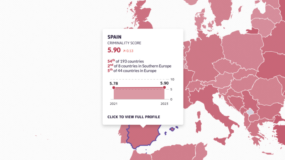
This illicit market reflects a broader pattern whereby environmental exploitation has become an increasingly lucrative area for organized crime. The Global Organized Crime Index highlights this trend, showing a steady increase in fauna crimes across its three editions. The latest edition, released in November, put the global average for fauna crimes at 4.90 out of 10 – up 0.27 since 2021 and 0.07 since 2023. Although not among the most pervasive illicit markets, this consistent growth emphasizes the escalating impact of environmental criminality. According to the Index, fauna trafficking is ‘rapidly becoming one of the most robust illegal markets globally’, with Mexico playing a ‘pivotal role’ due to its biodiversity and strategic geographical location.
Although fauna crimes in most Latin American countries are less prominent than other illicit markets, high levels of criminality and limited resilience in the region have created the ideal conditions for transpacific environmental crime to persist and expand. Mexico, for instance, has a score of 7.50 for fauna crimes, making it one of the countries most affected by this activity worldwide. At the same time, its resilience score is moderate to weak, and it is among the countries hardest hit by organized crime, with an overall criminality score of 7.68.
China, meanwhile, is widely recognized as the world’s largest destination for trafficked wildlife. The Index has consistently ranked China as the country with the highest level of fauna crime globally, and it has received scores of 9.0 since the first edition was published in 2021. In addition, the Index highlights the role of Chinese criminal actors operating across the trafficking ecosystem – as importers, processors and retailers – in fuelling poaching and environmental destruction worldwide.
From Baja to Beijing
In Mexico, it has been illegal to catch totoaba since 1976, when it was listed under Appendix I – the species threatened with extinction – by the Convention on International Trade in Endangered Species (CITES). The fish’s habitat also overlaps with that of the vaquita porpoise, the world’s most endangered marine mammal, whose population has been reduced to single figures by totoaba bycatch. In April 2017, in an attempt to halt the devastation, the Mexican government declared that the extraction of endangered species would become a felony comparable to organized crime.
However, demand in China continues to drive relentless poaching. Both domestic and foreign actors are embedded in the illicit supply chain, and the promise of large profits has attracted small-scale fishers and organized criminal groups. Although Beijing introduced a ban on the trade and consumption of wild animals in 2020, multiple legal loopholes, weak enforcement and persistent demand have enabled trafficking to continue. Conservation groups warn that CITES’s approval of commercial trade in farmed totoaba risks enabling laundering of wild-caught maw, since farmed bladders are far smaller and do not meet Asian market demand.
Multi-year investigations by Earth League International and C4ADS have revealed the inner workings of this trade. At least 17 major trafficking networks were traced, and over 160 suspected perpetrators identified. Many were Chinese traders based in Mexican cities such as Ensenada and Tijuana, working in partnership with local cartels that provided protection and logistical support, and facilitated bribes.
Converting the catch
The illicit transpacific trade in high-value commodities such as fish maw begins in the coastal regions of Mexico’s Gulf of California, Ecuador, Peru and Colombia. Fishers under economic pressure harvest the products, which are then processed and stored by intermediaries. Traffickers use forged documents, false export papers and concealment in legitimate seafood shipments to evade detection, transporting the goods by air cargo, courier, container or passenger luggage.
Hong Kong, Taiwan and South Korea are used as trans-shipment hubs where traffickers exploit opaque re-export chains to hide the origin of their shipments. Wholesalers in China’s coastal provinces, such as Guangdong and Fujian, grade and distribute the goods to restaurants, luxury retailers and traditional medicine markets.
Wildlife trafficking has also become increasingly integrated into broader organized crime networks, with actors profiting from related activities such as human smuggling, drug trafficking and corruption. These networks have been found to launder profits through real estate purchases in Mexico and Hong Kong, offshore shell companies and informal value transfer systems. In Mexico’s Baja California state, for instance, criminal groups exert territorial control over fishing zones, levy so-called ‘taxes’ on fishers and mediate sales to Asian buyers.
The resilience deficit
Despite Mexico’s longstanding ban on totoaba fishing and trade, the results of enforcement efforts remain extremely limited. Between 2016 and 2022, just 16 convictions for totoaba trafficking were recorded, and in 2023, CITES sanctioned Mexico for failing to protect the species adequately. The situation is a matter of weak implementation rather than an absence of legislation, however. The 2025 Index identified corruption and a lack of interagency coordination as key factors eroding the state’s regulatory capacity, with criminal investigations being ‘hampered by a lack of resources and widespread impunity’.
Totoaba trafficking exemplifies the convergence of environmental and organized crime. Every dried swim bladder represents not just the death of an endangered fish, but the functioning of a complex criminal economy that transcends oceans, connecting regional poverty with high-end demand. Behind each shipment lies a global crime story spanning two oceans and sustained by a collective willingness to look the other way.
Addressing this issue will require the same cutting-edge strategic tools used to combat drug trafficking and financial crimes. These include intelligence-led investigations, cross-border cooperation, anti-corruption enforcement and the tracing of financial flows. Only by taking a coordinated, systemic approach – one that recognizes wildlife crime as part of a larger organized criminal ecosystem – can the cycle of exploitation and environmental loss between Latin America and Asia be disrupted.
This analysis is part of the GI-TOC’s series of articles delving into the results of the Global Organized Crime Index. The series explores the Index’s findings and their effects on policymaking, anti-organized crime measures and analyses from a thematic or regional perspective.