Posted on 13 Nov 2026
The central Sahel is mired in a period of deep volatility in which political instability, violent extremism, broader insecurity and illicit economies are becoming ever more tightly interwoven. In Burkina Faso, Mali and Niger, military regimes have consolidated power and narrowed political and civic space, but they are struggling to convert promises of restored sovereignty and stronger security control into greater stability.
Instead, the region is increasingly characterized by fragmented authority; decreasing state territorial control; rising levels of conflict involving violent extremist organizations (VEOs), state forces and state auxiliaries; and fluid local power arrangements in which armed groups, mercenaries, coercive protection systems and illicit markets continue to adapt and embed themselves.
This has created a landscape in which the boundaries between conflict, governance and organized crime are becoming harder to discern. Across Burkina Faso, Mali and Niger, the Global Initiative Against Transnational Organized Crime (GI-TOC) has found increasing convergence between armed group instability and criminal economies, with gold mining, kidnapping and protection rackets at the centre of sources of revenue, influence and recruitment for armed groups. As these systems deepen, they are fuelling violence, further fragmenting authority and narrowing the space for effective state and international engagement.
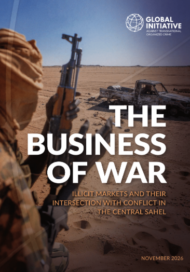
Drawing on the GI-TOC’s ongoing monitoring of illicit economies and their intersections with conflict across the Sahel, this report provides a situational update of the key trends shaping the role of illicit flows in the Sahel’s war economy. Leveraging this data set as a baseline for forecasting, the report maps out probable future trajectories of the main illicit economies driving violence and highlights critical milestones likely to reshape Sahelian conflict dynamics in the near future.