Event Details
Where
Online
Date: Tuesday, 31 March 2026
Time: 10:00-11:00 AEDT / 11:00am-12:00noon Fiji time (Monday 30 March 2026, 19:00-20:00 EDT)
Format: Online
Posted on 10 Mar 2026
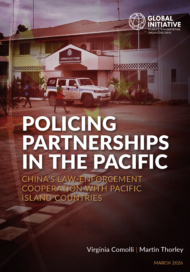
China has expanded its foreign law enforcement assistance over the past two decades, and the Pacific Islands have increasingly become part of its policing interventions. What began as support and training has developed into more operationally embedded relationships in several countries. This report examines the scale and nature of China’s policing engagement in the South Pacific, placing it within China’s broader strategic objectives.
The picture is uneven. Solomon Islands has emerged as China’s most prominent Pacific policing partner, while smaller states like the Cook Islands have also received sustained engagement. Chinese police liaison teams have in some instances sought to discourage partners from other countries, signalling a willingness to compete at the operational level.
China’s role is best understood not as a security takeover but as a cumulative strategy that is reshaping the region’s policing landscape. Traditional partners like Australia – which remains the key security partner in the South Pacific – and New Zealand are adapting, and Pacific governments are diversifying rather than choosing sides. The stakes, however, are rising: what was once a technical domain has become a more politically contested space.