Posted on 21 Nov 2026
On 23 October 2026, Thai police at a checkpoint in Tha Sai Luat discovered a live red panda hidden in the back of a pickup truck. The two men travelling in the vehicle could not produce the necessary paperwork for transporting the highly endangered animal, and were charged with illegally possessing protected wildlife.
As far as can be determined, this was the first red panda intercepted on Thailand’s land border with Myanmar. It was a long way from its home in the bamboo forests of the eastern Himalayas, or the far north of Myanmar’s Kachin state. Yet recent enforcement patterns and online advertisements suggest that these animals are appearing with increasing frequency in cross-border trade.
What remains unclear is how live red pandas – which do not occur naturally in Thailand – are being captured and channelled into regional trafficking routes. One possible answer lies in the rapid expansion of rare earth mining across Kachin state following Myanmar’s 2021 military coup.
From pelts to live animals
The red panda is listed as ‘Endangered’ on the IUCN Red List of Threatened Species, with some estimates suggesting that as few as 2 500 remain in the wild. International commercial trade is prohibited under the CITES agreement, and even non-commercial cross-border transfers are subject to strict controls, requiring both import and export permits.
Historically, red pandas were hunted for their pelts, but this threat has largely disappeared. In recent years, however, demand for live animals in the exotic pet market has become a growing concern. Since March 2024, Thai authorities have seized live red pandas on three occasions. In addition to the animal found in Tha Sai Luat, one was discovered at Bangkok’s Suvarnabhumi Airport and two were recovered from a house in Nonthaburi. In Myanmar in September 2025, nine red pandas were found in a vehicle on the Shwebo–Myitkyina highway, the largest red panda seizure ever recorded in the country.
Online monitoring points in the same direction. Between April 2024 and October 2026, ECO-SOLVE detected advertisements involving at least 26 live red pandas. Many of these posts stated that the animals were in Myanmar and available to overseas buyers.
Mining arrives in red panda country
The growth of this trade coincides with the expansion of mining in Kachin state. Myanmar is one of the world’s most important sources of rare earth elements, and Kachin holds some of the richest deposits of dysprosium and terbium, which are essential for green energy technologies such as electric vehicle motors and wind turbines, as well as defence systems. Mining began around 2017 and accelerated after the coup, with its footprint nearly doubling in the years to 2024.
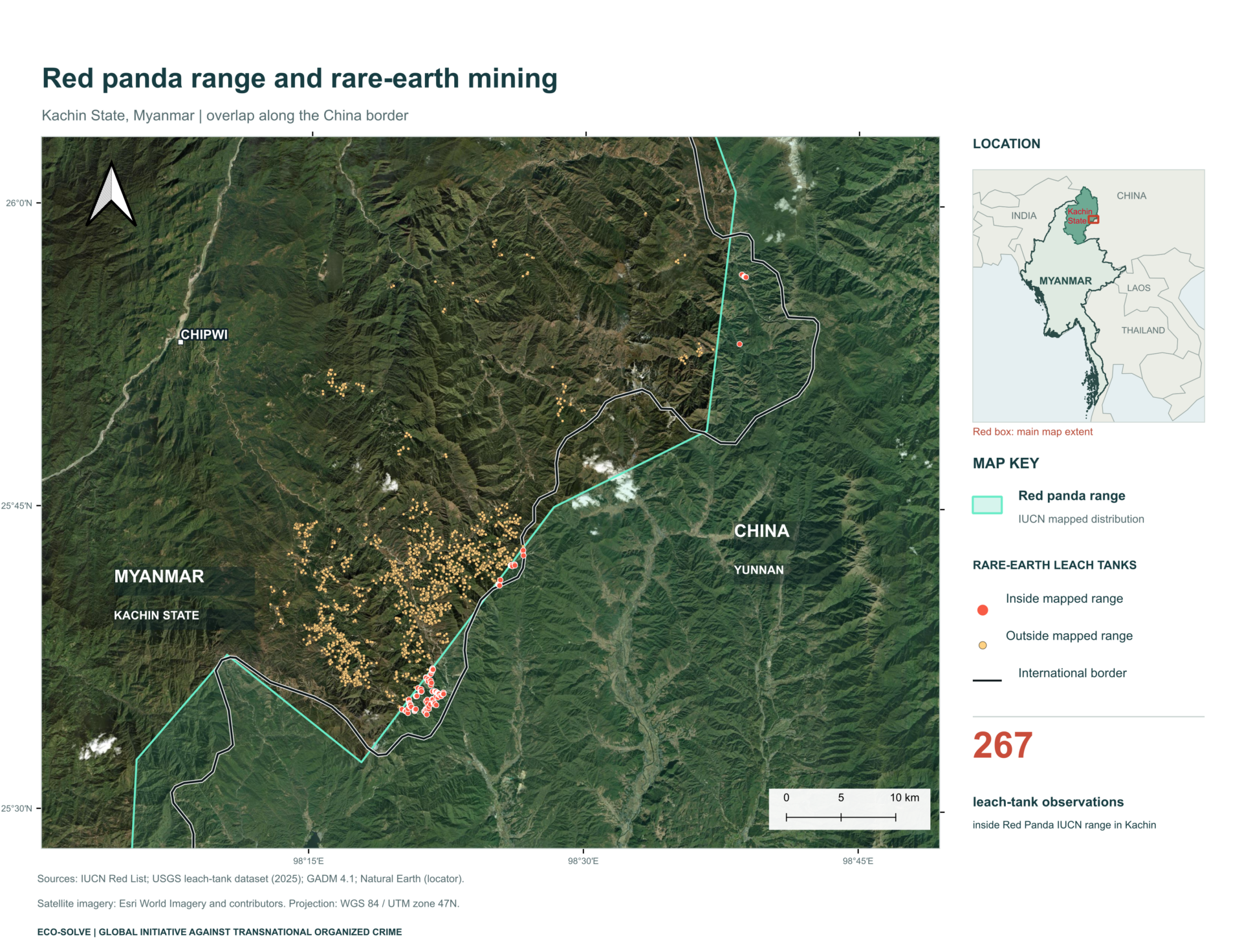 Caption: Rare-earth mining infrastructure and its spatial overlap with species distribution in Myanmar’s Kachin state.
Mining activity is concentrated around the towns of Chipwi and Pangwa, close to the Chinese border and adjacent to Imawbum National Park, where red pandas have been recorded since 2014. Habitat models have identified the Myanmar–China border region around Kachin as one of the most important areas of suitable habitat for red pandas across the species’ range. Mapping of leach tanks – used in the processing of rare earth elements – shows a definite overlap with the known ranges of red pandas within Myanmar (see the map below).
For decades, remote and difficult terrain afforded the species a degree of protection, but the rare earth boom in Kachin has stripped away many of those natural barriers. Between 2018 and 2024, the townships of Chipwi, Momauk and Bhamo lost 32 720 hectares of tree cover – an area roughly three times the size of Paris. At the same time, large numbers of migrant workers have moved into mining areas, increasing the likelihood of contact between people and red pandas. Before the COVID-19 pandemic, it was estimated that 20 000 workers were present in the Chipwi and Pangwa regions, a figure that has grown considerably since the coup.
Economic pressures may also be exacerbating the problem. Reports from Kachin’s mining sector describe months of delayed or unpaid wages, while the value of a red panda rises sharply along the supply chain. Animals reportedly offered locally for tens of dollars can ultimately sell for tens of thousands abroad. For workers facing prolonged wage insecurity, even a small share of those profits may provide a powerful incentive to participate in the trade.
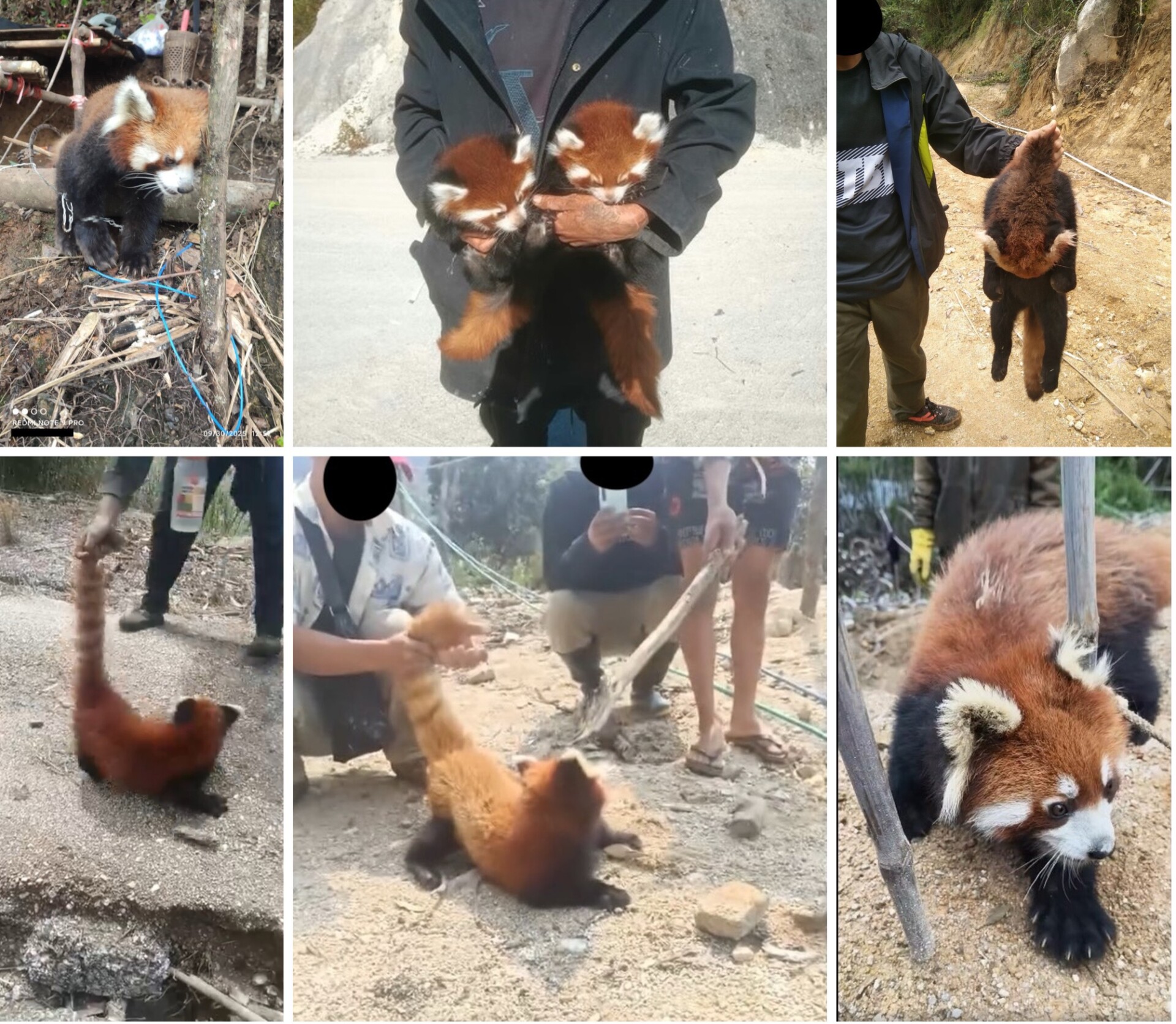 Caption: Images shared online of red pandas reportedly caught in Myanmar.
A panda named Lucky
Photos and videos gathered by ECO-SOLVE appear to show red pandas caught or held captive in mining communities (see images above). This suggests that the exploitation of the species in northern Myanmar may be linked to the social and economic environments created by rare earth extraction, rather than occurring solely through traditional trafficking channels.
One notable case involves a red panda known as ‘Lucky’, whose videos have attracted over a million views across Facebook and TikTok. The footage appears to show the animal roaming around a site linked to rare earth mining operations. The owner of the social media pages presents Lucky as a rescued animal, saved from being hunted for its meat or sold into the pet trade, and pairs conservation messages with requests for donations.
However, research has consistently demonstrated that social media content depicting wild animals in domestic settings normalizes wildlife ownership and stimulates demand. A single account operating from a rare earth mining site in Kachin, therefore, could expose large audiences across South East Asia and beyond to captive red pandas, potentially increasing interest in owning the species.
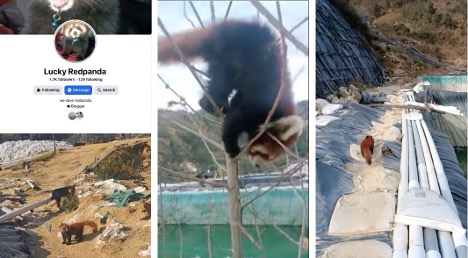 Caption: Images on social media show Lucky roaming around a site linked to rare earth mining.
Whether rescued or captured, Lucky demonstrates the pattern emerging in Kachin: a red panda removed from its habitat and generating value for the people who hold it.
A case for investigation
The available evidence suggests that rare earth mining is not only causing the environmental damage typically associated with extractive industries, but may also be contributing to an emerging live wildlife trade. Documented seizures, online advertisements and evidence from mining communities indicate that mining may be facilitating the entry of red pandas into trafficking networks that extend beyond Myanmar to international marketplaces.
While the scale of this trade remains unclear, the convergence of these findings provides sufficient grounds for targeted investigation and preventive action. In the meantime, authorities should scrutinize red pandas appearing in private collections, exotic pet cafés and zoos against CITES import records, and online platforms should take a more proactive approach to removing content related to the illegal wildlife trade. Without such action, the minerals powering the global shift to clean energy could cost the red panda one of its most important strongholds, and the animals that survived for so long in Kachin’s remote forests may finally run out of luck.