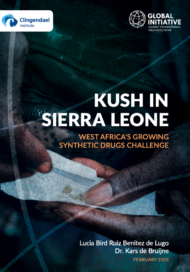
Synthetic drug and cocaine markets represent an urgent and complex public health, security, and human rights challenge in West Africa. The evidence base regarding their scope, scale, and associated harms has long been fragmented.
In November 2025, a high-level dialogue titled “Mapping the future of drug markets in West Africa – Synthetics, cocaine, criminal money, and strategic responses”, jointly convened by the Government of Ghana, the Government of the Netherlands, and the Global Initiative Against Transnational Organized Crime (GI-TOC), marked a pivotal step in bringing together key stakeholders to drive forward a more effective and cohesive response to drug markets – particularly cocaine and synthetic drugs. At this dialogue, two granular baseline studies were tabled for consultation and are now being published, feeding into the Commission on Narcotic Drugs (Vienna, 9–13 March 2026).
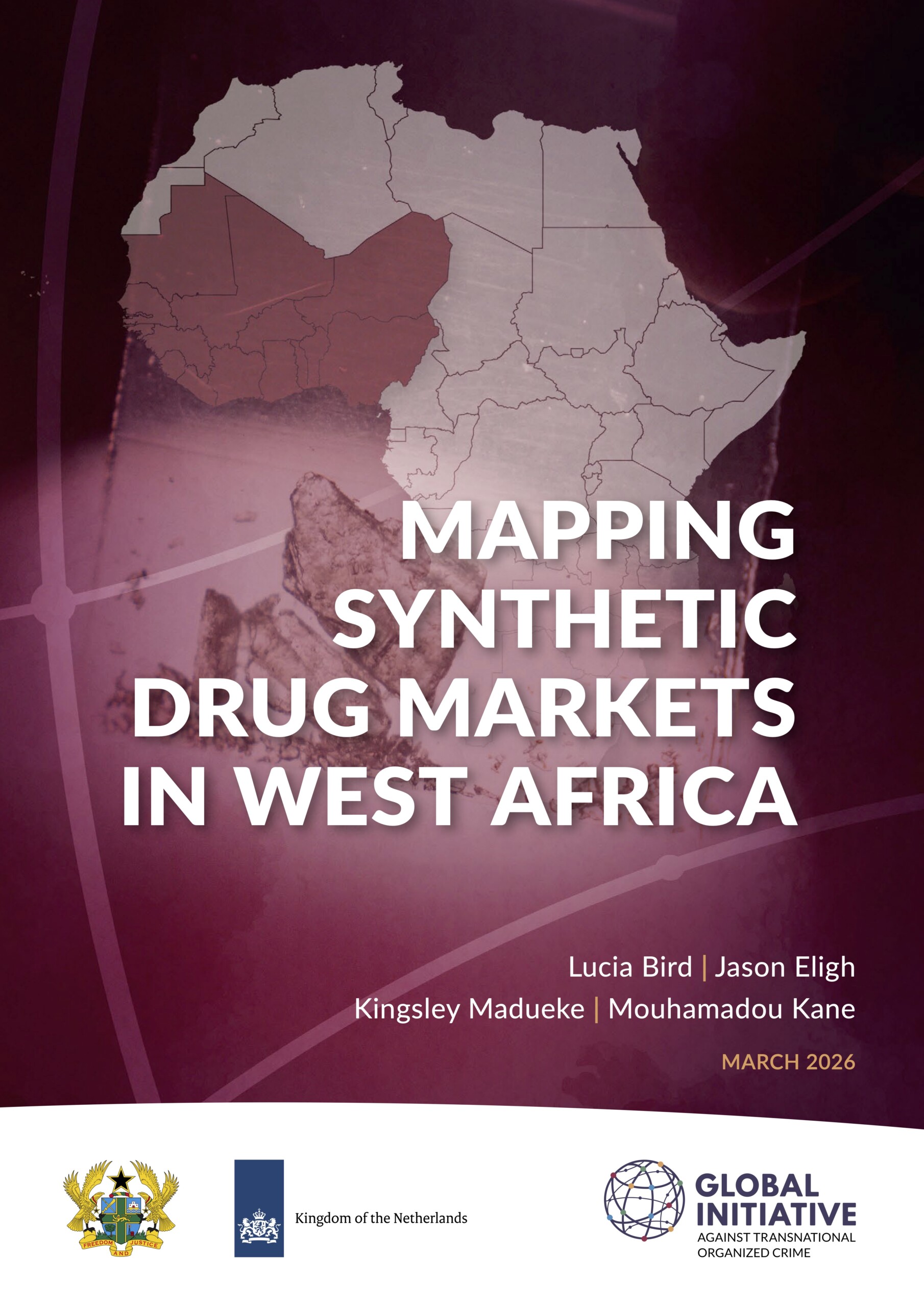
Report: Mapping Synthetic Drug Markets in West Africa
The proliferation of synthetic drugs across West Africa represents an urgent and complex public health and security challenge facing the region. In recent years, the illicit drug landscape has been fundamentally reshaped, moving away from traditional plant-based substances controlled by hierarchical criminal networks towards a fragmented, decentralized market for man-made psychoactive compounds.
This report examines the emergence and rapid expansion of West Africa’s current synthetic drug economy, detailing how low barriers to entry, minimal capital required for production, and the convenience and anonymity afforded by the proliferation of online platforms and technology have enabled a diverse array of new criminal actors to enter the trade. The influx of substances such as synthetic cannabinoids, nitazenes and other novel compounds of unknown composition, alongside the expansion of pre-existing markets such as methamphetamine, presents a multifaceted threat that is rapidly outpacing the response capacity of regional governments.
Report: Cocaine Markets in West Africa, Impacts, routes, trends, and actors.
West Africa is a major and growing logistics, redistribution and strategic operating base in the global cocaine trade. The region’s cocaine market is bigger than ever, with multi-tonne consignments warehoused across countries, consumption expanding in many urban hubs, and involvement by several of the world’s most powerful organized crime groups.
Since 2019, West Africa’s cocaine market has expanded sharply. Record production in Latin America, surging European demand, growing European pressure on direct trafficking routes from Latin America, and improving West African trading infrastructure are among the drivers. According to the Global Organized Crime Index 2025, cocaine trafficking was the fastest-growing criminal market in West Africa between 2019 and 2025.
To share key findings, the GI-TOC Observatory of Illicit Economies in West Africa (WEA-Obs) is convening a three-part webinar series exploring the rapid evolution of cocaine and synthetic drug markets in West Africa. Based on these two baseline research studies, the result of extensive fieldwork and consultation, the discussions will explore bulk cocaine flows, expanding synthetic markets, map the criminal actor landscape, and track the increasing harms affecting youth and marginalized communities.
At least one third of Europe’s cocaine is likely to be transiting West Africa, and this continues to grow. GI-TOC’s 2025 West Africa Illicit Hub Mapping shows synthetic drug trade activity in 44% of illicit hubs, indicating clear growth, rising from 11% in 2022 to 24% in 2024. The Global Organized Crime Index 2025 identified West Africa’s cocaine trade as the fastest growing market in the region (scoring 6.67, up from 5.20 in 2019), alongside the synthetic drugs trade (scoring 5.67, up from 4.80).
Webinar discussions are grounded in GI-TOC’s field research and focus on market dynamics, supply chains, actor typologies, protection frameworks, and response gaps, using an investigative, evidence-based approach. Through this research, we aim to address critical blind spots, including persistent intelligence and data gaps that can mask high-flow trafficking despite low or uneven seizure and conviction outcomes. Through this analysis, we examine how these markets operate, why they are changing, and where key challenges are emerging in public health, governance, and security.
25 March 2026, 3:00 PM CET
The rise of synthetic drugs in West Africa: supply chains, online markets and criminal fragmentation
Click here to register
1 April 2026, 3:00 PM CET
9 April 2026, 3:00 PM CET
Les marchés de la cocaïne et des drogues de synthèse représentent en Afrique de l’Ouest un défi urgent et complexe en matière de santé publique, de sécurité et de droits humains. Les connaissances disponibles sur leur portée, leur ampleur et les dommages y afférents sont depuis longtemps fragmentées.
En novembre 2025, un dialogue de haut niveau intitulé « Cartographier l’avenir des marchés de la drogue en Afrique de l’Ouest – Drogues de synthèse, cocaïne, argent sale et réponses stratégiques », coorganisé par le Gouvernement du Ghana, le Gouvernement des Pays-Bas et la Global Initiative Against Transnational Organized Crime (GI-TOC), a marqué une étape déterminante en réunissant les principaux acteurs dans le but de développer une réponse plus efficace et plus cohérente aux marchés de la drogue – en particulier ceux de la cocaïne et des drogues de synthèse. Lors de ce dialogue, deux rapports d’études de référence détaillés ont été présentés pour consultation et validation préliminaires et sont désormais publiés, en contribution à la Commission sur les Stupéfiants (Vienne, 9–13 mars 2026).
Rapport : Cartographier les marchés des drogues de synthèse en Afrique de l’Ouest
La prolifération des drogues de synthèse en Afrique de l’Ouest représente un défi urgent et complexe de santé publique et de sécurité à l’échelle de toute la région. Ces dernières années, le paysage des drogues illicites a été profondément remodelé, s’éloignant des substances traditionnelles d’origine végétale contrôlées par des réseaux criminels hiérarchisés, au profit d’un marché fragmenté et décentralisé de composés psychoactifs fabriqués.
Ce rapport examine l’émergence et l’expansion rapide de l’économie actuelle ayant trait aux drogues de synthèse en Afrique de l’Ouest, détaillant comment de faibles barrières à l’entrée, un capital minimal nécessaire à la production, ainsi que la commodité et l’anonymat rendus possibles par la prolifération des plateformes en ligne et des technologies, ont permis à une diversité de nouveaux acteurs criminels d’entrer dans le commerce. L’afflux de substances telles que les cannabinoïdes de synthèse, les nitazènes et d’autres composés nouveaux de composition inconnue, conjugué à l’expansion de marchés préexistants comme celui de la méthamphétamine, constitue une menace multiforme qui dépasse rapidement les capacités de réponse des gouvernements de la région.
Rapport : Marchés de la cocaïne en Afrique de l’Ouest : impacts, routes, tendances et acteurs. [À PARAÎTRE le 11 mars 2026]
L’Afrique de l’Ouest constitue une base logistique, de redistribution et d’opérations stratégiques majeure en plein essor dans le commerce mondial de la cocaïne. Le marché de la cocaïne dans la région n’a jamais été aussi important : des cargaisons de plusieurs tonnes sont entreposées dans différents pays, la consommation augmente dans de nombreux pôles urbains, et plusieurs des groupes criminels organisés les plus puissants au monde y sont impliqués.
Depuis 2019, le marché ouest-africain de la cocaïne s’est fortement développé. La production record en Amérique latine, la hausse de la demande européenne, le renforcement de la pression européenne sur les routes de trafic direct depuis l’Amérique latine et l’amélioration des infrastructures commerciales ouest-africaines figurent parmi les moteurs expliquant cela. Selon l’Indice mondial du crime organisé 2025, le trafic de cocaïne a été le marché criminel connaissant la croissance la plus rapide en Afrique de l’Ouest entre 2019 et 2025.
Afin de partager les principales conclusions, l’Observatoire des économies illicites en Afrique de l’Ouest de la GI-TOC (WEA-Obs) organise une série de trois webinaires consacrée à l’évolution rapide des marchés de la cocaïne et des drogues de synthèse en Afrique de l’Ouest. Fondées sur ces deux études de référence, issues d’un important travail de terrain et de consultations, les discussions porteront sur les flux de cocaïne en gros, l’expansion des marchés des drogues de synthèse, la cartographie du paysage des acteurs criminels et le suivi de l’aggravation des préjudices touchant les jeunes et les communautés marginalisées.
Au moins un tiers de la cocaïne consommée en Europe transiterait apparemment par l’Afrique de l’Ouest, et ce phénomène continue de s’amplifier. La cartographie 2025 des hubs illicites en Afrique de l’Ouest de la GI-TOC montre une activité liée au commerce des drogues de synthèse dans 44 % desdits hubs, signe d’une croissance nette, passant de 11 % en 2022 à 24 % en 2024. L’Indice mondial du crime organisé 2025 a identifié le commerce de la cocaïne en Afrique de l’Ouest comme le marché connaissant la croissance la plus rapide dans la région (score de 6,67, contre 5,20 en 2019), aux côtés du commerce des drogues de synthèse (score de 5,67, contre 4,80).
Les échanges des webinaires s’appuient sur les recherches de terrain de GI-TOC et portent sur la dynamique des marchés, les chaînes d’approvisionnement, les typologies d’acteurs, les cadres de protection et les lacunes des réponses, selon une approche d’enquête fondée sur des preuves. À travers ces recherches, nous visons à combler des zones d’ombre critiques, notamment les lacunes persistantes en matière de renseignement et de données, qui peuvent masquer des trafics à fort volume malgré des résultats faibles ou inégaux en matière de saisies et de condamnations. Cette analyse examine le fonctionnement de ces marchés, les raisons de leur transformation et les principaux défis émergents en matière de santé publique, de gouvernance et de sécurité.
25 mars 2026, 14 h 00 (GMT)
L’essor des drogues de synthèse en Afrique de l’Ouest : chaînes d’approvisionnement, marchés en ligne et fragmentation criminelle
Cliquez ici pour vous inscrire
1er avril 2026, 14 h 00 (GMT)
Kush : un choc de drogue de synthèse à propagation rapide
Cliquez ici pour vous inscrire
9 avril 2026, 14 h 00 (GMT)
Cartographier la géographie actuelle de la cocaïne en Afrique de l’Ouest : logistique, barons de la drogue et corruption
Cliquez ici pour vous inscrire
Os mercados de drogas sintéticas e de cocaína representam um desafio urgente e complexo de saúde pública, segurança e direitos humanos na África Ocidental. A base de evidências sobre a sua abrangência, escala e os danos associados tem sido, há muito tempo, fragmentada.
Em novembro de 2025, um diálogo de alto nível intitulado “Mapeando o futuro dos mercados de drogas na África Ocidental — sintéticos, cocaína, dinheiro criminoso e respostas estratégicas”, convocado conjuntamente pelo Governo do Gana, pelo Governo dos Países Baixos e pela Global Initiative Against Transnational Organized Crime (GI-TOC), marcou um passo decisivo ao reunir partes interessadas-chave para impulsionar uma resposta mais eficaz e coesa aos mercados de drogas — particularmente os de cocaína e drogas sintéticas. Nesse diálogo, dois estudos de linha de base detalhados foram apresentados para consulta e estão agora a ser publicados, alimentando os trabalhos da Comissão de Entorpecentes (Viena, 9–13 de março de 2026).
Relatório: Mapeando os mercados de drogas sintéticas na África Ocidental
A proliferação de drogas sintéticas pela África Ocidental representa um desafio urgente e complexo de saúde pública e segurança para a região. Nos últimos anos, o panorama das drogas ilícitas foi fundamentalmente remodelado, afastando-se de substâncias tradicionais de origem vegetal controladas por redes criminosas hierárquicas e caminhando para um mercado fragmentado e descentralizado de compostos psicoativos produzidos pelo homem.
Este relatório examina o surgimento e a rápida expansão da atual economia de drogas sintéticas na África Ocidental, detalhando como baixas barreiras de entrada, capital mínimo necessário para a produção e a conveniência e o anonimato proporcionados pela proliferação de plataformas online e tecnologias permitiram que uma ampla variedade de novos atores criminosos entrasse no comércio. A entrada de substâncias como canabinoides sintéticos, nitazenos e outros compostos novos de composição desconhecida, juntamente com a expansão de mercados já existentes como o da metanfetamina, apresenta uma ameaça multifacetada que está a superar rapidamente a capacidade de resposta dos governos da região.
Relatório: Mercados de cocaína na África Ocidental: impactos, rotas, tendências e atores. [EM BREVE, 11 de março de 2026]
A África Ocidental é uma base logística, de redistribuição e de operações estratégicas importante e crescente no comércio global de cocaína. O mercado de cocaína na região é maior do que nunca, com remessas de várias toneladas armazenadas em diferentes países, consumo em expansão em muitos centros urbanos e o envolvimento de alguns dos grupos de crime organizado mais poderosos do mundo.
Desde 2019, o mercado de cocaína na África Ocidental expandiu-se acentuadamente. Produção recorde na América Latina, aumento da demanda europeia, maior pressão europeia sobre rotas diretas de tráfico a partir da América Latina e melhoria da infraestrutura comercial na África Ocidental estão entre os fatores impulsionadores. De acordo com o Global Organized Crime Index 2025, o tráfico de cocaína foi o mercado criminal de crescimento mais rápido na África Ocidental entre 2019 e 2025.
Para partilhar as principais conclusões, o Observatório de Economias Ilícitas na África Ocidental da GI-TOC (WEA-Obs) está a organizar uma série de três webinars que explora a rápida evolução dos mercados de cocaína e drogas sintéticas na África Ocidental. Com base nesses dois estudos de linha de base, resultado de amplo trabalho de campo e de consultas, as discussões abordarão os fluxos de cocaína em grande escala, a expansão dos mercados de sintéticos, o mapeamento do panorama de atores criminosos e o acompanhamento do aumento dos danos que afetam jovens e comunidades marginalizadas.
Pelo menos um terço da cocaína consumida na Europa provavelmente transita pela África Ocidental, e esse fluxo continua a crescer. O West Africa Illicit Hub Mapping 2025 da GI-TOC mostra atividade de comércio de drogas sintéticas em 44% dos hubs ilícitos, indicando crescimento claro, subindo de 11% em 2022 para 24% em 2024. O Global Organized Crime Index 2025 identificou o comércio de cocaína na África Ocidental como o mercado de crescimento mais rápido na região (pontuação de 6,67, acima de 5,20 em 2019), juntamente com o comércio de drogas sintéticas (pontuação de 5,67, acima de 4,80).
As discussões dos webinars baseiam-se na pesquisa de campo da GI-TOC e focam na dinâmica de mercado, cadeias de abastecimento, tipologias de atores, estruturas de proteção e lacunas de resposta, usando uma abordagem investigativa e orientada por evidências. Por meio desta pesquisa, pretendemos enfrentar pontos cegos críticos, incluindo lacunas persistentes de inteligência e de dados que podem ocultar tráficos de alto volume apesar de resultados baixos ou desiguais em apreensões e condenações. Nesta análise, examinamos como esses mercados operam, por que estão a mudar e onde surgem desafios-chave em saúde pública, governança e segurança.
25 de março de 2026, 15:00 (CET)
A ascensão das drogas sintéticas na África Ocidental: cadeias de abastecimento, mercados online e fragmentação criminosa
Clique aqui para se inscrever
1 de abril de 2026, 15:00 (CET)
Kush: um choque de droga sintética em rápida evolução
Clique aqui para se inscrever
9 de abril de 2026, 15:00 (CET)
Mapeando a geografia atual da cocaína na África Ocidental: logística, chefões do crime e corrupção
Clique aqui para se inscrever