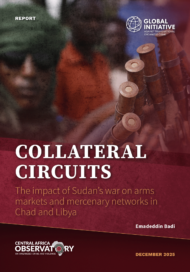
The war in Sudan has transformed far more than its own frontlines. It has reshaped the security economies of its neighbours, activating new supply nodes and embedding weapons and combatants into cross-border markets that now function as self-reinforcing “collateral circuits.”
As seized stockpiles from the Rapid Support Forces (RSF) and the Sudanese Armed Forces (SAF) entered circulation – alongside new external transfers moving into Sudan – these circuits fused manpower mobilization, convoy protection, fuel, communications technology and arms distribution. In doing so, they rewired the conflict economies of Chad and Libya.
As the report shows, Sudan’s descent into civil war accelerated the spread of weapons and spurred the mobilization of mercenaries. Far from being peripheral, mercenary leaders coordinated convoys, negotiated access, escorted shipments and kept arms flowing despite shifting frontlines. In effect, they built and managed the logistical networks that sustained the war, creating two interlinked circuits – of mercenaries and of weapons – that reinforced one another and gathered their own momentum.
The analysis traces how pre-war networks in Libya and Chad were revived and repurposed once the Sudanese conflict erupted in April 2023. In southern Libya, units aligned with the Libyan Arab Armed Forces (LAAF), including formations in Sebha, Kufra, Murzuq and Qatrun, adapted to new demand by securing infrastructure, escorting flows and managing access to desert corridors. In northern Chad, rebel remnants and ex-combatants embedded in goldfields and border regions operated as brokers, escorts and intermediaries, grounding arms circulation in commercial and kinship-based arrangements.
As fighting intensified, supply routes evolved. Initial RSF resupply through Kufra was disrupted by the loss of the Chevrolet base, forcing convoys onto harsher desert tracks and constraining high-volume deliveries. From mid-2023 onward, Amdjarass emerged as both a logistical and political pivot. Cargo flights disguised as humanitarian assistance, convoy marshalling and coordination with local stakeholders transformed the town into the backbone of RSF resupply into Darfur. Mercenary mobilization followed this realignment, with Chadian fighters and rebel splinters entering transactional relationships that linked eastern Chad to RSF positions.
By 2024, mounting pressure from SAF-aligned factions along the eastern Chadian routes pushed operations back toward Libya. The refurbishment of Ma’aten al-Sarah – a previously disused airbase near the tri-border zone – turned it into the epicentre of a new corridor linking Chad to southeastern Libya. From this hub, weapons and vehicles were aggregated, stockpiled and pushed directly into Darfur, creating a revitalized supply route designed to bypass interdictions and sustain the flow of materiel to the RSF.
The study also traces outbound proliferation. Weapons moved through Chad and Libya via diversion, resale and spillovers shaped by brokerage networks, local tensions, price signals and the involvement of mercenary and auxiliary forces. These flows deepened a regionalized economy of insecurity in which arms markets and armed labour sustain each other.
The report’s forward-looking assessment highlights four principal risks: the durability of collateral circuits, the regionalization of instability, escalation from localized disputes and the politicization of logistical hubs. Recommendations include integrating mercenary dynamics into disarmament planning, draining surplus weapons, targeting brokerage networks and embedding arms management into any future Sudanese political settlement.
Circuits collatéraux: L’impact de la guerre au Soudan sur les marchés d’armes et les réseaux de mercenaires au Tchad et en Libye
La guerre au Soudan n’a pas seulement remodelé ses propres lignes de front, mais elle a aussi transformé les économies de sécurité plus larges de ses voisins. La prolifération des armes et le recours grandissant aux mercenaires refaçonnent l’architecture sécuritaire du Sahel et de la région du Sahara, non pas comme de simples effets résiduels du conflit, mais comme des forces persistantes qui reconfigurent les économies de guerre et approfondissent la fragilité structurelle. Les groupes mercenaires – souvent constitués de vestiges de mouvements rebelles ou de combattants nouvellement recrutés et employés comme des forces auxiliaires quasi étatiques – évoluent désormais avec fluidité entre conflits motivés par des considérations idéologiques, crime organisé et guerres sous contrat. En parallèle, la circulation des armes est devenue de plus en plus régionalisée, opportuniste et à visée commerciale.
Dans les zones frontalières faiblement gouvernées, le marché de la main-d’œuvre mercenaire et celui des armes interagissent pour enraciner une économie régionalisée de l’insécurité. Quand ils se recoupent, ces marchés créent des circuits se renforçant mutuellement : des réseaux où les armes, les combattants, le carburant et les technologies de communication circulent ensemble. Les armes incitent à la mobilisation de main-d’œuvre combattante, et, en retour, les mercenaires se déplacent pour sécuriser, transporter ou tirer profit des armes. C’est cette manière dont chaque marché soutient et dépend de l’autre qui les définit comme des « circuits collatéraux », c’est-à-dire des systèmes secondaires mais imbriqués, qui tirent leur dynamisme l’un de l’autre.
Peu d’événements ont accéléré ce processus aussi dramatiquement que la guerre au Soudan, qui a éclaté en avril 2023, déclenchant des flux d’armes entrants comme sortants. L’effondrement du contrôle militaire interne et la fragmentation des structures de commandement ont permis une prolifération rapide de flux d’armes provenant à la fois des stocks des Forces de soutien rapide (FSR) et de ceux des Forces armées soudanaises (SAF) au Soudan vers les marchés régionaux. En parallèle, des transferts importants vers le Soudan, réalisés par des acteurs externes étatiques et non-étatiques, ont généré de nouveaux afflux, dont certains ont déjà été détournés vers l’extérieur. Les chefs mercenaires ont organisé des convois, fourni des services d’escorte et négocié des passages à des postes de contrôle, liant la mobilisation de combattants et les transferts d’armes au sein d’un même système. Ces dynamiques reflètent clairement les quatre voies de prolifération identifiées par le Groupe de travail des Nations unies sur l’utilisation des mercenaires (UNWG-M) dans son rapport de 2024 : les approvisionnements soutenus par les États, le détournement des stocks étatiques, les réseaux opaques de courtage et les échanges illicites impliquant des forces mercenaires et auxiliaires. La guerre au Soudan a activé ces quatre mécanismes, les ancrant dans des marchés transfrontaliers qui s’étendent à l’ensemble du Sahel. Les effets déstabilisateurs qui en ont résulté ont dépassé les frontières soudanaises. Les pays voisins, le Tchad et la Libye, ont été entraînés dans cette spirale, devenant des zones de prolifération d’armes, de recrutement mercenaire et de facilitation logistique. La guerre au Soudan a activé de nouveaux nœuds d’approvisionnement, étendu et remodelé les infrastructures de trafic, intégré du matériel lié au Soudan dans les marchés d’armes et créé de nouveaux incitatifs à la mobilisation mercenaire transfrontalière. Ces schémas ont illustré en temps réel comment les voies de prolifération définies par le groupe de travail UNWG-M se matérialisent dans les zones frontalières fragiles, sapant les efforts de désarmement et faisant obstacle à la résolution du conflit.
Les mercenaires ont joué un rôle central dans chaque phase du conflit et dans le fonctionnement de ses différentes filières d’approvisionnement. Ils n’opèrent pas en marge du trafic, mais agissent comme des organisateurs et facilitateurs des circuits, escortant les convois, gérant les accès et assurant la continuité des flux transfrontaliers. Leur implication permet aux armes de continuer à circuler, même lorsque la demande sur les lignes de front évolue, ce qui en fait des acteurs essentiels tant au réapprovisionnement opérationnel qu’aux dynamiques plus larges de prolifération. Au-delà des armes, les acteurs mercenaires s’insèrent également dans d’autres économies illicites, notamment celle de l’or, augmentant le risque que leur influence perdure même si l’intensité de la guerre au Soudan venait à diminuer. Cela renforce la durabilité des circuits collatéraux et leur profonde intégration dans les économies de guerre dans la région.
Ce rapport se concentre sur le nord du Tchad et le sud de la Libye, car leurs dynamiques internes – le réalignement post cessez-le-feu en Libye et la fragmentation post-Doha au Tchad – les ont rendus particulièrement vulnérables à ces pressions. Il retrace la façon dont les marchés régionaux des armes et les réseaux mercenaires ont évolué en tandem, en mettant en évidence les acteurs clés, les routes en mutation et les mécanismes par lesquels les flux liés au Soudan ont modifié la circulation des armes et de la main-d’œuvre.
Le rapport est développé en trois parties. Premièrement, il revient sur les principaux développements contextuels en Libye et au Tchad dans la période précédant la guerre au Soudan. Deuxièmement, il s’intéresse à la manière dont les armes ont afflué au Soudan via des chaînes d’approvisionnement soutenues par les États. Et, troisièmement, il évalue comment les armes prolifèrent de nouveau au Tchad et en Libye, remodelant les marchés, les structures de prix et les dynamiques de sécurité. Une sous-partie du rapport est également dédiée au rôle des mercenaires en tant que vecteurs de prolifération, en s’appuyant sur le cadre analytique du groupe de travail des Nations Unies sur les mercenaires. Le rapport se conclut par une analyse prospective des implications que ces dynamiques pourraient avoir pour la région lorsque le conflit au Soudan perdra en intensité, et formule des recommandations pour atténuer les risques liés à la fois aux flux d’armes sortants et à la mobilisation de mercenaires.