Posted on 25 Feb 2026
Levels of organized crime have remained stable across Europe while increasing in most other regions, according to the 2025 Global Organized Crime Index. Europe remains the second-lowest continent for criminality after Oceania. However, this overall stability masks a dynamic situation across criminal markets and criminal actors.
Europe’s overall criminality score stands at 4.74, while its resilience score reaches 6.28 —the highest globally. Although Europe continues to outperform other continents across all 12 resilience indicators, criminality continues to expand and adapt, highlighting the need to update resilience strategies to keep pace with emerging threats.
Financial crime remains the most pervasive criminal market in Europe for the second consecutive edition of the Index. These crimes include increasingly complex and sophisticated fraud schemes, largely occurring online, such as investment fraud, business email compromise and romance scams, as well as embezzlement and tax evasion. Financial crimes are inherently transregional and are particularly facilitated by corruption.
Europe continues to be a global hotspot for cyber-dependent crimes, ranking second continentally. These crimes range from ransomware attacks to malware distribution and cryptocurrency fraud, often targeting government institutions, major corporations and critical infrastructure. Hybrid and traditional cybercrime actors are increasingly intertwined, with state-sponsored groups often disguising themselves as cybercriminals.
Drug markets remain salient. Cocaine and synthetic drugs have recorded the sharpest increases since 2023. Cocaine is a primary source of revenue for numerous organized crime groups in Europe, and the continent functions as a destination, transit hub and consumer market. Synthetic drug production is becoming increasingly dispersed across Europe, with Central and Eastern Europe registering the sharpest increase since 2021. Heroin, by contrast, is showing signs of decline, while cannabis remains the most widely consumed illicit drug.
Human trafficking and human smuggling remain far-reaching and widespread. Smuggling networks are entrenched along the Western Balkans route, and many European countries serve as final destinations where smuggled people may face forced labour or sexual exploitation.
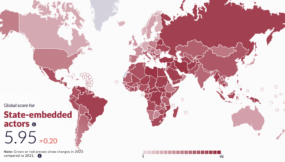
The presence of criminal actors has grown steadily since 2021. Foreign actors remain the most concerning actor type, recording the largest overall increase since 2021. These groups are increasingly heterogeneous, multi-ethnic and interconnected. Private-sector actors also play a pivotal role in laundering illicit funds, while state-embedded actors, though less pervasive than elsewhere, are implicated in facilitating criminal activity in some contexts.
Europe’s resilience strengths lie in international cooperation, national policies and laws, and territorial integrity. However, government transparency and accountability consistently rank lowest among resilience indicators. Anti-money laundering and economic regulatory capacity also remain areas of concern.
While Europe demonstrates relatively strong resilience overall, certain criminal markets and actors are expanding. The findings underscore the need for more effective and tailored response mechanisms as organized crime continues to adapt across the continent.