Posted on 28 Aug 2026
Over the last year and a half, several of the world’s most recognizable criminal organizations have spread across borders faster than governments have been able to respond. Venezuela’s Tren de Aragua has cells in Colombia, Peru and Chile, while Mexico’s Jalisco New Generation Cartel (CJNG) has contacts as far afield as Australia, China and South East Asia. Brazil’s Primeiro Comando da Capital (PCC) has strengthened its ties with European criminal groups, with about a thousand members operating in Portugal. INTERPOL now tracks Italy’s ‘Ndrangheta in more than 84 countries.
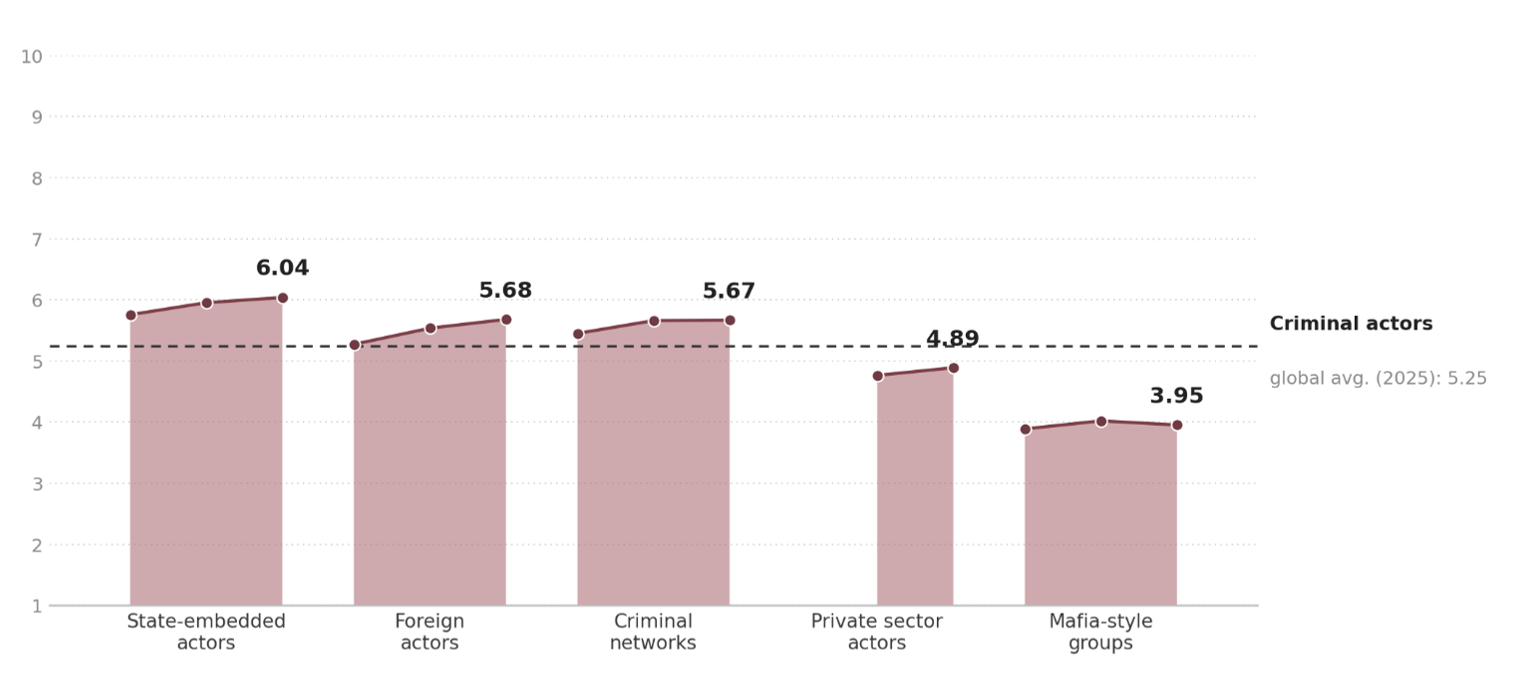
The Global Organized Crime Index reflects this trend – but in a somewhat unexpected way. The Index’s most significant finding in this area is that foreign actors registered the sharpest increase of all actor types, reaching a score of 5.68 in 2025 (see the graph). By contrast, the average for global mafia-style groups has barely changed since 2023, rising from 3.89 to 4.02 before falling again to 3.95. They remain the least pervasive of the five categories of criminal actor.
This may seem counterintuitive. Given that the cartels and mafias that dominate the headlines are, by definition, mafia-style groups, one might expect this category to be rising most rapidly. The reason, however, lies in how the Index classifies criminal actors.
As a general rule, a mafia-style group – an organization with a name, leadership structure, territorial presence and identifiable membership – is categorized as such only in its home country. When operating abroad, it is counted as a foreign actor. As the Index measures organized crime by country, the same organization may be recorded as a mafia-style group at home but as a foreign actor elsewhere.
Mafia-style scores can, of course, increase domestically. For instance, Ecuador’s score in this category rose from 6.5 in 2021 to 8.5 in 2025, reflecting the influence of such actors. In this case, however, the increase is confined to a single country. When a criminal organization transcends borders, it can affect foreign actor scores in several countries at once. The following five groups, spanning five continents, are among the most visible examples of this pattern.
The Tren de Aragua cartel is categorized as a mafia-style group in Venezuela, contributing to the country’s score of 9.5 for that indicator. The organization established footholds across South America following the Venezuelan migration crisis, with its expansion accelerating after a raid in 2023 dispersed parts of its leadership into pre-existing cells. The impact is conspicuous in the region’s foreign actors scores: Chile and Peru each rose from 5.0 to 6.5, while Bolivia’s score increased by one point to 5.5. Colombia and Ecuador are among the countries with the highest scores in this category, at 7.5 and 8.0, respectively.
Brazil’s score of 8.0 for mafia-style groups is driven in large part by the PCC. However, the group’s activities extend well beyond national borders. In Paraguay, for instance, it has gained significant control over parts of the prison system, and is recognized as one of the most dominant foreign actors. Paraguay’s foreign actors score of 9.0 – the highest recorded in the 2025 Index – reflects this prominence. The increase in Uruguay’s foreign actors score, from 2.5 in 2023 to 4.0 in 2025, is also linked to the PCC. The group also has a footprint in Africa and Europe, attributable to cocaine trafficking routes that cross the Atlantic through West Africa.
The PCC also sits at the centre of a broader criminal alliance linking Colombian cocaine suppliers, including the Clan del Golfo (one of the largest cocaine exporters in the hemisphere), to Italian and Balkan buyers. It relies on Chinese networks for synthetic-drug precursors and for laundering illicit proceeds. The group has struck logistics deals with Tren de Aragua.
The ‘Ndrangheta, widely considered the wealthiest and most powerful mafia group in the world, is largely responsible for Italy’s near-maximum score of 9.0 in this category. Yet much of its influence is exported. As a leading wholesale player in the European cocaine market, the group has established a major presence in key North Sea ports – a fact reflected in the foreign actors scores of countries central to Europe’s cocaine supply chain. The Netherlands, home to Rotterdam, saw its foreign actors score rise from 4.5 in 2021 to 7.0 in 2025, while Belgium and Germany, with major ports Antwerp and Hamburg, increased to 6.0 and 7.5, respectively. These shifts align with the ‘Ndrangheta’s trafficking pipeline, which links Latin American brokers, PCC logistics networks and Albanian-speaking partners to Europe’s ports, often through West Africa. The group has also established permanent footholds in Latin America, Canada and the United States.
The Sinaloa Cartel and the CJNG add another layer of complexity. In 2025, Mexico recorded a mafia-style groups score of 9.0, to which both groups are major contributors. Their clearest growth, however, is occurring further afield.
Over the past decade, the Sinaloa Cartel and the CJNG have expanded into Europe, Africa and the Asia-Pacific region. While they remain heavily involved in cocaine trafficking, their international expansion is tied to synthetic drugs, with precursor chemicals predominantly sourced through Chinese and Indian networks. Working with local criminal actors, they have also set up methamphetamine production facilities in parts of Europe, Asia and Africa. Mexican cartels have become major suppliers of this drug in Australia and New Zealand, a development reflected in New Zealand’s foreign actors score, which rose from 3.5 in 2021 to 5.0 in 2025. Their increasing use of Pacific Island staging posts, including Fiji and Papua New Guinea, has also raised concerns that these transit countries may themselves become consumer markets, resulting in higher levels of organized crime and violence.
Kompania Bello perhaps offers the clearest illustration of how cross-border criminal activity is captured in the foreign actors category. This cocaine syndicate, comprising 14 criminal clans, was an Albanian organization on paper. Yet Albania’s mafia-style groups score declined over the three iterations of the Index, falling from 7.0 to 6.5. This is because Kompania Bello was not run from Albania, but from a prison in Ecuador. There, the group’s kingpin conducted negotiations directly with South American suppliers, while cocaine was moved from Antwerp and Rotterdam by group cells in the Netherlands, Belgium and Italy.
Kompania Bello never worked alone. It relied on partnerships with Ecuadorian brokers, Colombian and Mexican cartels and a Chinese underground banking system, creating a network of four nationalities operating in one illicit market. The group’s activities were therefore reflected in foreign actors scores in countries like Ecuador (8.0) and European hubs such as the Netherlands (7.0) and Spain (7.5).
The most effective enforcement operations have generally mirrored the cross-border nature of the groups they target. Kompania Bello was dismantled in 2020 as part of Operation Los Blancos, a five-year investigation spanning 10 countries led by Europol and Eurojust. The organization’s leader was arrested in Istanbul in late 2023 and extradited to Albania. In 2025, the man regarded as the ‘Ndrangheta’s ‘top boss’ in Latin America was apprehended in Bogotá during Interpol’s I-CAN project, which has resulted in the arrest of over 60 members of the group worldwide.
This kind of response, however, appears to be stalling. International cooperation is generally the most robust of the Index’s 12 resilience indicators, yet in 2025 it barely increased, seeing the smallest gain since the first global Index in 2021. This reflects an increasingly fractured international system and a retreat from multilateralism. At a time when organized criminal networks are becoming more internationally connected, a decline in collaborative action risks undermining one of the few approaches that has consistently produced results.
This analysis is part of the GI-TOC’s series of articles delving into the results of the Global Organized Crime Index. The series explores the Index’s findings and their effects on policymaking, anti-organized crime measures and analyses from a thematic or regional perspective.