Posted on 18 Nov 2026
A resounding vote by state parties to the UN Convention against Transnational Organized Crime (UNTOC) in favour of negotiating an ambitious protocol on environmental crimes is a milestone that should be welcomed. However, reaching agreement on a final text will be far more challenging, especially given friction over its broad scope and the ambivalence or outright opposition of major powers.
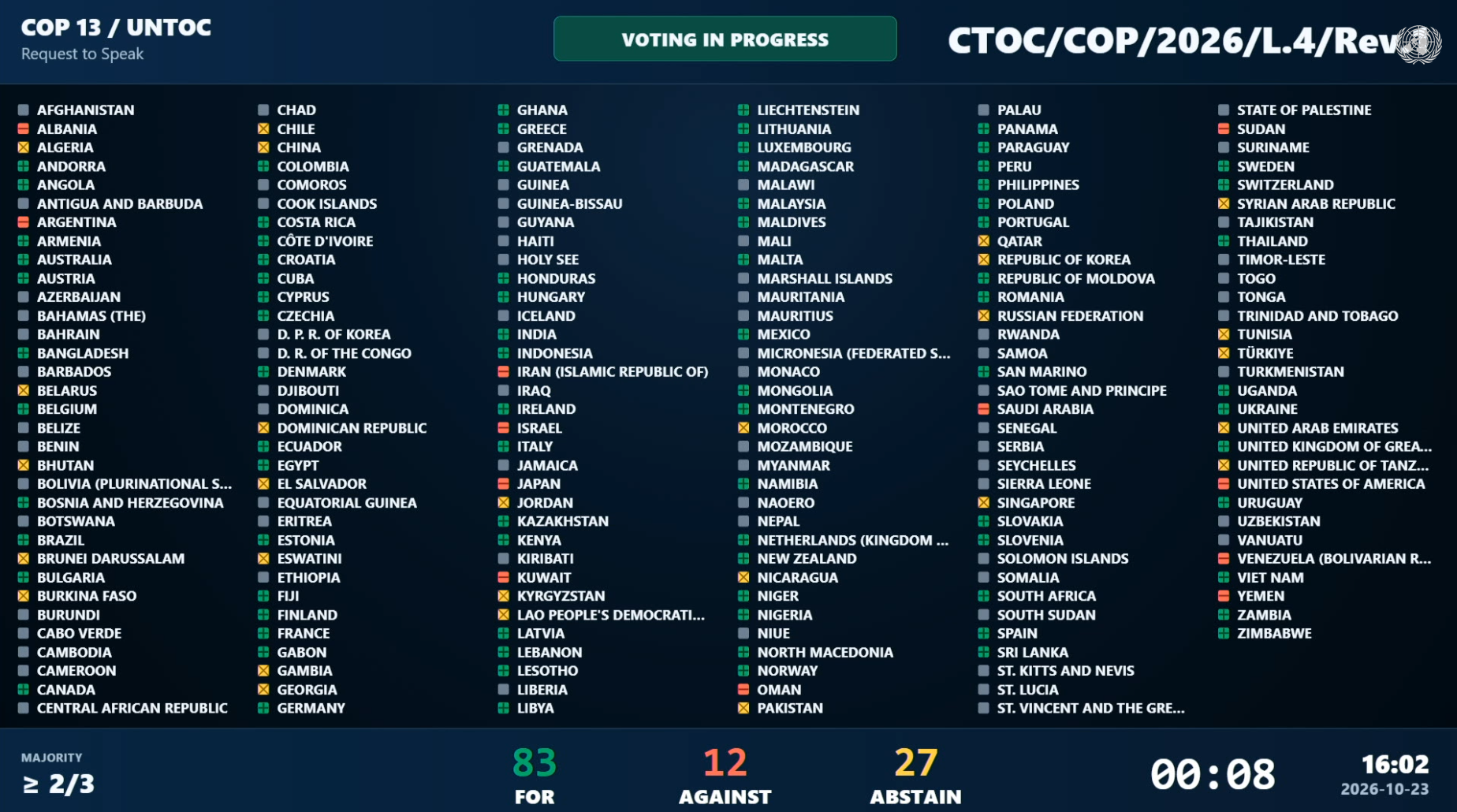
The resolution to establish an ad hoc committee to draft an environmental crimes protocol was adopted at the 13th session of UNTOC’s Conference of the Parties (COP) in Vienna on 23 October, by an impressive margin of 83 votes in favour and only 12 against, with 27 abstentions.
The goal is to negotiate the protocol across four committee sessions – each lasting no more than 10 days – in time for the next COP, which is scheduled for October 2028. If it comes to fruition, the new protocol will be the UNTOC’s first in more than two decades and its fourth overall, adding to existing protocols on human trafficking, firearms trafficking and migrant smuggling.
The proposed environmental crimes protocol aims to address a wide range of illicit activities, such as the exploitation of flora and fauna (including timber and timber products), the illegal mining and trafficking of minerals and precious metals, and waste trafficking.
Brazil tabled the resolution, which was backed by a diverse coalition of governments and civil society organizations. These groups have long lobbied for a transnational legal and enforcement architecture that can better respond to the worsening ecological and security threat posed by environmental crimes.
Overall, however, the generally positive response masks resistance from some of the UN’s most powerful member states, most notably outright opposition from the US, Japan and Saudi Arabia. China and Russia abstained, while participation from many key regions was patchy. (It is likely for this reason, too, that the UN Office on Drugs and Crime remained neutral on the issue, neither clearly supporting nor opposing the protocol.)
The US position had become increasingly clear in recent months, making its final stance no great surprise. Russia had previously been in favour of a wildlife trafficking focused protocol, but its backing fell away in light of the resolution’s broader mandate.
Encouragingly, support among European and other Western countries solidified when the time came to vote, with EU member states unanimously in favour. Australia, Canada and New Zealand, which had previously expressed scepticism about the need for a new protocol, also voted for, with the strong engagement of Indigenous communities highlighted as an influential factor.
Most Latin American countries, led prominently by Brazil and Peru, also voted in favour (with Argentina and Venezuela the only countries in the region to vote against). Chile, El Salvador, Nicaragua and the Dominican Republic abstained.
In Africa, only Sudan voted against, although the significant abstentions and non-attendance will be a cause for concern for the negotiations, despite strong endorsements by South Africa and Egypt.
South, South East and East Asian countries gave the resolution a mixed reception. India, Indonesia, Malaysia, Mongolia, Thailand, Sri Lanka and Bangladesh voted in favour, while Bhutan, Brunei, Laos, Pakistan, Singapore and South Korea all abstained.
Only Cuba and the Dominican Republic took part in the sessions among Caribbean nations, and no Pacific countries participated in the vote. Given the particular vulnerabilities faced by regions such as these, their presence at the negotiating table will need to be more comprehensive than at COP13. That goal may be constrained by the ad hoc committee sitting in Vienna rather than Geneva or New York, where more small countries have permanent missions. This places an onus on the international community, whether the UN or those member states supporting the process, to facilitate and support attendance by countries from those regions.
Protecting the broad scope
The inclusion of illegal mining and minerals trafficking in the scope of the negotiations is genuinely innovative, and retaining these issues in the final protocol should be a priority. Illegal mining and the illicit trade in minerals and metals are highly lucrative forms of transnational organized crime, from gold and other precious metals to critical minerals such as coltan and the rare earth elements needed for the energy transition. Illicit activities in this sector finance criminal groups, drive corruption, and cause lasting environmental and human harm. In addition, these commodities often move through the same networks and ports as weapons and drugs.
Opaque mineral markets also allow criminals to infiltrate formal global markets. The race to secure supplies of critical minerals risks putting access ahead of transparency and responsibly sourced minerals, making the trade even more accessible and attractive to criminal actors.
Retaining a focus on these matters will ensure that the UNTOC is better equipped to address these interconnected forms of organized crime. However, in the absence of previously agreed definitions, reaching consensus in this area will be particularly challenging. Once negotiations begin, there is a risk that the scope of the proposed protocol will be narrowed, thereby limiting its impact.
Civil society input crucial to success
Civil society expertise and activity in responding to environmental crime is arguably greater than in any other sector of the organized crime debate (with the possible exception of human trafficking). It is no surprise, then, that civil society engagement was key to securing support for the establishment of an ad hoc committee. Diverse groups, including community representatives and Indigenous leaders, contributed expertise, experience and evidence over several years, including during closed sessions.
Furthermore, the ad hoc committee will operate under the COP’s procedural rules, meaning civil society observers will be invited to participate in negotiation sessions. This provides a crucial opportunity for engagement, which both civil society and member states should make the most of. While civil society groups will not always share the same views, they bring frontline perspectives that will be critical to shaping an effective response to environmental crimes.
One blind spot so far has been the lack of input from the private sector, which generally does not engage in UNTOC discussions. Yet the protocol could have significant implications for business through future criminalization, reporting and due diligence requirements once it enters into force and is incorporated into national statute books. Constructive participation will be crucial as negotiations move forward.
Consensus on a protocol in time for COP14 is ambitious, especially given the need to ensure meaningful participation by vulnerable states, civil society and the private sector. COP13 also took the important step of launching a reform process for the UNTOC review mechanism, whose shortcomings are now widely recognized and whose reform will be critical to the success of any future protocol.
Strengthening oversight and implementation arrangements must therefore go hand in hand with efforts to develop a robust new instrument. COP13 has created a rare window of opportunity to advance the international response to organized crime, and environmental crimes in particular.