Coordinated attacks in Mali shift territorial control and realign illicit economies
Posted on 08 May 2026
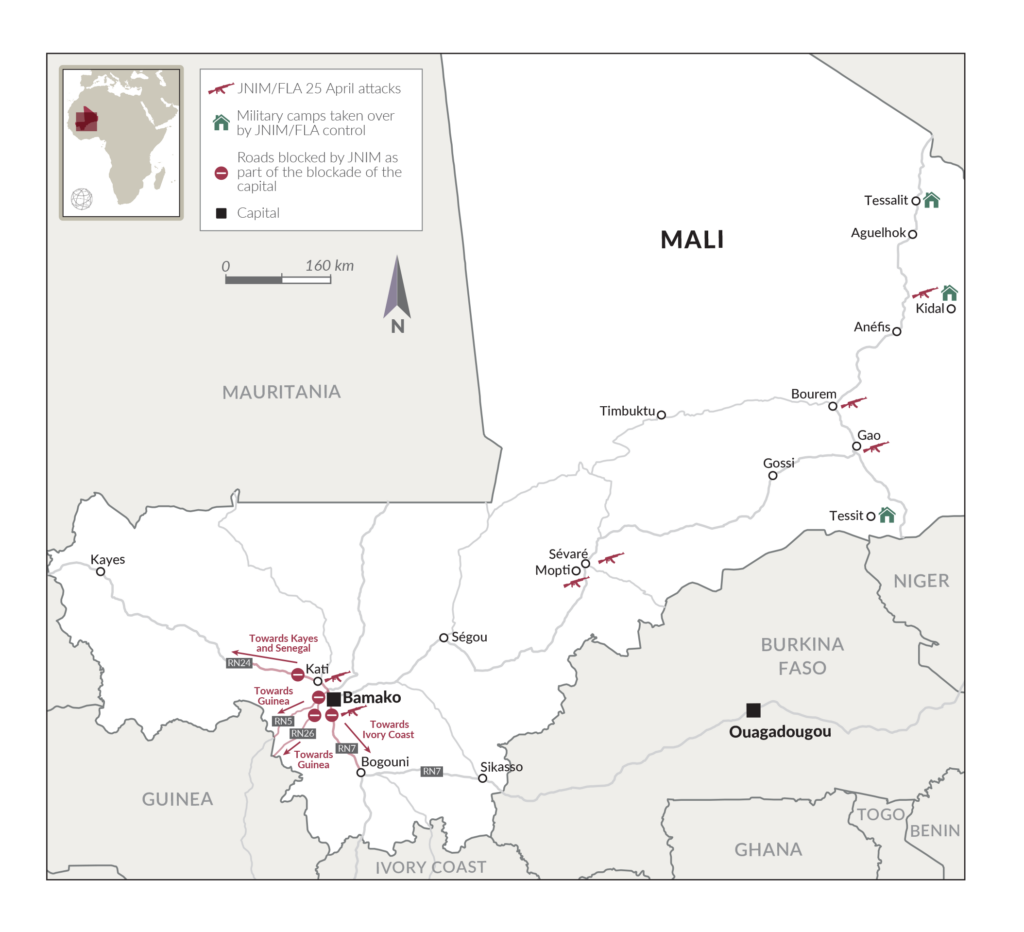
In the early hours of 25 April, Mali experienced arguably its most consequential security shock since 2012, when an offensive in the north sparked the 14 years of conflict that have since engulfed the country. In a series of coordinated attacks, several locations were struck simultaneously by the separatist Azawad Liberation Front (FLA) and the violent extremist group Jama’at Nusrat al-Islam wal-Muslimin (JNIM), including Kidal and Gao in the north, Sévaré and Mopti in the centre, the capital of Bamako, and the adjacent army stronghold of Kati in the south.
The attacks in Bamako and Kati were largely repelled, with the Malian armed forces (FAMa) and Russia’s Africa Corps holding key installations, including the airport. But the state suffered important casualties, including the death of the defence minister. On 28 April, JNIM announced a blockade on Bamako, and has since continued to disrupt entry and exit routes into the capital, leaving hundreds of vehicles stranded.
In the north, the outcome was more decisive. The FLA and JNIM took Kidal on 25 April, and moved into other towns and military camps, including Tessalit and Tessit, in the following days. The takeover was carried out with limited fighting: FAMa and Africa Corps either negotiated surrender or left the towns and camps before the arrival of JNIM and the FLA. The group now claims to control 80% of the Kidal region.
Overview of April attacks, territorial control shifts and road blockages in Mali.
These attacks should be read as part of JNIM’s efforts to put pressure on the government in Bamako, with the now explicit goal of bringing it down. The group increasingly appears to be positioning itself not only as an insurgent force but as a political actor seeking to shape the future state order. Within this rapidly changing security landscape, two key questions emerge: how will these developments affect the lucrative illicit economies in northern Mali and the financing of violent extremist groups? And what impact will they have on the future role of Africa Corps?
Northern Mali’s smuggling corridors: A return to the previous order?
Since the attacks, FAMa and Africa Corps have communicated extensively, presenting the image of an active response. They claim to have carried out several airstrikes in retaliation, killing hundreds of fighters, and continue to conduct patrols. And while they probably lack the resources to launch a counter-offensive and retake the military camps and towns in Kidal for now, they are making it clear that this is not the end of the story.
FAMa has stated that the army is reorganizing to reconquer lost ground, and that reinforcements are being sent to Anéfis, one of the force’s last remaining camps in the north. The landing of a Russian military aircraft in Bamako on 6 May, carrying materiel and personnel, suggests that Moscow is not stepping back either. However, if the FLA and JNIM retain their influence over the region, previously prominent illicit arrangements could re-emerge, benefiting both groups.
Before the August 2023 offensive by FAMa and the Wagner Group, Kidal had experienced limited violence and offered a stable environment for illicit economies. JNIM and the FLA predecessor groups (including the Cadre Stratégique Permanent (CSP), a coalition of rebel and pro-government armed groups from northern Mali) maintained informal agreements and taxation systems over trafficking routes used to move migrants, fuel, foodstuffs, cannabis resin and cocaine. They also controlled or taxed artisanal gold-mining activities and used the mines as resource and trading hubs. Key roads and economic hubs in Kidal, Timbuktu and Gao were divided between groups in ways that served everyone’s economic interests, and together they formed a significant breadbasket.
The resurgence of conflict in the north in 2023 disrupted these arrangements, due to high levels of violence and insecurity along key corridors. Some major hotspots, such as former arms and drug hubs like Tabankort and Ber, saw business collapse.
The FLA’s return to Kidal means strengthening the Tuareg networks that have historically connected the region to northern Niger and Libya, and could enable a resurgence of previously active trafficking routes. This would likely provide northern Mali with a better connection to the growing movement of arms from the Sudanese conflict, feeding demand across the region.
If the FLA and JNIM stabilize their positions in the north, they will need to secure ongoing financing and resources – and for this, they are likely to once again rely on artisanal mining. The N’Tahaka mine, the largest in the region, and the many smaller sites across Kidal are likely to be prioritized. Control of this sector serves a triple function. Revenue is gained through the taxation of miners and traders and, as gold spot prices soar, this financing stream seems set to grow (with any shocks to the Mali–Dubai gold supply chains resulting from the Iran conflict likely to be temporary).
Governance of these sites through access regulation and protection also provides an opportunity to build legitimacy with communities, many of whom rely on artisanal mining for their livelihoods. Before 2023, JNIM and the CSP gained significant local buy-in through their control of N’Tahaka, framing it as security provision rather than predation.
Mining areas also function as resourcing hubs, where goods, people, arms and cash circulate. This makes them central to the logistical strategy of any armed group seeking to sustain a long-term campaign. Although JNIM has consistently secured a share of revenues from N’Tahaka, even during periods of dominance by pro-government forces, with the FLA as a close ally they may now be able to negotiate better terms.
Cocaine trafficking: The future of Bamako and Africa Corps
The reestablishment of FLA and JNIM influence over Kidal may gradually enable their affiliated networks to move larger quantities of cocaine, thus reversing the trend of small-volume trafficking observed since 2023, which arose due to instability and a lack of trust between the main armed groups.
However, the sheer profitability of the cocaine economy means protection is more closely linked to power in the capital than in borderland areas like Kidal. For example, while the August 2023 offensive in northern Mali caused some disruption to the trade, Niger’s 2023 coup had a far more lasting impact, as it disrupted the centralized protection infrastructure on which trafficking networks depend. It is this kind of political shock, rather than shifts in territorial control in the north, that poses the greater threat to the market.
Developments in Bamako will therefore prove more important in shaping the cocaine trade than power-sharing in the north. Crucial nodes in the protection ecosystem have been damaged with the death or injury of notable junta leaders, including within the national intelligence services, an institution central in the protection of this illicit economy for decades. Moreover, the volatility of the current situation makes new deals difficult and movement riskier in the short term. But whatever happens next in the capital, trafficking will not be permanently disrupted. The handful of major drug lords at the centre of Mali’s cocaine ecosystem have been operating since the early 2000s, surviving coups, political upheaval and the emergence of new armed groups. They are not ideologically driven and have no lasting allegiance.
What next for the regime?
Meanwhile, the future of the military regime remains unclear. JNIM continues to pursue its downfall, as emphasized in their 30 April communiqué, in which they called on political parties, the armed forces, religious authorities and traditional chiefs to unite to take down the ‘terrorist junta’ and join them in establishing a peaceful transition.
Recognizing the critical role of Africa Corps in the regime’s survival, JNIM and the FLA have sought to drive a wedge between the allies. Both have directly addressed Russia, urging it to stay out of the conflict. However, as Assimi Goïta, the leader of Mali’s military government, signalled by hosting a Russian delegation during his first public reappearance after a conspicuous four-day absence, there are no indications that Russia is planning to leave the country. Instead, Africa Corps has stated that it is fighting alongside FAMa, and that Russia’s commitment to Mali remains unchanged.
As the dust settles on April’s attacks, the future of powerholders in Bamako and elsewhere remains uncertain. While JNIM continues to exert significant pressure on key trading routes, illicit economies in the north are likely to gradually revert to established patterns. Ultimately, however, the fate of the capital will determine which actors shape Mali’s cocaine trafficking landscape.
Choc sécuritaire au Sahel
Des attaques coordonnées au Mali redessinent le contrôle territorial et réalignent les économies illicites
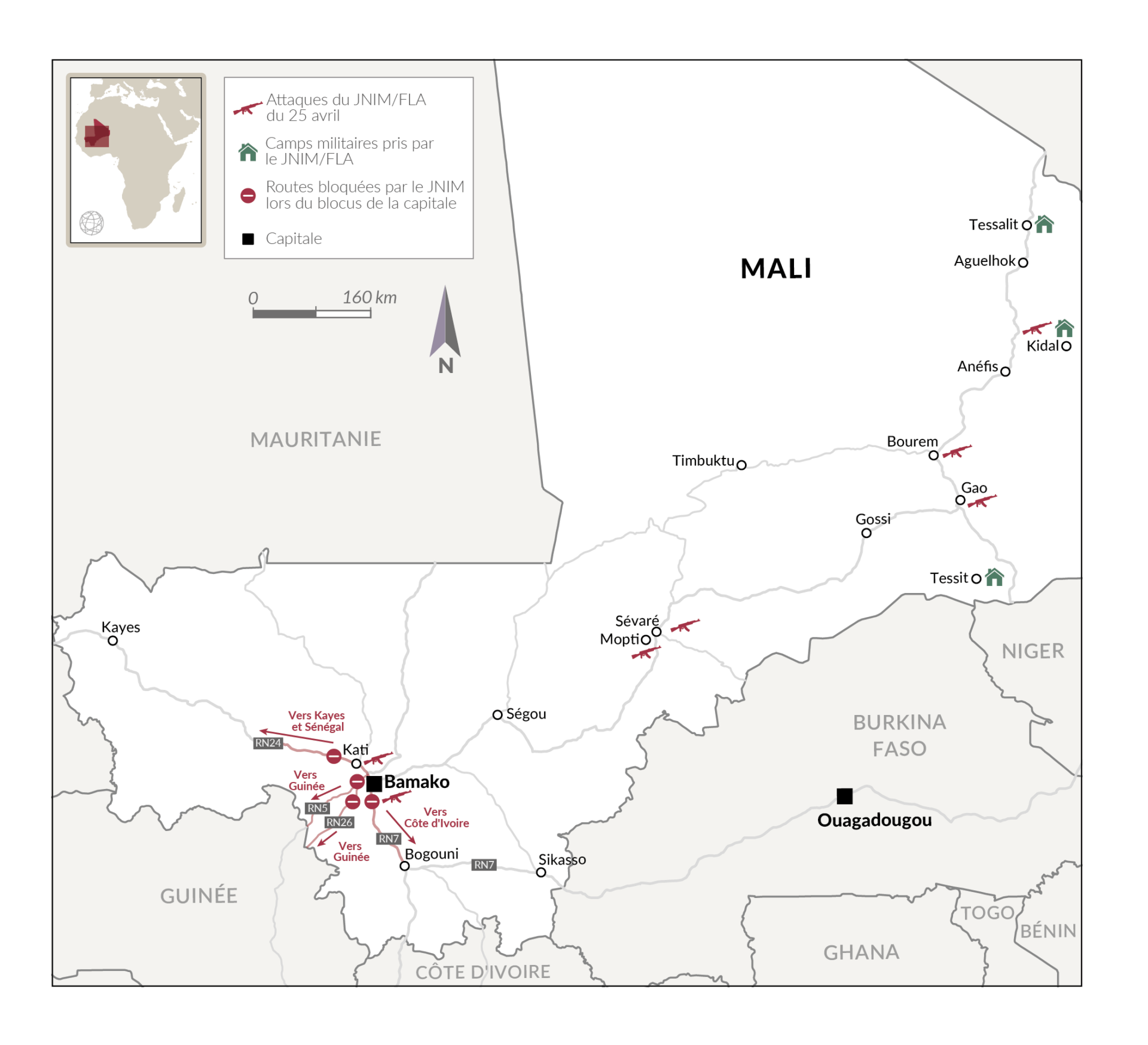
Au petit matin du 25 avril 2026, le Mali a connu ce que l’on peut considérer comme le choc sécuritaire le plus marquant depuis 2012, année où une offensive dans le nord a déclenché les quatorze années de conflit dans lesquelles le pays reste plongé. Une série d’attaques coordonnées a frappé simultanément plusieurs sites stratégiques : le Front de libération de l’Azawad (FLA), de tendance séparatiste, et le groupe extrémiste violent Jama’at Nusrat al-Islam wal-Muslimin (JNIM) ont visé Kidal et Gao au nord, Sévaré et Mopti au centre, ainsi que la capitale Bamako et la garnison voisine de Kati au sud.
Les assauts sur Bamako et Kati ont été en grande partie repoussés. Les Forces armées maliennes (FAMa), épaulées par l’Africa Corps russe, ont conservé le contrôle des installations clés, dont l’aéroport. Toutefois, l’État a subi des pertes importantes, parmi lesquelles la mort du ministre de la Défense. Le 28 avril, le JNIM a annoncé un blocus de Bamako et continue depuis de perturber les voies d’entrée et de sortie de la capitale, immobilisant des centaines de véhicules.
Dans le nord, le rapport de forces a basculé bien plus nettement. Le FLA et le JNIM se sont emparés de Kidal le 25 avril, puis ont pris dans les jours suivants d’autres localités et camps militaires, notamment Tessalit et Tessit. Cette prise s’est faite avec peu de combats : les FAMa et l’Africa Corps ont soit négocié leur reddition, soit évacué les sites avant l’arrivée des assaillants. Le FLA revendique désormais le contrôle de 80 % de la région de Kidal.
Aperçu des attaques en avril, des évolutions du contrôle territorial et des barrages routiers au Mali.
Ces attaques doivent être lues comme un volet de la stratégie du JNIM visant à accentuer la pression sur le gouvernement de Bamako, avec pour objectif désormais affiché de le faire tomber. Le groupe tend de plus en plus à se poser non seulement en force insurrectionnelle, mais aussi en acteur politique aspirant à façonner l’ordre étatique de demain. Dans ce paysage sécuritaire en pleine recomposition, deux questions essentielles se dégagent : comment ces évolutions pèseront-elles sur les économies illicites lucratives du nord du Mali et sur le financement des groupes extrémistes violents ? Et quelles incidences auront-elles sur le rôle futur de l’Africa Corps ?
Les corridors de contrebande du nord : un retour à l’ordre ancien ?
Depuis les attaques, les FAMa et l’Africa Corps communiquent abondamment, soucieux de projeter l’image d’une riposte vigoureuse. Ils affirment avoir mené plusieurs frappes aériennes en représailles, qui auraient neutralisé des centaines de combattants, et poursuivent leurs opérations de patrouille. S’ils n’ont sans doute pas, à ce stade, les moyens de lancer une contre-offensive pour reprendre les camps militaires et les villes de la région de Kidal, ils tiennent à faire comprendre que le dernier mot n’a pas été dit.
Des renforts ont été dépêchés à Anéfis, l’un des derniers bastions de l’armée dans le nord, et l’atterrissage à Bamako, le 6 mai, d’un avion militaire russe transportant matériel et personnel laisse entendre que Moscou n’entend pas non plus se désengager.Si le FLA et le JNIM parviennent à asseoir durablement leur emprise sur le nord, certains arrangements illicites pourraient refaire surface, au profit des deux groupes.
Avant l’offensive d’août 2023 conduite par les FAMa et le groupe Wagner (prédecesseur de Africa Corps), Kidal connaissait un niveau de violence limité et constituait un environnement propice aux économies illicites. Le JNIM et les formations dont est issu le FLA – dont le Cadre stratégique permanent (CSP), coalition de groupes armés rebelles et progouvernementaux – entretenaient des accords informels et des dispositifs de taxation sur les routes servant au trafic de migrants, de carburant, de denrées alimentaires, de résine de cannabis et de cocaïne. Ils contrôlaient ou taxaient également l’orpaillage artisanal et se servaient des sites d’orpaillages comme de plateformes de ressources et d’échanges.Les axes routiers et pôles économiques clés des régions de Kidal, Tombouctou et Gao étaient répartis entre les groupes selon une logique qui servait les intérêts économiques de chacun.
La reprise du conflit dans le nord en 2023 avait déstabilisé ces arrangements, en raison des niveaux élevés de violence et d’insécurité le long des corridors stratégiques. Certaines villes clefs, comme Tabankort ou Ber, autrefois plaques tournantes du trafic d’armes et de drogues, ont vu leur activité s’effondrer.
Le retour du FLA à Kidal peut mener au renforcement des réseaux touaregs qui relient historiquement le nord du Mali au nord du Niger et à la Libye, et pourrait redynamiser des routes de trafic. Le nord du Mali se trouverait alors mieux raccordé aux flux croissants d’armes issus du conflit soudanais, qui alimentent la demande dans toute la région.
Si le FLA et le JNIM stabilisent leurs positions dans le nord, il leur faudra s’assurer un financement et des ressources sur la durée – et pour cela, ils s’appuieront probablement à nouveau sur l’orpaillage artisanal. La mine de N’Tahaka, la plus importante du nord du Mali, ainsi que de nombreux sites plus petits à travers la région de Kidal, seront vraisemblablement prioritaires. Le contrôle de l’orpaillage artisanal remplit une triple fonction. Des revenus sont tirés de la taxation des mineurs et des négociants et, à mesure que le cours au comptant de l’or s’envole, cette source de financement semble appelée à croître (les éventuelles secousses subies par les chaînes d’approvisionnement en or entre le Mali et Dubaï du fait du conflit iranien devraient n’être que passagères).
La gouvernance de ces sites, par la régulation des accès et l’offre de protection, constitue également un moyen de se forger une légitimité auprès des communautés, dont beaucoup vivent de l’orpaillage artisanal. Avant 2023, le JNIM et le CSP avaient ainsi obtenu une adhésion locale significative grâce à leur contrôle de N’Tahaka, en présentant leur action comme une fourniture de sécurité plutôt que comme de la prédation.
Les zones minières font également office de plateformes de ressources, où circulent marchandises, personnes, armes et liquidités. Cela en fait des éléments centraux de la stratégie logistique de tout groupe armé cherchant à inscrire son action dans la durée. Bien que le JNIM ait constamment obtenu une part des revenus de N’Tahaka, y compris dans les périodes de domination des forces progouvernementales, son alliance étroite avec le FLA pourrait désormais lui permettre de négocier des conditions plus avantageuses.
Trafic de cocaïne : l’avenir de Bamako et de l’Africa Corps
Le rétablissement de l’influence du FLA et du JNIM sur la région de Kidal pourrait progressivement permettre à leurs réseaux affiliés d’acheminer de plus grandes quantités de cocaïne. Cela inverserait la tendance au trafic de petits volumes observée depuis 2023, conséquence de l’instabilité et du manque de confiance entre les principaux groupes armés opérant le long du corridor stratégique.
Cependant, la rentabilité considérable du trafic de cocaïne fait que sa protection tient bien davantage au pouvoir exercé à la capitale qu’au contrôle de zones périphériques comme Kidal. Si l’offensive d’août 2023 dans le nord a quelque peu perturbé ce trafic, le coup d’État au Niger la même année a eu une incidence bien plus durable, en désorganisant l’infrastructure centralisée de protection dont dépendent les réseaux trafiquants. C’est ce type de choc politique, et non les recompositions territoriales du nord, qui influence le trafic de cocaine dans la région.
Les évolutions à Bamako pèseront donc plus lourdement sur l’avenir du trafic que les recompositions ue pouvoir dans le nord. Des maillons essentiels du dispositif de protection du trafic de cocaine ont été ébranlés par la mort ou les blessures de figures de premier plan de la junte, notamment au sein des services de renseignement, institution qui joue depuis des décennies un rôle central dans la protection de cette économie illicite. De plus, il est clair qu’à court terme la volatilité de la situation rend la conclusion d’accords et l’organisation de convoi plus risqués. Par contre, à long terme, et quoi qu’il advienne dans la capitale, il est peu probable que le trafic ne soit pas durablement perturbé. La poignée de barons de la drogue au cœur de l’écosystème malien de la cocaïne opère depuis le début des années 2000 et a survécu à de multiples coups d’État, bouleversements politiques et émergences de nouveaux groupes armés. Ils ne sont pas mus par une idéologie et n’ont d’allégeance durable envers personne.
Quel avenir pour le régime ?
L’avenir du régime militaire demeure incertain. Le JNIM poursuit son entreprise de déstabilisation, comme l’a souligné son communiqué du 30 avril, dans lequel il a appelé les partis politiques, les forces armées, les autorités religieuses et les chefs traditionnels à s’unir pour faire tomber ce qu’il qualifie de « junte terroriste » et à se joindre à lui pour établir une transition pacifique.
Conscients du rôle déterminant de l’Africa Corps dans la survie du régime, le JNIM et le FLA cherchent à diviser les deux alliés. Tous deux se sont adressés directement à la Russie, l’exhortant à rester en dehors du conflit. Pourtant, en recevant une délégation russe lors de sa première apparition publique après quatre jours d’absence remarquée, le chef du gouvernement militaire malien, Assimi Goïta, a clairement laissé entendre que rien ne laissait présager un désengagement russe. L’Africa Corps a au contraire affirmé combattre aux côtés des FAMa et soutenu que l’engagement de la Russie au Mali restait intact.
À mesure que la poussière retombe après les attaques de fin avril, l’avenir des détenteurs du pouvoir à Bamako et ailleurs reste en suspens. Si le JNIM continue de peser lourdement sur les principaux axes commerciaux autour de la capitale, les économies illicites du nord devraient progressivement renouer avec leurs équilibres antérieurs. S’agissant du trafic de cocaïne, c’est le sort de la capitale qui déterminera quels acteurs en dessineront les contours au Mali.