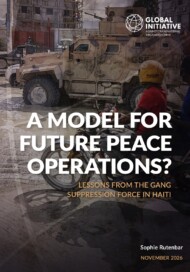
On 18 October 2026, four Salvadoran soldiers serving with the Gang Suppression Force (GSF) disappeared in gang-controlled territory in metropolitan Port-au-Prince while reportedly returning from an errand. At the time of writing, their fate remains unknown. The episode captures the predicament at the heart of this paper. More than a year after the UN Security Council authorized the force to neutralize Haiti’s gangs, criminal groups still control most of the territory in which that force operates, shaping and controlling daily life for a large share of the population. One in 10 Haitians is still internally displaced, and more than half the population face acute food insecurity. Elections, first planned for August 2026 and then for 13 December, have been pushed back to 18 July 2027 for the first round, with a run-off scheduled for 4 October 2027.
In this context, the GSF has become more than a security operation. While it is expected to push back the gangs, restore the presence of the state, make elections possible and open the way to social recovery, the force that exists today cannot yet carry that weight. Its mandate is narrow: to neutralize, isolate and deter gangs. Its strength is still partial, with just over 2 000 personnel deployed against an authorized complement of 5 500, and full operational capacity is not expected before December 2026 at the earliest.
The GSF architecture has no precedent. It is authorized by the UN, supported by a UN office (the UN Support Office in Haiti, UNSOH) and staffed in part by former UN personnel, yet it is not led by the UN. Strategic direction rests with a Standing Group of Partners, funding is spread across several mechanisms and the force’s legal status has had to be negotiated piece by piece. Building such a force from scratch takes time, but every month of delay gives criminal groups another month to observe it, test it and adapt. That adaptation is already under way while the force’s own operations generate responses it cannot always contain. In Gros Morne, gang members massacred around a dozen civilians only hours after a GSF operation killed three of their members.
The gap between what the GSF is expected to deliver and what it can deliver is therefore more than a problem of perception. It places the force under a dilemma: if it holds to its plan, it risks appearing absent when communities come under attack, as the calls for its deployment to Kenscoff in August made clear. If it answers every crisis, it disperses its limited capacity, drifts into areas it was not designed to hold, and delays the build-up on which its impact depends. Its decision to establish a base near Gros Morne after the massacre shows how quickly that second path can open.
Criminal groups have every incentive to exploit this, using violence against civilians as a lever to push the force towards static protection and to turn public frustration against it. The experience of the GSF’s predecessor, the Multinational Security Support Mission, shows that the gap will not close on its own. The GSF received a stronger mandate and greater capabilities precisely because its predecessor fell short, yet the promise of a more robust force has only raised expectations. For the GSF, managing expectations has become a condition of operational success. None of this is intended as an argument against the GSF. Parts of Haiti have deteriorated to such an extent that the country must be pulled back from the brink before durable change becomes possible, and no other instrument is currently available to do so. But a force designed to restore security cannot, on its own, sustain it. Its legacy will depend on what follows it: a national police force able to hold cleared ground, a justice and detention system able to process those arrested, a credible pathway for those who leave the gangs and funding that outlasts the current wave of international attention.
On each of these fronts, preparations lag well behind the force itself. This policy brief maps the institutional landscape in which the GSF operates and examines the four challenges that will shape its trajectory: how to coordinate a crowded, hybrid operational architecture; the logistics of building a multinational force without, but in parallel to, UN machinery; the gap between its mandate and the expectations placed upon it; and the tension between restoring security and maintaining it. It concludes with lessons for future operations of this kind, which, in a constrained multilateral system, are likely to become the default response to crises such as Haiti’s.
Un modèle pour les futures opérations de paix? Les enseignements de la force de répression des gans en Haïti
Le 18 octobre 2026, quatre soldats salvadoriens servant au sein de la Force de répression des gangs (FRG) ont disparu dans un territoire contrôlé par les gangs, dans la zone métropolitaine de Port-au-Prince, alors qu’ils rentraient, selon certaines informations, d’une course. Au moment de la rédaction de ce rapport, leur sort demeure inconnu. Cet épisode illustre la problématique au cœur de ce rapport. Plus d’un an après que le Conseil de sécurité de l’ONU a autorisé la Force à neutraliser les gangs haïtiens, des groupes criminels contrôlent toujours la majeure partie du territoire où elle opère, façonnant et régissant le quotidien d’une grande partie de la population. Un Haïtien sur dix demeure déplacé à l’intérieur du pays4, et plus de la moitié de la population est confrontée à une insécurité alimentaire aiguë. Les élections, d’abord prévues en août 2026 puis le 13 décembre, ont été repoussées au 18 juillet 2027, avec un second tour prévu le 4 octobre 2027.
Dans ce contexte, la FRG est devenue plus qu’une opération de sécurité. Alors qu’on attend d’elle qu’elle repousse les gangs, qu’elle rétablisse la présence de l’État, qu’elle rende possible la tenue d’élections et qu’elle ouvre la voie au relèvement social, la Force telle qu’elle existe aujourd’hui n’est pas encore en mesure d’assumer une telle charge. Son mandat est limité : neutraliser, isoler et dissuader les gangs. Ses effectifs restent incomplets, avec un peu plus de 2 000 membres du personnel déployés sur 5 500 autorisés, et sa pleine capacité opérationnelle n’est pas attendue avant décembre 2026 au plus tôt.
L’architecture de la FRG est inédite. Elle est autorisée par l’ONU, appuyée par un bureau de l’ONU (le Bureau d’appui des Nations Unies en Haïti, UNSOH) et en partie composée d’anciens membres du personnel de l’ONU, sans pour autant être dirigée par l’ONU. La direction stratégique relève du Groupe permanent de partenaires (GPP), le financement est réparti entre plusieurs mécanismes et le statut juridique de la Force a dû être négocié point par point. Construire une telle force à partir de zéro prend du temps, mais chaque mois de retard donne aux groupes criminels un mois de plus pour l’observer, la tester et s’adapter. Cette adaptation est déjà en cours, tandis que les opérations de la Force elle-même provoquent des ripostes qu’elle ne parvient pas toujours à contenir. À Gros Morne, des membres de gangs ont massacré une douzaine de civils quelques heures seulement après qu’une opération de la FRG a tué trois des leurs.
L’écart entre ce qui est attendu de la FRG et ce qu’elle est en mesure d’accomplir est donc plus qu’un simple problème de perception. Il place la Force face à un dilemme : si elle s’en tient à son plan, elle risque de paraître absente lorsque des communautés sont attaquées, comme les appels à son déploiement à Kenscoff en août l’ont bien montré. Si elle répond à chaque crise, elle disperse ses capacités limitées, dérive vers des zones qu’elle n’était pas censée tenir et retarde la montée en puissance dont dépend son efficacité. Sa décision d’établir une base près de Gros Morne après le massacre montre à quelle vitesse cette seconde voie peut s’ouvrir.
Les groupes criminels ont tout intérêt à exploiter cette situation, en utilisant la violence contre les civils comme levier pour pousser la Force vers une protection statique et retourner contre elle la frustration de la population. L’expérience du prédécesseur de la FRG, la Mission multinationale d’appui à la sécurité (MMAS), montre que l’écart ne se résorbera pas de lui-même. La FRG a reçu un mandat renforcé et des capacités accrues précisément car son prédécesseur n’avait pas été à la hauteur, mais la promesse d’une force plus robuste n’a fait qu’accroître les attentes. Pour la FRG, la gestion des attentes est devenue une condition du succès opérationnel.
Rien de tout cela ne se veut un argumentaire contre la FRG. Certaines parties d’Haïti se sont dégradées à un tel point que le pays doit être tiré du bord du gouffre avant qu’un changement durable devienne possible, et aucun autre instrument n’est actuellement disponible pour y parvenir. Mais une force conçue pour rétablir la sécurité ne peut, à elle seule, la maintenir. Son héritage dépendra de ce qui viendra après elle : une police nationale capable de tenir les zones reprises, un système judiciaire et de détention capable de traiter le cas des personnes arrêtées, une voie de sortie crédible pour ceux qui quittent les gangs et un financement qui dure au-delà de la vague actuelle d’attention internationale. Sur chacun de ces fronts, les préparatifs accusent un net retard par rapport à la Force elle-même. Ce rapport dresse un état des lieux du cadre institutionnel dans lequel la FRG opère et examine les quatre défis qui façonneront sa trajectoire : comment coordonner une architecture opérationnelle hybride et encombrée ; la logistique de la mise sur pied d’une force multinationale en dehors de l’appareil onusien, mais parallèlement à lui ; l’écart entre son mandat et les attentes qui pèsent sur elle ; et la tension entre rétablir la sécurité et la maintenir. Le rapport se conclut par des enseignements à tirer pour de futures opérations de ce type, qui, dans un système multilatéral sous contrainte, sont appelées à devenir la réponse par défaut à des crises telles que celle d’Haïti.