Posted on 19 Oct 2026
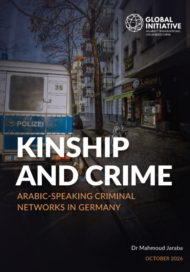
This report maps two interconnected fields of transnational crime linking Germany to the Middle East: long-established Mardin-origin clans and newer Syrian formations that gained visibility after 2015. It shows how kinship and regional ties enable collaboration across Germany, Türkiye, Lebanon and Syria. The report provides an overview of the phenomenon in Germany and is accompanied by two subsequent studies on drug markets and migrant smuggling involving Mardin-origin actors and Syrian organized crime networks.
The focus is not on entire communities or ethnic groups, but on specific actors and subgroups who use kinship and regional ties to organize criminal cooperation. The analysis does not seek to portray Arab groups or pockets of Arabic-speaking communities in Germany as criminal ethnic groups. Instead, it focuses on kinship structures and the principal criminal activities and networks rather than attributing criminality to ethnicity, nationality or language. The analysis rests on a simple premise: differentiation is not minimization, but is essential to effective, rights-based practice.
Two structurally distinct forms of transnational crime are examined: long-established Mardin-origin clans with roots in south-eastern Türkiye, and emerging Syrian criminal networks organized around kinship and regional ties. The report analyzes how these actors sustain and expand illicit operations across European and Middle Eastern contexts, drawing on strong internal cohesion, kinship-based trust and shared geographic identities. It provides an empirically grounded analysis of their operational dynamics, internal organization and transnational reach.
Over several decades, specific segments of Mardin-origin kinship networks in Germany have become associated with drug trafficking, fraud, property crime and informal value-transfer arrangements (systems for moving money or other assets outside formal financial channels). In this report, ‘Mardin-origin clans’ refers to kinship-based networks originating from Mardin Province in south-eastern Türkiye – particularly from the village of al-Rashidiya (Turkish: Üçkavak). These kinship groups are Arabic-speaking and shaped by overlapping – often contested – Arab and Kurdish identities.
More recently, certain Syrian formations have become associated with migrant smuggling, local drug retail, theft and regional support networks. For both the Mardin and Syrian actors, the key issue is the operational linkage between local activity in Germany, and partners and facilitators in Türkiye, Lebanon and Syria. Mardin-origin networks also operate elsewhere in Europe, particularly in Sweden, the Netherlands and Denmark, while links elsewhere in Europe are less clearly documented.
Public debate around these actors in Germany has been shaped by police reporting and criminal cases that have achieved a certain notoriety involving individuals publicly linked to Mardin-origin clan milieus. The theft of the ‘Big Maple Leaf’, a large gold coin, from Berlin’s Bode Museum in 2017 and the Green Vault burglary in Dresden in 2019 became emblematic examples. Together with drug trafficking, fraud, extortion and informal value-transfer arrangements, such cases fuelled a public and policing narrative around ‘Mardin-origin clans’ as highly adaptive criminal actors with local roots and transnational reach. That reach is apparent not only in Germany, but also in the operational links some actors maintain with Sweden, Türkiye, Lebanon and other parts of the Middle East. One example is call-centre fraud of the so-called ‘false police officer’ type (more of which below), in which operations targeting victims in Germany were, in certain instances, organized from Türkiye by actors connected to Mardin-origin networks. Such cases illustrate how these networks can extend beyond local criminal activity through cross-border family ties, logistical support and safe havens linking Germany to the Middle East.
The report addresses four core questions:
- What is meant by ‘clan’ in this study, and how does it operate in diasporic contexts – membership, authority, obligation, reciprocity and boundary-making?
- How can kinship structures and other social networks facilitate, shape or give rise to criminal activities?
- How are criminal activities organized and coordinated within and across these networks?
- What combinations of kinship and non-kin ties – online and offline – enable collaboration across Germany, Türkiye, Lebanon and Syria?
The report sets out the conceptual framework, kinship structures and cross-border networking patterns relevant to both the Mardin-origin and Syrian groups, and concludes with evidence-based recommendations for German and European stakeholders. The migrant-smuggling market study that follows will map facilitators, corridors and protection economies, with guidance for rights-compliant practice. The drug-trafficking market study will detail market organization, routes, money flows and leverage points for prevention and enforcement.
Key points
- Activities and markets: Primary activities include drug trafficking (cocaine, cannabis, Captagon), migrant smuggling and call-centre fraud. Value is frequently moved using hawala; laundering typically occurs through cash-based channels rather than the formal banking system.
- Mardin-origin trajectories: These actors are multigenerational and locally anchored in Berlin, North Rhine-Westphalia, Lower Saxony and Bremen. A younger cohort is increasingly involved in transactional, cross-ethnic networks.
- Syrian formations: More dispersed and adaptive, they operate through reconstituted clan structures and, in parallel, regional non-kin networks that enable rapid coordination and cross-border logistics.
- Tools and governance: Both fields rely on encrypted platforms and informal mediation (Friedensrichter) that can de-escalate disputes across borders but operate outside court processes. Social gatherings such as weddings and funerals function as hubs for information exchange and alliance-building.
- Framing: Public debate often summarizes these dynamics under the label ‘clan crime’. The evidence, however, points to specific segments and networks that engage in organized crime, not entire communities.