Posted on 16 Oct 2026
Environmental crime has become one of the fastest-growing forms of organized crime worldwide. Illegal mining and logging, wildlife trafficking, illegal fishing, and waste dumping generate enormous profits while causing lasting damage to ecosystems, livelihoods and social cohesion. In many regions, these activities are closely linked to corruption, violence, armed groups and weak governance, further undermining security and sustainable development. As environmental crime expands in scale and sophistication, it increasingly threatens not only biodiversity and climate stability, but also human health, food security and economic opportunities for present and future generations.
Addressing environmental crime requires coordinated action across government institutions, civil society and affected communities. While law enforcement and regulatory frameworks remain essential, there is growing recognition that enforcement alone cannot address the complex social, economic and governance conditions that allow environmental crime to flourish.
Over recent decades, approaches such as community-based natural resource management, participatory action research, community conservation, Indigenous territorial governance, and locally led development have demonstrated the value of engaging communities in the protection and governance of natural resources. In practice, these approaches have included community patrols and territorial monitoring, awareness-raising and education programmes, biodiversity protection and restoration, sustainable livelihood initiatives and co-management arrangements. While their design and results vary across contexts, they offer useful lessons for prevention-oriented responses to environmental crime, particularly by strengthening local stewardship, improving monitoring and early detection, and increasing community ownership over natural resources.
Despite this growing recognition, there remains limited practical guidance on how to engage communities in territories affected by environmental crime, criminal governance and violence. Working in these conditions presents specific challenges. Communities may be directly affected by environmental harm, dependent on activities linked to illicit economies, resistant to illicit activities, exposed to intimidation by criminal actors or even involved in illicit activities in different ways. They may also be operating in areas where state presence is limited and trust in institutions is low.
This is especially important because environmental crime is often embedded in local economic realities, power structures and territorial dynamics. Understanding these dynamics therefore requires working with the people who live alongside them and experience their effects directly. Practitioners face a fundamental question: how can they work with communities safely, ethically and effectively, while supporting their role in preventing and responding to environmental crime?
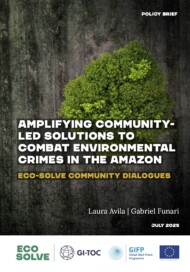
This handbook seeks to answer this question. Drawing on the experience of ECO-SOLVE, an EU-funded global programme that aims to strengthen responses to environmental crime, as well as broader lessons from community engagement, participatory approaches and feminist methodologies, this handbook provides practical guidance for designing and implementing community engagement processes in contexts affected by environmental crime.
Rather than presenting a single model to be replicated, the handbook offers tools, examples and reflections drawn from implementation experience, providing a foundation that practitioners can adapt to their own objectives, contexts and constraints.
Who is this handbook for?
This handbook is designed for practitioners seeking to integrate, strengthen or improve community engagement in efforts to prevent and respond to environmental crime. It is intended for civil society organizations, international NGOs, donor agencies, United Nations entities, government institutions and anyone designing or implementing community-level initiatives in affected territories.
It will be particularly useful for those seeking to understand how to engage with a specific community, facilitate dialogues, support community-led responses to environmental crime, or explore collaboration between communities and institutions.
The chapters that follow begin by examining why community engagement matters in the context of environmental and organized crime, as well as some of the challenges involved in putting it into practice. The second part of the handbook presents a practical toolkit, drawing on relevant approaches and principles, and incorporating examples from ECO-SOLVE’s experience, to support practitioners in designing engagement processes that are inclusive, context-sensitive and grounded in local realities. The final section explores possible actions that can emerge from community engagement and offers some reflections on strengthening future practice.