Posted on 15 Jan 2024
Illicit financial flows (IFFs) are a serious concern in the Mekong region, which includes Cambodia, Lao People’s Democratic Republic (PDR), Myanmar, Thailand and Vietnam. Facilitated by state-embedded actors, each year vast amounts of illicit proceeds are generated, moved and laundered across the region and beyond in offshore tax havens. This distorts the local economies; deprives the state of income needed for health, education and infrastructure; and deepens inequality.
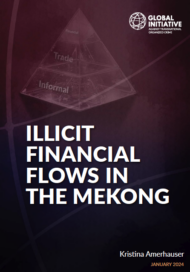
This paper is part of a comparative research project that tests and applies the IFFs pyramid, a new framework of analysis proposed by Tuesday Reitano, in the context of the Mekong region. Based on a review of secondary literature, it provides an overview of financial flows, trade flows and informality – the three main means by which IFFs are enabled, moved and held according to the IFFs pyramid – and discusses how IFFs manifest across the Mekong. It finds that:
- There is widespread evidence that each flow is significant in the Mekong and that flows converge and intersect. Nevertheless, current responses to IFFs almost entirely focus on the formal financial system.
- Porous borders and strong trade relationships, including with neighbouring China, offer abundant and diverse opportunities for trade-based money laundering (TBML). Lack of capacity to identify misclassified goods and low cross-border collaboration are the main impediments to its response.
- There are a large number of special economic zones (SEZs), some of which are treated as ‘lawless zones’ where national governments have no authority. This creates widespread opportunities for value to be extracted, under-reported and comingled with legitimate flows. They have also been linked to other illicit markets, such as drug trafficking, the illegal wildlife trade (IWT), human trafficking and financial crimes, and provide the space to generate and launder illicit proceeds in a multitude of ways.
- The large informal economy, coupled with the substantial number of people who remain outside the formal financial system, limits the efficiency of regulatory and oversight instruments.
- Political will to tackle IFFs in the Mekong appears to be limited, in large part due to the involvement of Chinese actors. In fact, some actors in charge of the response to IFFs seem to have created loopholes to their own benefit. State-embedded actors are part of the problem, both as a source of IFFs as well as by further enabling them.
This research shows that the IFFs pyramid proposed by Reitano is a helpful tool for organizing information related to IFFs in the Mekong and for improving understanding of the major negative impact and harms that these illicit flows exert on the societies and economies of the region.