Posted on 16 Apr 2026
A new legal instrument to address environmental crime is urgently needed, given the growing scale, sophistication and transnational nature of these offences. However, a recent UN expert meeting dedicated to the issue ended without a consensus being reached on how to move forward.
The Intergovernmental Expert Group on crimes that affect the environment held its second and final meeting in February, during which Saudi Arabia led a rearguard effort to oppose a new treaty protocol. In its official statements, the country cited the broad scope of the UN Convention against Transnational Organized Crime (UNTOC), arguing that the measure was unnecessary. Their concerns over sovereignty, and fears that a new protocol could interfere with control over resources, particularly oil production and trade, were clear.
Demonstrating the links to oil politics, the Saudis galvanized member states of the Organization of the Petroleum Exporting Countries and the Arab Group to object strongly to a new protocol. As the meeting was only mandated to make recommendations by consensus, neither side of the debate could prevail, resulting in the Expert Group process concluding without any agreed recommendations. This approach was consistent with Saudi Arabia’s recent efforts to oppose multilateral action on environmental crime within other UN processes.
The issue will return to the agenda at the 13th Conference of the Parties to the UNTOC in October, as it is expected that supportive countries will table a resolution on the topic. Despite the political contestation, states will then have to decide – potentially through a vote – on whether to open negotiations on a new protocol.
Why is a protocol needed?
The call for a new protocol to tackle environmental crime did not emerge overnight. It reflects years of mounting evidence and frustration with existing legislative frameworks. Legal loopholes, weak implementation and limited investigative and prosecutorial capacity continue to allow environmental crime to flourish, a reality well documented by law enforcement agencies and affected communities, as well as by research from institutions such as the UNODC, which highlights the significant financial, societal and environmental harms these crimes cause.
While various international instruments address certain specific aspects of environmental crime, such as the illicit wildlife trade (primarily the Convention on International Trade in Endangered Species of Wild Fauna and Flora – CITES), hazardous waste (the Basel Convention) and mercury pollution (the Minamata Convention), or transnational organized crime more generally (the Palermo Convention), and while regional approaches exist under the EU and the Council of Europe, there is still no global framework that treats environmental crime as a criminal economy in its own right.
Criminal groups involved in environmental crime exploit the gaps between these measures, allowing them to proliferate, spread and appear unstoppable. Environmental crime is no longer just about the trafficking of animals and their body parts; it has become a large-scale, organized industry that is interconnected with other major criminal markets and lubricated by corruption at all levels. Groups involved in the illegal extraction and trafficking of gold, for instance, may also be engaged in drug and arms trafficking, waste trafficking and illegal deforestation. They now operate like other modern, adaptive organized criminal networks, rather than the mafias or narcos of the past, using front companies and legal trade routes, laundering proceeds and relying on specialized service providers. They also typically have flatter, less hierarchical structures.
In addition, the same routes, brokers, corrupt gatekeepers and laundering systems are often shared between various organized criminal groups. Thus, if environmental crime is investigated in isolation, the larger criminal ecosystem that makes those markets resilient remains hidden. And networks are making full use of technology: an astonishing 74% of online wildlife trafficking takes place on Facebook, demonstrating the inadequacy of current international frameworks in addressing digital facilitation.
What happened at the UN expert group?
These problems are increasingly being recognized at the international level. In October 2024, the Conference of the Parties to the UNTOC adopted a resolution, tabled by Brazil, France and Peru, thereby initiating a new UN process to consider the adequacy of the current legal regime and potential responses, including the possible development of a protocol. The Intergovernmental Expert Group has met twice at the UN in Vienna, in July 2025 and February 2026. During these meetings, experts from the UN and member states presented the challenges in detail. More than 100 member states were represented, although civil society organizations were regrettably not invited to participate.
Throughout this period, momentum continued to build in favour of a new protocol. Indeed, the responses to an official questionnaire distributed to member states in early 2025 (last updated in January 2026) revealed a greater degree of openness than outright opposition (see table).
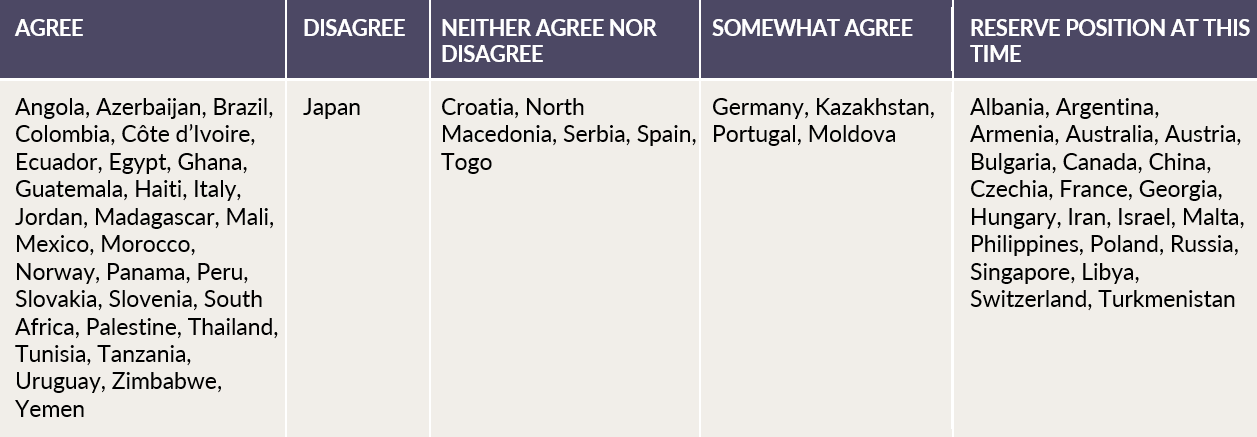
South Africa, which led international initiatives on environmental crime during its G20 presidency, made the case for the adoption of a protocol during the final session of the meeting, supported in the room by Zimbabwe and Tanzania. As one of the countries most affected by the issue, South Africa concluded its intervention by summarizing its position:
‘The issue before us, therefore, is not whether the Convention [UNTOC] can theoretically apply. It is whether the current framework is operationally sufficient. Previous protocols under this Convention were adopted not because the Convention was irrelevant, but because specific and evolving criminal economies required clearer legal alignment and stronger cooperation mechanisms. Crimes that affect the environment have now reached that same level of transnational organization and sophistication.’
Norway, which has consistently supported international responses to crimes affecting the climate and forests, also expressed strong support for the adoption of a protocol, saying:
‘Transnational organized crime groups will choose the activities that are less regulated and with less international cooperation, to ensure maximum profits with as little risk as possible. With the current situation, with no international binding regulation of environmental crime, the crime they turn to is likely to be environmental crime.’
The public record does not capture all statements and exchanges, but it is also notable that Brazil has launched an initiative – the Coalition for Multilateral Action against Crimes that Affect the Environment – bringing together over a dozen states from Africa, South America and Central America, as well as 10 civil society organizations, including the GI-TOC.
Taken together, these factors constitute a diverse, emerging, multistakeholder group that is likely to continue pursuing action through the development of a new protocol, despite the lack of consensus at the most recent Expert Group meeting and the mobilization of a Saudi-led opposition bloc.
Decision time: If not now, why not?
The second Expert Group meeting in February exposed competing visions for how – or even whether – to move forward. A sizeable group of countries, mainly from Western states and parts of Asia, remained silent or non-committal, either refraining from articulating a clear position or adopting a cautious stance.
Nevertheless, supportive countries are planning to table a resolution at the 13th UNTOC Conference of the Parties in October. This would initiate negotiations on a new protocol, more than 25 years after the Convention and its three original protocols on human trafficking, human smuggling and firearm trafficking were adopted.
If some countries continue to oppose the proposal, it will be put to a vote, requiring all states present to take a position on whether the process should commence. As this moment approaches, the question will shift from ‘why a protocol’ to ‘why not?’