Posted on 16 Mar 2026
Scams and fraud have undergone a profound evolution in recent decades, becoming one of the most sophisticated, pervasive and lucrative forms of organized crime globally. According to the Global Anti-Scam Alliance, 57% of adults worldwide reported experiencing a scam in the previous 12 months. Estimates suggest that more than US$1 trillion was generated from scams and fraud in 2024 alone.
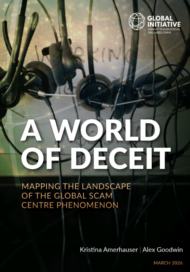
Rather than focusing on individual scam typologies – such as romance, investment or impersonation scams – this report examines the scam centre as a distinct organizational unit, mapping the various forms they take, the different economic models they use, and the broader ecosystem that allows them to operate and expand.
Around the world, these hubs of scams appear in different shapes and sizes. Some are located in apartments, hotels or villas, which offer discretion and the ability to relocate quickly – and sometimes in-built security. Many rent office space, sometimes with legal call centres as neighbours, providing camouflage for criminal activities. At the largest scale, cyber scam compounds in South East Asia host extensive workforces and structured operations with management, financial services and technical infrastructure. In some contexts, they also operate from prisons or pre-trial detention centres, where a captive workforce and collusion with officials can facilitate criminal activity.
This new research report finds that whatever form they take, size does not always correlate to impact. Small operations can also be highly effective, and may sometimes be linked to an overarching scam network, essentially making them nodes in a dispersed scam centre.
Despite their varied physical footprints, scam centres are enabled by six common ‘glocal’ force multipliers that allow them to operate, scale and target victims worldwide: networked groups; technology and crime-as-a-service; money; political protection; people; and geopolitics.
Technology is a critical driver of the scam economy. It enables scammers to reach victims around the world at minimal cost and provides tools to circumvent cyber defences. Some of the tools used include deepfakes, cloned applications, fake investment platforms and instant translation, as well as the use of data that enables precise social targeting of victims.
Illicit financial flows generated through scams are handled through a combination of money mules, cryptocurrencies, fintech tools and physical assets. These mechanisms often operate simultaneously, making it difficult and time-sensitive for law enforcement to trace illicit proceeds.
The report also highlights the central role of people in scam centre operations. Workers may be recruited locally with promises of lucrative salaries or trafficked from abroad and forced to work in exploitative conditions. In South East Asia alone, an estimated 300 000 people have been trafficked into scam compounds.
Looking ahead, the research identifies three major risks: displacement, diffusion and deglobalization. These dynamics may lead scam centres to become more embedded in more places, especially in areas where governance is weak. Some countries may also become linked to the scam economy not by hosting scam centres themselves but by facilitating money laundering or enabling services.
The report concludes that tackling scam centres requires addressing the interconnected nature of their operations. Single-strand approaches may disrupt individual operations, but they will not meaningfully affect the broader environment in which scam centres thrive.