Event Details
Where
GI-TOC Virtual Conference Room
Posted on 20 Jan 2026
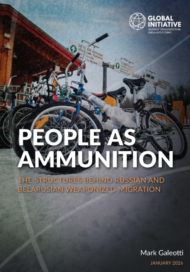
Weaponized migration, which is sometimes called instrumentalized migration or coercive engineered migration, is by no means a new challenge, but it is one that is arguably easier to apply in the modern age of cheap and easy international travel and growing awareness of the wealth and security disparities across the globe. It is also more likely to have local and widespread political impacts within democratic governments with free media.
This report considers particular case studies from the Russian–Finnish border in 2015 and, especially, the Belarusian borders with Poland and Lithuania in 2021, and Russia’s with Finland and Norway in 2023/24. In subtly different ways, these were all examples of attempts to use weaponized migration to bring pressure to bear on the target countries, in the hope of influencing their leaderships by generating division, disruption and costs, both practical and political. They certainly all proved problematic and, although there is scope for serious debate as to whether they were ultimately effective or counter-productive, the consensus appears to be that both Minsk and Moscow were left with the sense that, in the short term at least, weaponized migration remained a viable tool within their ‘hybrid war’ toolbox.
Given the scope for the renewed use of this tool by Belarus and, especially, the Russian Federation, as well as its potential use by other nations such as Türkiye, which has already employed it, European societies in particular must consider the contexts in which it can be used against them in the future and potential responses. This report, therefore, concludes with future scenarios for the weaponization of migration, ranging from facilitating flows from North Africa to the online encouragement of would-be asylum seekers, as well as a range of recommendations for both the EU and individual states, ideally that do not simply depend on a dangerous ‘Fortress Europe’ approach.