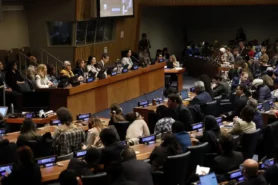
From 25 to 27 November, the Caribbean’s third Regional Network Meeting for Crime Analysts, organized by the Board of Chiefs of Police of the Dutch Caribbean, brought together nearly 50 analysts, police chiefs and intelligence officers from across the region in Santo Domingo. The meeting aimed to share insights into criminal networks, financial crimes, drug flows and artificial intelligence. The Global Initiative Against Transnational Organized Crime (GI-TOC) participated in its capacity as a civil society organization, contributing to discussions on strengthening collaboration and sharing expertise across the wider Caribbean Basin.
Over the course of three days, participants presented their latest analyses, providing a comprehensive overview of the evolving criminal landscape. Topics covered included firearms incidents, homicide trends, drug flows, violence involving young people, coastal vulnerabilities, inter-island group dynamics, cyber-enabled crime and the rising influence of digital platforms on illicit activities.
The meeting underscored the Caribbean’s growing centrality in the global criminal economy. Cocaine trafficking continues to put significant pressure on institutions with limited capacity to respond, while high-quality cannabis originating from the United States and Canada has fuelled barter exchanges (cannabis for cocaine, and often for weapons) across several islands. In places such as the island of Sint Maarten and Saint Martin, where a gram of cocaine sells for less than US$20, these exchanges have become firmly embedded in local illicit economies.
Changes in air and maritime routes further illustrate the adaptability of trafficking networks. For example, Suriname’s airport has become a key point of origin for couriers bound for Europe, with routes increasingly passing through Port of Spain, Brazil and French territories. Enhanced controls in Amsterdam have prompted diversification, challenging regional law enforcement agencies to adapt to these rapidly shifting patterns.
A recurring finding was that multiple trafficking routes are operating simultaneously. No single route has replaced another; they all remain active, adaptive and interconnected. However, the primary final destination of cocaine flows has shifted. Rather than the United States – long the dominant market – Europe has become the end point of the supply chain transiting through the Caribbean. Europe’s position as the world’s epicentre of cocaine consumption has found a perfect geographic platform for trafficking in the Caribbean, a dynamic further fuelled by corruption, impunity and limited judicial follow-through, which continue to undermine security efforts. In addition, parallel illicit markets – such as firearms trafficking, illegal gold mining and trafficking, or the rising influence of oil-related criminal actors in Guyana, Suriname and Trinidad and Tobago – further complicate an already complex regional criminal landscape.
Within this expanding threat landscape, firearms trafficking was identified as one of the region’s most urgent concerns. Between 2018 and 2022, 7 399 firearms recovered from crime scenes were successfully traced. Although this figure represents only a fraction of the weapons circulating in the region, 73 per cent of those traced were sourced from the United States. The flow of illicit firearms, like cocaine, moves through every possible route and vector, exploiting institutional vulnerabilities across the region. These include limited human and technical capacity within customs and intelligence services, as well as the prevalence of private ports and docks where public authorities struggle to assert access and effective oversight. The geography of the Caribbean further enables micro-trafficking from island to island, beyond the reach of surveillance and interdiction. Several territories, including Saint Martin and the British Virgin Islands, have recorded sharp increases in firearms-related incidents. The circulation of shared weapons among gangs complicates tracing and ballistic forensics, and drives cycles of retaliatory violence.
Finally, it is increasingly clear that firearms and cocaine trafficking can no longer be addressed in isolation. Combating both phenomena must be pursued jointly, forming the basis for dialogue and cooperation between Caribbean authorities and external partners, notably the Netherlands, France, the United Kingdom, the United States, Canada and governments across Central and South America, including Costa Rica, Panama, Colombia, Venezuela, Guyana and Suriname.
However, participants highlighted persistent structural vulnerabilities in crime-analysis ecosystems. While many jurisdictions possess national tools for data collection and several regional bodies generate timely intelligence, such as the Caribbean Community Implementation Agency for Crime and Security, these systems remain largely siloed. There were repeated calls for integrated platforms, shared databases and enhanced digital forensic capacity. The absence of harmonized cybersecurity legislation, uneven investigative resources, outdated infrastructure and jurisdictional complexities continue to impede coordinated responses. For small island territories, these challenges are exacerbated by tight-knit communities where witness intimidation, loyalty and fear hinder cooperation with the justice system.
Despite these pressures, the meeting revealed a growing readiness among practitioners to pursue more integrated, cross-border responses. Participants highlighted the need to strengthen the links between law enforcement and judicial institutions to ensure that arrests lead to successful prosecutions. They also emphasized the importance of engaging with civil society organizations that can produce comparative, transnational analysis and connect Caribbean developments to those in Central America, Colombia, Venezuela, Suriname, Guyana, Brazil and beyond.
The discussions in Santo Domingo made it clear that the Caribbean is at a decisive juncture. The region is increasingly exposed to global illicit flows, criminal actors are becoming more sophisticated and institutional constraints – from cyber capacity to data management and witness protection – remain substantial. But there is also a growing willingness to confront these challenges collectively, and to invest in the analytical and operational cooperation needed to strengthen regional resilience.
The GI-TOC will continue to work alongside governments, law enforcement agencies, regional institutions and local partners to support these efforts and contribute to more informed, coordinated and effective responses to transnational organized crime in the Caribbean Basin.
Cómo responder al crimen organizado en el Caribe: Los analistas piden enfoques integrados ante el creciente papel de la región en la economía ilícita mundial
Del 25 al 27 de noviembre, el tercer Encuentro Regional de Analistas sobre Crimen Organizado del Caribe, organizada por la Junta de Jefes de Policía del Caribe Neerlandés, reunió en Santo Domingo a casi 50 analistas, jefes de policía y oficiales de inteligencia de toda la región. El objetivo de la reunión era compartir conocimientos sobre redes criminales, delitos financieros, flujos de drogas e inteligencia artificial. La Global Initiative Against Transnational Organized Crime (GI-TOC) participó en calidad de organización de la sociedad civil, contribuyendo a los debates sobre el fortalecimiento de la colaboración y el intercambio de conocimientos especializados en toda la cuenca del Caribe.
A lo largo de tres días, los participantes presentaron sus últimos análisis, ofreciendo una visión completa del panorama criminal en constante evolución. Entre los temas tratados figuraron los incidentes con armas de fuego, las tendencias en materia de homicidios, los flujos de drogas, la violencia que afecta a los jóvenes, las vulnerabilidades costeras, la dinámica de los grupos interinsulares, la delincuencia cibernética y la creciente influencia de las plataformas digitales en las actividades ilícitas.
La reunión puso de relieve la creciente importancia del Caribe en la economía criminal mundial. El tráfico de cocaína sigue ejerciendo una presión considerable sobre las instituciones con capacidad limitada para responder, mientras que el cannabis de alta calidad procedente de los Estados Unidos y Canadá ha impulsado el tráfico y el trueque (cannabis por cocaína y, a menudo, por armas) en varias islas. En lugares como la isla de Sint Maarten y San Martín, donde un gramo de cocaína se vende por menos de 20 dólares estadounidenses, estos intercambios se han arraigado firmemente en las economías ilícitas locales.
Los cambios en las rutas aéreas y marítimas ilustran aún más la capacidad de adaptación de las redes de tráfico. Por ejemplo, el aeropuerto de Surinam se ha convertido en un punto clave de origen para los correos y mulas con destino a Europa, con rutas que pasan cada vez más por Puerto España, Brasil y territorios franceses. El refuerzo de los controles en Ámsterdam ha impulsado la diversificación, lo que supone un reto para los organismos policiacos regionales, que deben adaptarse a patrones en rápida evolución.
Una conclusión recurrente fue que existen múltiples rutas de tráfico que operan simultáneamente. Ninguna ruta ha sustituido a otra; todas siguen activas, adaptables e interconectadas. Sin embargo, el principal destino de los flujos de cocaína ha cambiado. En lugar de Estados Unidos, que durante mucho tiempo fue el mercado dominante, Europa se ha convertido en el punto final de la cadena de suministro que transita por el Caribe. La posición de Europa como epicentro mundial del consumo de cocaína ha encontrado una plataforma geográfica perfecta para el tráfico en el Caribe, una dinámica que se ve alimentada por la corrupción, la impunidad y el limitado seguimiento judicial, que siguen socavando los esfuerzos en materia de seguridad. Además, los mercados ilícitos paralelos —como el tráfico de armas de fuego, la extracción y el tráfico ilegal de oro, o la creciente influencia de los actores criminales relacionados con el petróleo en Guyana, Surinam y Trinidad y Tobago— complican aún más un ecosistema criminal regional ya de por sí complejo.
En este panorama de amenazas en expansión, el tráfico de armas de fuego se identificó como una de las preocupaciones más urgentes de la región. Entre 2018 y 2022, se logró rastrear 7 399 armas de fuego recuperadas en escenas del crimen. Aunque esta cifra representa solo una fracción de las armas que circulan en la región, el 73 % de las armas rastreadas procedían de los Estados Unidos. El flujo de armas de fuego ilícitas, al igual que la cocaína, se mueve a través de todas las rutas y vectores posibles, aprovechando las vulnerabilidades institucionales de toda la región. Entre ellas se encuentran la limitada capacidad humana y técnica de los servicios de aduanas e inteligencia, así como la prevalencia de puertos y muelles privados en los que las autoridades públicas tienen dificultades para ejercer su acceso y supervisión efectiva. La geografía del Caribe facilita el tráfico de isla en isla, fuera del alcance de la vigilancia y la interdicción. Asimismo, la circulación de armas compartidas entre las bandas complica el rastreo y el análisis balístico, y alimenta los ciclos de violencia en represalia.
Por último, está claro que el tráfico de armas de fuego y cocaína no pueden abordarse de forma paralela. La lucha contra ambos fenómenos debe llevarse a cabo de manera conjunta, sentando las bases para el diálogo y la cooperación entre las autoridades caribeñas y los socios externos, en particular los Países Bajos, Francia, el Reino Unido, los Estados Unidos, Canadá y los Gobiernos de América Central y del Sur, incluidos Costa Rica, Panamá, Colombia, Venezuela, Guyana y Surinam.
Sin embargo, los participantes destacaron las persistentes vulnerabilidades estructurales de los sistemas de análisis de la delincuencia. Si bien ciertas jurisdicciones cuentan con herramientas nacionales para la recopilación de datos y varios organismos regionales generan información oportuna, como la Agencia de Implementación de la Comunidad del Caribe para el Crimen y la Seguridad, estos sistemas siguen estando en gran medida aislados. Durante las reuniones, se hicieron repetidos llamamientos en favor de plataformas integradas, bases de datos compartidas y una mayor capacidad forense digital. La ausencia de una legislación armonizada en materia de ciberseguridad, la desigualdad de los recursos de investigación, la infraestructura obsoleta y las complejidades jurisdiccionales siguen obstaculizando las respuestas coordinadas. En el caso de los pequeños territorios insulares, estos retos se ven agravados por las dimensiones de las comunidades, en las que la intimidación de los testigos, la lealtad y el miedo dificultan la cooperación con el sistema judicial.
A pesar de estas presiones, la reunión reveló una creciente disposición entre los profesionales a buscar respuestas más integradas y transfronterizas. Los participantes destacaron la necesidad de fortalecer los vínculos entre las instituciones policiales y judiciales para garantizar que las detenciones conduzcan a enjuiciamientos exitosos. También hicieron hincapié en la importancia de colaborar con organizaciones de la sociedad civil que puedan producir análisis comparativos y transnacionales y conectar los acontecimientos del Caribe con los de América Central, Colombia, Venezuela, Surinam, Guyana, Brasil y otros países.
Los debates celebrados en Santo Domingo dejaron claro que el Caribe se encuentra en una encrucijada decisiva. La región está cada vez más expuesta a los flujos ilícitos mundiales, los delincuentes son cada vez más organizados y las limitaciones institucionales —desde la capacidad cibernética hasta la gestión de datos y la protección de testigos— siguen siendo considerables. Pero también existe una voluntad mayor de afrontar estos retos de forma colectiva y de invertir en la cooperación analítica y operativa necesaria para reforzar la resiliencia regional.
GI-TOC seguirá colaborando con los Gobiernos, las fuerzas del orden, las instituciones regionales y los socios locales para apoyar estos esfuerzos y contribuir a dar respuestas más informadas, coordinadas y eficaces al crimen organizado transnacional en la cuenca del Caribe.
Répondre au crime organisé dans les Caraïbes: Les analystes appellent à des approches intégrées alors que la région joue un rôle croissant dans l’économie illicite mondiale
Du 25 au 27 novembre, la troisième réunion du réseau régional des analystes criminels des Caraïbes, organisée par le Conseil des chefs de police des Caraïbes néerlandaises, a rassemblé près de 50 analystes, chefs de police et agents de renseignement de toute la région à Saint-Domingue. La réunion avait pour objectif de partager des informations sur les réseaux criminels, la criminalité financière, les flux de drogue et l’intelligence artificielle. La Global Initiative Against Transnational Organized Crime (GI-TOC) a participé en tant qu’organisation de la société civile, contribuant aux discussions sur le renforcement de la collaboration et le partage d’expertise dans l’ensemble du bassin des Caraïbes.
Au cours de ces trois jours, les participants ont présenté leurs dernières analyses, offrant un aperçu complet de l’évolution du paysage criminel. Parmi les thèmes abordés figuraient les incidents impliquant des armes à feu, les tendances en matière d’homicides, les flux de drogues, la violence impliquant des jeunes, les vulnérabilités côtières, la dynamique des groupes interinsulaires, la cybercriminalité et l’influence croissante des plateformes numériques sur les activités illicites.
La réunion a souligné le rôle central croissant des Caraïbes dans l’économie criminelle mondiale. Le trafic de cocaïne continue d’exercer une pression considérable sur les institutions dont la capacité de réaction est limitée, tandis que le cannabis de haute qualité provenant des États-Unis et du Canada alimente de nouvelles dynamiques d’échanges et de troc (cannabis contre cocaïne, et souvent contre des armes) dans plusieurs îles. Dans des endroits tels que l’île de Sint Marteen / Saint-Martin, où le gramme de cocaïne se vend moins de 20 dollars américains, ces échanges sont solidement ancrés dans les économies illicites locales.
Ensuite, les changements dans les routes aériennes et maritimes illustrent la capacité d’adaptation des réseaux de trafic. Par exemple, l’aéroport du Suriname est devenu un point de départ clé pour les trafiquants et mules à destination de l’Europe, les routes passant de plus en plus par Port of Spain, le Brésil et les territoires français. Le renforcement des contrôles à Amsterdam a entraîné une diversification, mettant sous pression les services de police régionaux et européens.
La GI-TOC a fait le constat que des dizaines de routes de trafic fonctionnent simultanément. Aucune route n’a remplacé une autre ; elles restent toutes actives, adaptables et interconnectées. Cependant, la principale destination finale des flux de cocaïne a changé. Plutôt que les États-Unis, qui ont longtemps été le marché dominant, c’est l’Europe qui est devenue le point final de la chaîne transitant par les Caraïbes. La position de l’Europe en tant qu’épicentre mondial de la consommation de cocaïne a trouvé une plateforme géographique idéale dans les Caraïbes, une dynamique alimentée par la corruption, l’impunité et le suivi judiciaire limité, qui continuent de compromettre les efforts en matière de sécurité. En outre, les marchés illicites parallèles – tels que le trafic d’armes à feu, l’extraction et le trafic illégaux d’or, ou l’influence croissante des acteurs criminels liés au pétrole en Guyane, au Suriname et à Trinité-et-Tobago – compliquent encore un paysage criminel régional déjà complexe.
Dans ce contexte de menaces croissantes, le trafic d’armes à feu a été identifié comme l’un des problèmes les plus urgents de la région. Entre 2018 et 2022, 7 399 armes à feu récupérées sur des scènes de crime ont pu être tracées. Bien que ce chiffre ne représente qu’une fraction des armes en circulation dans la région, 73 % des armes tracées provenaient des États-Unis. Le trafic d’armes à feu illicites, à l’instar de la cocaïne, emprunte toutes les voies et tous les vecteurs possibles, exploitant les vulnérabilités institutionnelles de la région. Il s’agit notamment des capacités humaines et techniques limitées des services douaniers et de renseignement, ainsi que de la prévalence des ports et des docks privés où les autorités ont du mal à affirmer leur accès et à exercer une surveillance efficace. La géographie des Caraïbes facilite en outre le micro-trafic d’île en île, hors de portée de la surveillance et de l’interdiction. Plusieurs territoires, dont Sint Marteen / Saint-Martin et les îles Vierges britanniques, ont enregistré une forte augmentation des incidents liés aux armes à feu. La circulation d’armes partagées entre les gangs complique le traçage et les analyses balistiques, et alimente les cycles de représailles.
Enfin, il apparaît de plus en plus clairement que les trafics d’armes à feu et de cocaïne ne peuvent plus être traités isolément. La lutte contre ces deux phénomènes doit être menée conjointement, en jetant les bases du dialogue et de la coopération entre les autorités caribéennes et les partenaires extérieurs, notamment les Pays-Bas, la France, le Royaume-Uni, les États-Unis, le Canada et les gouvernements d’Amérique centrale et d’Amérique du Sud, en particulier le Costa Rica, le Panama, la Colombie, le Venezuela, la Guyane et le Suriname.
Toutefois, les participants ont souligné les vulnérabilités structurelles persistantes des écosystèmes d’analyse de la criminalité. Si de nombreuses juridictions disposent d’outils nationaux de collecte de données et si plusieurs organismes régionaux produisent du renseignement, notamment CARICOM IMPACS, ces systèmes restent largement cloisonnés. Durant les réunions, des appels répétés ont été lancés en faveur de plateformes mieux intégrées, de bases de données partagées et d’une capacité renforcée en matière de lutte contre la cybercriminalité. L’absence de législation harmonisée en matière de cybersécurité, l’inégalité des ressources d’enquête, l’obsolescence des infrastructures et la complexité des juridictions continuent d’entraver la coordination des réponses. Pour les petits territoires insulaires, ces défis sont exacerbés par des communautés très soudées où l’intimidation des témoins, la loyauté et la peur entravent la coopération avec le système judiciaire.
Malgré ces pressions, la réunion a révélé une volonté croissante des praticiens de mettre en place des réponses transfrontalières plus intégrées. Les participants ont souligné la nécessité de renforcer les liens entre les forces de l’ordre et les institutions judiciaires afin de garantir que les arrestations aboutissent à des poursuites fructueuses. Ils ont également insisté sur l’importance de collaborer avec les organisations de la société civile qui peuvent produire des analyses comparatives et transnationales et relier les développements dans les Caraïbes à ceux en Amérique centrale, en Colombie, au Venezuela, au Suriname, en Guyane, au Brésil et au-delà.
Les discussions à Saint-Domingue ont clairement montré que les Caraïbes se trouvent à un tournant décisif. La région est de plus en plus exposée aux flux illicites mondiaux, les acteurs criminels deviennent plus sophistiqués et les contraintes institutionnelles – des capacités cybernétiques à la gestion des données et à la protection des témoins – restent importantes. Mais il existe une volonté croissante de relever ces défis collectivement et d’investir dans la coopération analytique et opérationnelle nécessaire pour renforcer la résilience régionale.
La GI-TOC continuera à travailler aux côtés des gouvernements, des institutions régionales et des partenaires locaux pour soutenir ces efforts et contribuer à des réponses plus éclairées, coordonnées et efficaces à la criminalité transnationale organisée dans le bassin des Caraïbes.