Posted on 30 Mar 2026
Montevideo / Geneva – The Global Initiative Against Transnational Organized Crime (GI‑TOC) and the Ministry of the Interior of the Oriental Republic of Uruguay (MI–Uruguay) have formalized a new collaboration through the signing of a Memorandum of Understanding (MoU), marking an important step in strengthening democratic security, evidence-based policymaking and regional cooperation in Latin America.
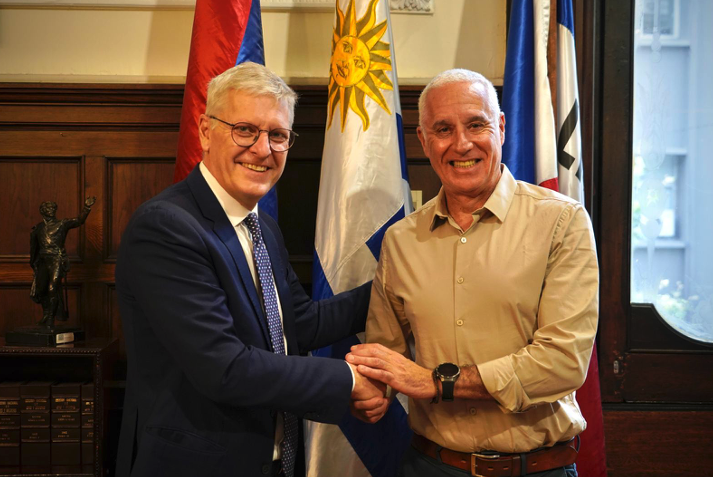 Mark Shaw, Executive Director of GI‑TOC and Technical Secretary of GLACSED with Carlos Negro, Minister of Interior of Uruguay
The agreement is grounded in a shared understanding that organized crime represents one of the most pressing threats to democratic governance, sustainable development and citizen security across the region. Both parties recognize the urgent need to deepen research, support institutional resilience and promote coordinated responses that are legitimate, effective and sustainable.
This initiative aligns with the growing regional momentum to address organized crime through holistic and evidence-based approaches – momentum reflected also in the launch of the Latin American and Caribbean Group on Security and Democracy (LACSED), a platform designed to strengthen public security policies, multilevel cooperation and respect for the rule of law. GI‑TOC serves as the Technical Secretariat of GLACSED, bringing analytical capacity and a broad expert network to support regional coordination efforts.
A collaboration rooted in democratic security and evidence-based action
Through the MoU, GI‑TOC and MI–Uruguay establish a framework for cooperation that includes:
- facilitating dialogue to identify areas of joint work in alignment with Uruguay’s National Public Security Plan and GI‑TOC’s GLACSED agenda;
- supporting Uruguay’s engagement in regional forums as a potential reference point for democratic security approaches;
- co-organizing events, exchanges and roundtables in Uruguay and internationally to strengthen technical and political support for Uruguay’s security strategy;
- collaborating on research outputs to advance understanding of organized crime dynamics and policy responses.
- and, as part of the implementation of this cooperation, GI‑TOC will embed a dedicated researcher within the Ministry of the Interior to support data collection, analytical processes and the development of evidence-based decision-making tools.
These commitments echo the priorities highlighted during the launch of GLACSED, where regional leaders emphasized that security and democracy must advance together, guided by evidence, territorial coordination and human rights.
Shared perspectives from the partners
Speaking on the significance of this partnership, Mark Shaw, Executive Director of GI‑TOC and Technical Secretary of GLACSED, underlined the urgency of coordinated action:
“What we are building is a platform rooted in political consensus, expert knowledge and practical engagement on the ground. It has never been more urgent to respond to organized crime with concrete and legal solutions. Citizens’ fears are real, and our responsibility is to address them firmly, but always within the rule of law.”
From the Uruguayan side, Carlos Negro, Minister of the Interior, highlighted Uruguay’s commitment to democratic security grounded in human rights and scientific evidence, noting that the collaboration with GI‑TOC will help strengthen regional ties, elevate Uruguay’s contributions in hemispheric security debates and support innovation in public policy development. He said: “Addressing the complexity of public security requires rigorous analysis, informed debate, and responsible decision-making. In this context, the systematic production and use of scientific knowledge are not merely complementary to security policy but essential for its effectiveness, legitimacy, and long-term sustainability.”
The MoU reinforces Uruguay’s growing role in regional efforts to confront organized crime. By engaging with platforms like GLACSED, Uruguay contributes to a regional conversation that seeks to build responses from the local level upward – responses that rely on strong institutions, international cooperation and an unwavering commitment to democratic principles.