Posted on 23 Jun 2026
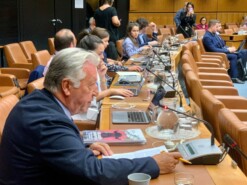
From 1 to 5 June, the UN Commission on Crime Prevention and Criminal Justice (CCPCJ) held its 35th session in Vienna, offering some insight into the current state of international cooperation on organized crime. This was the first meeting for Monica Juma, the newly appointed executive director of the UN Office on Drugs and Crime (UNODC), who had taken up her post just weeks earlier. What she would have witnessed was a paradox: disagreement on fundamental UN principles alongside apparent consensus on tackling some of the world’s fastest-growing criminal threats.
This set the session apart from previous UNODC-led meetings, which have been characterized by more overt confrontation in recent years – most notably at the Commission on Narcotic Drugs in March. At this year’s CCPCJ, three resolutions – ranging from familiar issues such as human trafficking to relatively new or rapidly developing ones such as cyber scams and ‘sextortion’ – were adopted by consensus. Meanwhile, side events and statements throughout the week highlighted a growing international interest in stronger responses to environmental crimes.
A historic low
Only three resolutions were put forward at this year’s session, which is a record low and a possible sign that many member states are reluctant to stake out public positions in an increasingly fractious multilateral environment. It is therefore notable that all three passed without a vote. Two of these were supported by the US, indicating its ongoing interest in the topics on the UNODC’s agenda.
The first resolution, tabled by Japan and backed by Costa Rica, Ecuador, the UK and the US, addressed the global surge in fraud, after a summit on the topic was held in Vienna in March. It promotes a whole-of-society approach to this rapidly innovating form of organized crime – including through private sector involvement – and emphasizes the need to strengthen support, protection and recovery mechanisms for victims. Notably, this is the first CCPCJ resolution to explicitly refer to cyber scam centres, acknowledging their growing role in facilitating fraud. The breadth of the co-sponsorship suggests that this is now understood to be a global phenomenon and not just a problem relevant to South East Asia.
The US presented a resolution on what is referred to as ‘sextortion’ of children – namely, the practice of coercing children into producing sexual images and then using the threat of exposure to extort them. However, this term, which had been introduced in the first draft, proved contentious: many member states argued that it is not reflected in their national legislation, making consensus on a shared language difficult to achieve. Ultimately, member states agreed on the term ‘sexual extortion of children’. The resolution clearly links the phenomenon with organized crime groups, calls for more research into this connection, and argues that it should be addressed as a form of transnational organized crime. However, the final text omits references to issues of importance to other member states – which the US succeeded in keeping out – such as the Convention on the Rights of the Child, gender and the sustainable development goals (SDGs).
As in previous years, the resolution on countering trafficking in persons was the subject of the most controversy. The resolution was tabled by Kazakhstan and supported by Belarus, the country that has traditionally led this initiative, but which was not re-elected to the CCPCJ for the 2025–2028 term. The resolution incorporates important elements of the response, including the principle of non-punishment, respect for human rights and dignity, and sustainable development. As with the US resolution, references to the SDGs and gender were not included in the final text.
In their formal statements, Canada, Australia, Ukraine and the EU did not oppose the substance of the resolution, but instead publicly criticized Belarus – still listed as a co-sponsor – for its double standards. By supporting Russia’s war in Ukraine, they argued, Belarus has contributed to the problems addressed by the resolution. They also noted Belarus’s own record of instrumentalizing migrants and severe human rights violations in this respect. Despite the diplomatic friction, the resolution was passed with the support of Egypt, Chile and Ghana.
Familiar fault lines
Beneath all three negotiations lay a tension that surfaced repeatedly during the week: some member states being unwilling to endorse references to foundational UN concepts, such as the SDGs and the term ‘gender’. While this is not a new development, it has become more visible in recent years.
The clearest demonstration of it came during the adoption of the agenda for next year’s session. The US called for the removal of any references to the SDGs, prompting Colombia to request a vote. Only the US opposed the references, with Argentina’s support, while Japan and the UAE abstained. While the references were retained, the episode illustrates how concepts that were once considered part of the established UN framework are now being actively contested.
An unofficial priority
Although not formally on the agenda, environmental crime generated some of the week’s most animated discussion. In a high-level plenary statement, Brazil – speaking on behalf of a coalition of 23 countries and 11 civil society organizations – advocated for an additional protocol on crimes that affect the environment to be launched at the 13th Conference of Parties to the UN Convention against Transnational Organized Crime (UNTOC) in October.
The session should have been dedicated to the outcomes of the 15th UN Crime Congress, which was due to take place in Abu Dhabi in April. The Crime Congress, whose outcomes were meant to anchor much of the CCPCJ’s agenda, was postponed due to the regional conflict in the Middle East. It is now scheduled to take place in late September/early October, with a reconvened CCPCJ session in December expected to take up its conclusions. This provided another piece of evidence of the impact on geopolitical friction on the UNODC’s operational calendar.
A fresh approach
Against this complicated backdrop, Monica Juma’s early signals have been well received. Her background as Kenya’s National Security Advisor provides her with relevant experience of transnational criminal threats as well as the kinds of challenges currently facing the UNODC.
It is already evident that Juma has brought a new spirit of engagement to the fight against organized crime, including through direct acknowledgement of the vital role played by civil society. Juma took part in an informal dialogue with civil society during the week and returned to the theme in her closing statement, describing civil society partners as ‘bring[ing] unique perspectives and insights that ensure we do not lose sight of the people we are here to serve’. This choice of language positioned the UNODC as accountable not only to member states but to the communities most affected by organized crime.
The key questions that will need to be answered in the coming months – including through open engagement with civil society – are how to respond to UN reform challenges, how to reinvigorate the implementation of the UNTOC, how to make the most of the nascent Convention against Cybercrime, and what the main strategic outcomes of the Crime Congress should be.
The 35th CCPCJ did not resolve these matters, but it did show that meaningful international engagement is still possible when the political will exists. The challenge for Juma and the UNODC will be to cultivate this will and to ensure that it outlasts the current moment of geopolitical fragmentation and multilateral strain.