Posted on 04 Dec 2025
ECO-SOLVE are undertaking a global horizon scan on “Technologies to Combat Environmental Crimes.” The findings of the horizon scan will be published, outlining key technologies, practical applications and providing essential recommendations for stakeholders.
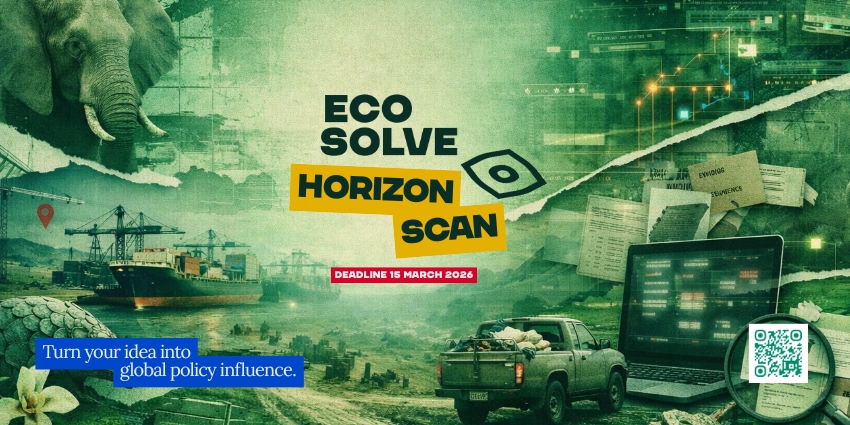
>>> Click here to register to the Submission Clinic
Law enforcement agencies often struggle to stay ahead of emerging trends and criminal network adaptation in illegal environmental commodity markets. One reason for this is the current underutilization and inaccessibility of data and technologies that would make enforcement more effective. Owing to recent significant technological advancements we have an opportunity to improve responses and equip law enforcement with better tools. Technologies may also have potential to enhance other interventions aimed to prevent or suppress environmental crime beyond law enforcement.
A crucial step in this process is harnessing expert knowledge to identify and prioritise existing and emerging technologies that can be applied to environmental crime. Horizon scanning helps organizations and researchers anticipate emerging trends, risks, and opportunities before they become urgent, allowing proactive decision-making. It supports strategic planning, innovation, and resilience by integrating diverse evidence and expert insights. The use of horizon scanning as a forecasting tool can reduce the unpredictability of impacts and allow time and resources to be invested in technological progress, policy change or on-the-ground action.
Through the open call for ideas and the expertise of carefully selected participants, the horizon scanning process will pre-emptively identify and prioritise existing or future technologies that present realistic solutions to environmental crimes. This approach is both novel and practically orientated: no solution-focused horizon scan has ever been applied to the topic area. Results will be of interest to a wide range of stakeholders and will help inform the priorities and strategy of governments, academics, non-government organisations and the private sector. With each idea evaluated against key criteria (novelty, plausibility and impact), the final prioritised list will identify technologies that are ready for investment or further research, that have previous been overlooked, or that require a change in policy or practice to reach their full potential.
We invite all those interested in contributing expertise and insight to participate. You do not need a deep understanding of environmental crime, or to be working in the area. The threat from environmental crime is complex, linked closely to other crimes, with many different actors and domains affecting it. We are especially keen to hear from those in different institutions, disciplines and sectors.
A submitted idea should be:
• An existing or emerging technology that could benefit enforcement efforts or other interventions aimed at addressing environmental crimes.
• Globally relevant, although the initial submission may be framed to a specific region/locality.
• Related to one or more elements of illicit commodity supply chains (sourcing, transport mechanisms, marketplaces, consumer demand, legal and regulatory frameworks, convergence with other criminal activities.
• Applicable to detection, prevention, and/or prosecution of environmental crimes.
• A technology that is not widely known by potential users or that is currently underutilised, or which will require a change in practice, policy and/or further research in order to be widely adopted.
Contributed ideas could reflect a range of scales, from broad themes to specific, localised issues. Please remember that even if a technology/idea has not have been developed specifically for environmental crime, it may still be valuable.
Examples of ideas could relate to:
• Monitoring and enforcement of environmental commodity supply chains, including illegal sale and transport.
• Detection of illegal environmental activity, including wildlife trade, poaching, deforestation, mining, fishing, or land degradation.
• Legal supply chain resilience to illicit activity.
• Analysis of large datasets to identify environmental crime patterns.
• Species and origin identification for enforcement purposes.
• Digital evidence of environmental crimes, including online illegal wildlife trade and waste trafficking.
You may submit up to 3 ideas as part of the horizon scan through the online Call for Ideas.