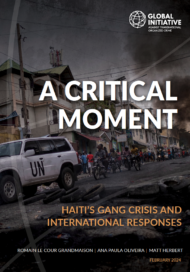
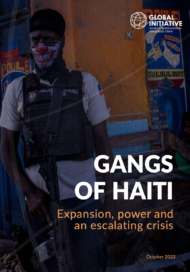
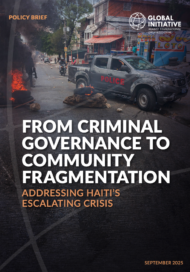
This report examines United Nations and international responses to the evolving dynamics of transnational organized crime in Haiti over the past two decades, and how these dynamics have contributed to the country’s current breakdown.
It assesses the extent to which UN peace operations have addressed organized criminal actors and illicit economies, identifies structural limitations in past approaches, and extracts lessons applicable both to Haiti and to peace operations operating in comparable contexts worldwide.
Beyond a retrospective assessment, the report seeks to clarify what is concretely required to contribute to stabilizing Haiti today, and how UN bodies and international partners can more effectively support national and local actors. The growing influence of organized crime, trafficking, and illicit financial flows in Haiti reflects a broader global trend, one that is likely to intensify amid the weakening of multilateral norms and institutions. As a small island state at the heart of transnational criminal flows, Haiti represents a critical test case for the international community’s capacity to confront organized crime in crisis settings.
The Security Council’s decision to establish a new Gang Suppression Force (GSF) provides a pivotal opportunity to reassess past strategies and develop more effective operational approaches. Lessons drawn from Haiti are therefore not only urgent for the country itself, but also potentially instructive for future UN and non-UN interventions confronting organized crime elsewhere.
The report is structured in two parts. The first provides an overview of the current gang landscape in Port-au-Prince and traces the evolution of organized criminal dynamics alongside international responses since 2004, focusing on MINUSTAH, MINUJUSTH, and BINUH. It reviews the tools deployed by successive UN missions, highlights missed warning signs, and analyzes why previous gains proved partial, fragile, or reversible. The second part proposes a practical toolbox for peace operations addressing transnational organized crime, drawing on lessons from Haiti as well as other UN contexts where trafficking and organized crime shape conflict dynamics, including Sudan, South Sudan, and Colombia. The report concludes by outlining a minimum yet feasible pathway forward to improve the situation in Haiti under current constraints.
Ce rapport examine les réponses des Nations Unies et de la communauté internationale face à l’évolution des dynamiques de la criminalité transnationale organisée en Haïti au cours des deux dernières décennies, ainsi que la manière dont ces dynamiques ont contribué à l’effondrement actuel du pays.
Il évalue dans quelle mesure les opérations de paix de l’ONU ont pris en compte les acteurs criminels organisés et les économies illicites, identifie les limites structurelles des approches antérieures et tire des enseignements applicables tant à Haïti qu’aux opérations de paix menées dans des contextes comparables à travers le monde.
Au-delà d’une analyse rétrospective, le rapport vise à clarifier ce qui est concrètement nécessaire pour contribuer aujourd’hui à la stabilisation d’Haïti, ainsi que la manière dont les organes de l’ONU et les partenaires internationaux peuvent soutenir plus efficacement les acteurs nationaux et locaux.
L’influence croissante de la criminalité organisée, des trafics et des flux financiers illicites en Haïti reflète une tendance mondiale plus large, appelée à s’intensifier dans un contexte d’affaiblissement des normes et des institutions multilatérales.
État insulaire situé au cœur des flux criminels transnationaux, Haïti constitue un cas test crucial pour la capacité de la communauté internationale à faire face à la criminalité organisée dans des situations de crise.
La décision du Conseil de sécurité d’établir une nouvelle Force de répression des gangs (Gang Suppression Force – GSF) offre une occasion déterminante de réévaluer les stratégies passées et de développer des approches opérationnelles plus efficaces. Les enseignements tirés de l’expérience haïtienne sont donc non seulement urgents pour le pays lui-même, mais également susceptibles d’éclairer de futures interventions onusiennes ou non onusiennes confrontées ailleurs à la criminalité organisée.
Le rapport est structuré en deux parties. La première dresse un panorama du paysage actuel des gangs à Port-au-Prince et retrace l’évolution des dynamiques criminelles organisées parallèlement aux réponses internationales depuis 2004, en se concentrant sur la MINUSTAH, la MINUJUSTH et le BINUH. Elle examine les outils déployés par les différentes missions de l’ONU, met en évidence des signaux d’alerte manqués et analyse pourquoi les acquis précédents se sont révélés partiels, fragiles ou réversibles.
La seconde partie propose une boîte à outils pratique pour les opérations de paix confrontées à la criminalité transnationale organisée, en s’appuyant sur les enseignements tirés d’Haïti ainsi que d’autres contextes onusiens où les trafics et la criminalité organisée façonnent les dynamiques de conflit, notamment au Soudan, au Soudan du Sud et en Colombie. Le rapport conclut en esquissant une voie minimale mais réaliste pour améliorer la situation en Haïti dans le cadre des contraintes actuelles.