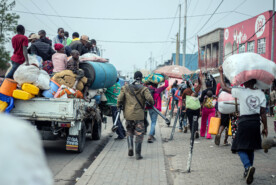
In January 2025, Goma fell to the M23 rebel group, marking a brutal turning point in the protracted conflict in the eastern Democratic Republic of Congo (DRC). Goma, the capital of North Kivu province, is a strategic geopolitical and security hub. Its capture by the Rwanda-backed armed group was a stinging setback for the DRC military, its allies and the other international forces deployed in the region, including UN peacekeepers. But it also served to cement an economy of war at the heart of the Great Lakes region, boosting the illicit financial flows that fuel and sustain armed violence in eastern DRC. The rebel-controlled areas facilitate the smuggling of lucrative minerals, including gold and transition metals, across regional borders.
In the months following the seizure of Goma, diplomatic initiatives intensified. The UN Security Council adopted resolutions calling for a ceasefire, condemning the M23, demanding the withdrawal of Rwandan troops, maintaining sanctions against those involved in the conflict and strengthening the mandate of the UN stabilization mission, MONUSCO. The African Union appointed the president of Togo as its high–level mediator for the DRC crisis. Qatar convened the Congolese and Rwandan presidents, and facilitated several rounds of direct talks between the DRC and the M23. The United States, for its part, initiated a negotiation process between Rwanda and the DRC. Since the current crisis began in 2021, rhetoric supporting peace in the Great Lakes region has never been voiced on such an international scale.
The missing link in the interventions: transnational organized crime
Yet these initiatives, as well as those led by the European Union and France, have had little impact. One year later, the M23 still holds Goma and the group’s reach has expanded. In February 2025, it seized Bukavu, the capital of South Kivu, and Uvira in December 2025, before withdrawing a month later. The M23 already controls vast resource-rich territories and, according to sources within the armed group, it also has bold ambitions to take over the strategic mining region of the former province of Katanga. The rebels’ advance – which openly flouts international injunctions – highlights the gap between the international statements peppering the news and the reality on the ground.
As has been evidenced by numerous cases around the world where crime and conflict converge – from Sierra Leone and the Central African Republic to Colombia, Afghanistan and Myanmar – violent competition over mineral resources drives or intensifies conflict. The M23’s persistent defiance lays bare the inherent limitations of current diplomatic approaches to conflicts in which transnational organized crime – while not necessarily the root cause – plays a major structural role. That the rebel group is still in control of Goma and other areas one year on illustrates how any actionable approach to resolving the conflict must strategically confront the illicit economies underpinning the war.
The core limitations of many of the diplomatic initiatives is that they lack enforcement mechanisms, particularly the UN resolutions. Without political will, they remain largely symbolic – mere ‘empty slogans’, as one diplomatic source described them. UN Security Council Resolution 2773, adopted after the fall of Bukavu, provides a striking illustration of this. Although it formally demanded an end to Rwandan support and the withdrawal of the M23 from occupied areas, the UN’s demands were not met. The M23 continued its operations, including by restricting the movement of MONUSCO, which had been using Goma as its eastern DRC headquarters before January 2025.
Ongoing peace processes have also been limited by their reluctance to challenge existing economic power dynamics – or to account for the reality of the players on the ground. This is particularly evident in the Doha and Washington frameworks. Presented as attempts at high-level diplomatic re–engagement following the failure of Angolan mediation on behalf of the African Union, these processes illustrate the international community’s stubbornly persistent blind spot towards the criminality sustaining ongoing conflicts.
The M23 has methodically consolidated a de facto, deeply illegal, parallel administration. It exercises direct control over several lucrative mining sites in North and South Kivu, and imposes taxes on all local economic activities, including trade, transport, agriculture, and artisanal and semi-mechanized mining. These forms of criminal governance leave no choice to civilians but to finance this sanctioned entity. The M23’s economic activities sustain the movement and enrich its leaders. Meanwhile, the group’s illegal activities, particularly from mineral flows, generate revenues that may provide economic and strategic benefits to Rwanda, Uganda and beyond. More significantly, they incentivize the movement to continue.
In spite of this, the Doha process failed to sufficiently take into account that the M23 is a non-state armed actor that has – thanks to external support – established itself as an autonomous territorial power, with its own economic resources and the capacity for sustainable administration. Even more worryingly, the framework carefully avoided addressing the central issue of the political economy of war. Neither the capture of natural resources, nor illegal taxation, nor the control of illicit cross-border trade featured among the main topics of discussion. Yet if these financial flows are left to endure, the incentives to continue the conflict will remain intact.
The Doha process was thus caught in a paradox: seeking to end a war, while refusing to address the illicit political economy that sustains it. Unsurprisingly, the end result, in November 2025, was a ‘framework agreement for comprehensive peace’ that the M23 leadership described as a ‘mutual scam, a seller of fake diamonds paid with fake dollars’.
The Washington process showed greater lucidity in recognizing the centrality of the war economy. The Washington Accords, signed in December 2025, are betting on contributing to peace by transforming economic potential into a lever for stabilization between the warring parties. However, by failing to challenge the existing power relations and predatory economies upstream, this approach risks promoting the economic normalization of illegal activity, benefiting actors capable of operating in unstable environments that have been politically ‘stabilized’ by diplomacy.
In the absence of strict conditions, the Washington Accords could primarily benefit US interests and consolidate states and political-economic networks that already profit from the war economy in eastern DRC. The promise of new investment flows, security assistance and economic partnerships could strengthen these actors without requiring, in return, a clear break with cross-border predatory circuits. The desired stabilization would thus become a mechanism that enables accumulation, rather than a tool for transformation.
Finally, the failure to call out regional responsibilities is another major deficiency in the recent diplomatic approaches to the situation in the DRC. Despite the reports and data establishing Uganda’s involvement in the political economy of the conflict, both the Doha and Washington processes were reluctant to name and involve the country in the discussions and the accords.
The ongoing conflict in eastern DRC exposes a hard truth: peace efforts that ignore the transnational illicit economy that sustain war are bound to fail. As long as armed groups and regional actors profit from violence, diplomacy is doomed to remain detached from realities on the ground. Meanwhile, civilians continue to pay the price through insecurity, poverty and displacement, and future generations are put at risk.
Goma, un an après : profits illicites et paix hors de portée
Toute approche durable visant à mettre fin au conflit en RDC doit s’attaquer aux économies illicites qui alimentent la guerre.
En janvier 2025, Goma est tombée aux mains du groupe rebelle M23, marquant un tournant brutal dans le conflit prolongé qui sévit dans l’est de la République démocratique du Congo (RDC). Goma, capitale de la province du Nord-Kivu, est un centre stratégique sur le plan géopolitique et sécuritaire. Sa prise par le groupe armé soutenu par le Rwanda a constitué un revers cuisant pour l’armée de la RDC, ses alliés et les autres forces internationales déployées dans la région, y compris les casques bleus de l’ONU. Mais elle a également contribué à consolider une économie de guerre au cœur de la région des Grands Lacs, stimulant les flux financiers illicites qui alimentent et entretiennent la violence armée dans l’est de la RDC. Les zones contrôlées par les rebelles facilitent la contrebande de minerais lucratifs, notamment l’or et les métaux critiques de la transition énergétique, à travers les frontières régionales.
Dans les mois qui ont suivi la prise de Goma, les initiatives diplomatiques se sont intensifiées. Le Conseil de sécurité des Nations unies a adopté des résolutions appelant à un cessez-le-feu, condamnant le M23, exigeant le retrait des troupes rwandaises, maintenant les sanctions contre les parties impliquées dans le conflit et renforçant le mandat de la mission de stabilisation des Nations unies, la MONUSCO. L’Union africaine a nommé le président du Togo comme médiateur de haut niveau pour la crise en RDC. Le Qatar a réuni les présidents congolais et rwandais et a facilité plusieurs cycles de pourparlers directs entre la RDC et le M23. Les États-Unis, pour leur part, ont lancé un processus de négociation entre le Rwanda et la RDC. Depuis le début de la crise actuelle en 2021, jamais les discours en faveur de la paix dans la région des Grands Lacs n’avaient été aussi nombreux à l’échelle internationale.
Le chaînon manquant dans les interventions : la criminalité transnationale organisée
Cependant, ces initiatives, ainsi que celles menées par l’Union européenne et la France, ont eu peu d’impact. Un an plus tard, le M23 contrôle toujours Goma et l’influence du groupe s’est étendue. En février 2025, il s’est emparé de Bukavu, la capitale du Sud-Kivu, puis d’Uvira en décembre 2025, avant de se retirer un mois plus tard. Le M23 contrôle déjà de vastes territoires riches en ressources et, selon des sources au sein du groupe armé, il ambitionne également de s’emparer de la région minière stratégique de l’ancienne province du Katanga. L’avancée des rebelles, qui bafoue ouvertement les injonctions internationales, met en évidence le fossé entre les déclarations internationales qui émaillent l’actualité et la réalité sur le terrain.
Comme l’ont démontré de nombreux cas à travers le monde où la criminalité et les conflits convergent – de la Sierra Leone et la République centrafricaine à la Colombie, l’Afghanistan et le Myanmar –, la concurrence violente pour les ressources minérales alimente ou intensifie les conflits. La défiance persistante du M23 met en évidence les limites inhérentes aux approches diplomatiques actuelles des conflits dans lesquels la criminalité transnationale organisée, sans en être nécessairement la cause profonde, joue un rôle structurant majeur. Le fait que le groupe rebelle contrôle toujours Goma et d’autres zones un an après montre que toute approche concrète visant à résoudre le conflit doit s’attaquer stratégiquement aux économies illicites qui alimentent la guerre.
La principale limite de nombreuses initiatives diplomatiques réside dans l’absence de mécanismes d’application, en particulier dans le cas des résolutions de l’ONU. Sans volonté politique, elles restent largement symboliques, de simples « slogans creux », comme les a décrites une source diplomatique. La résolution 2773 du Conseil de sécurité des Nations unies, adoptée après la chute de Bukavu, en est une illustration frappante. Bien que l’ONU ait officiellement la fin du soutien rwandais et le retrait du M23 des zones occupées, ses demandes n’ont pas été satisfaites. Le M23 a poursuivi ses opérations, notamment en restreignant les mouvements de la MONUSCO, qui utilisait Goma comme quartier général dans l’est de la RDC avant janvier 2025.
Les processus de paix en cours ont également été limités par leur réticence à remettre en cause les rapports de force économiques existants ou à tenir compte de la réalité des acteurs sur le terrain. Cela est particulièrement évident dans les cadres de Doha et de Washington. Présentés comme des tentatives de réengagement diplomatique de haut niveau après l’échec de la médiation angolaise au nom de l’Union africaine, ces processus illustrent l’aveuglement persistant de la communauté internationale face à la criminalité qui alimente les conflits en cours.
Le M23 a méthodiquement consolidé une administration parallèle de facto, profondément illégale. Il exerce un contrôle direct sur plusieurs sites miniers lucratifs dans le Nord et le Sud-Kivu, et impose des taxes sur toutes les activités économiques locales, y compris le commerce, les transports, l’agriculture et l’exploitation minière artisanale et semi-mécanisée. Ces formes de gouvernance criminelle ne laissent d’autre choix aux civils que de financer cette entité sous sanctions. Les activités économiques du M23 soutiennent le mouvement et enrichissent ses dirigeants. Parallèlement, les activités illégales du groupe, en particulier celles liées aux flux des minerais, génèrent des revenus qui peuvent apporter des avantages économiques et stratégiques au Rwanda, à l’Ouganda et au-delà. Plus important encore, elles incitent le mouvement à poursuivre ses activités.
Malgré cela, le processus de Doha n’a pas suffisamment pris en compte le fait que le M23 est un acteur armé non étatique qui, grâce à un soutien extérieur, s’est imposé comme une puissance territoriale autonome, disposant de ses propres ressources économiques et d’une capacité d’administration durable. Plus inquiétant encore, le cadre a soigneusement évité d’aborder la question centrale de l’économie politique de la guerre. Ni la capture des ressources naturelles, ni la taxation illégale, ni le contrôle du commerce transfrontalier illicite ne figuraient parmi les principaux sujets de discussion. Or, si ces flux financiers persistent, les incitations à poursuivre le conflit resteront intactes.
Le processus de Doha s’est ainsi retrouvé pris dans un paradoxe : chercher à mettre fin à une guerre tout en refusant d’aborder l’économie politique illicite qui la soutient. Sans surprise, le résultat final, en novembre 2025, a été un « accord-cadre pour une paix globale » que les dirigeants du M23 ont qualifié d’« escroquerie mutuelle, un vendeur de faux diamants payé avec de faux dollars ».
Le processus de Washington a fait preuve d’une plus grande lucidité en reconnaissant le rôle central de l’économie de guerre. Les accords de Washington, signés en décembre 2025, misent sur la contribution à la paix en transformant le potentiel économique en un levier de stabilisation entre les parties belligérantes. Cependant, en ne remettant pas en cause les relations de pouvoir existantes et les économies prédatrices en amont, cette approche risque de favoriser la normalisation économique des activités illégales, au profit d’acteurs capables d’opérer dans des environnements instables qui ont été « stabilisés » politiquement par la diplomatie.
En l’absence de conditions strictes, les accords de Washington pourraient principalement profiter aux intérêts américains et consolider les États et les réseaux politico-économiques qui tirent déjà profit de l’économie de guerre dans l’est de la RDC. La promesse de nouveaux flux d’investissements, d’une aide à la sécurité et de partenariats économiques pourrait renforcer ces acteurs sans exiger, en contrepartie, une rupture claire avec les circuits prédateurs transfrontaliers. La stabilisation souhaitée deviendrait ainsi un mécanisme permettant l’accumulation, plutôt qu’un outil de transformation.
Enfin, l’absence de responsabilisation régionale est une autre lacune majeure des récentes approches diplomatiques de la situation en RDC. Malgré les rapports et les données établissant l’implication de l’Ouganda dans l’économie politique du conflit, les processus de Doha et de Washington ont tous deux hésité à nommer et à impliquer ce pays dans les discussions et les accords.
Le conflit qui sévit actuellement dans l’est de la RDC met en évidence une dure réalité : les efforts de paix qui ignorent l’économie illicite transnationale qui alimente la guerre sont voués à l’échec. Tant que les groupes armés et les acteurs régionaux tireront profit de la violence, la diplomatie restera déconnectée des réalités sur le terrain. Pendant ce temps, les civils continuent de payer le prix fort en termes d’insécurité, de pauvreté et de déplacements, et les générations futures sont mises en danger.