Posted on 19 May 2026
In April, the Chinese Embassy in Madagascar issued a public statement warning people about the risk of being tricked into forced labour in online scam operations in the country. The announcement followed a Chinese national’s dramatic escape from a scam compound in Antananarivo, where he had allegedly been lured by a recruiter in Cambodia.
This case, alongside a flood of posts on Telegram and other social media platforms advertising dubious marketing or so-called ‘dating’ jobs based in Africa, suggests that scam syndicates with links to China are increasingly turning their attention to the continent. And without a strong and coordinated response, the trend is likely to accelerate, particularly as mounting pressure in South East Asia – the long-standing epicentre of these activities – means that scammers are looking for new, more permissive locations.
Setting up shop
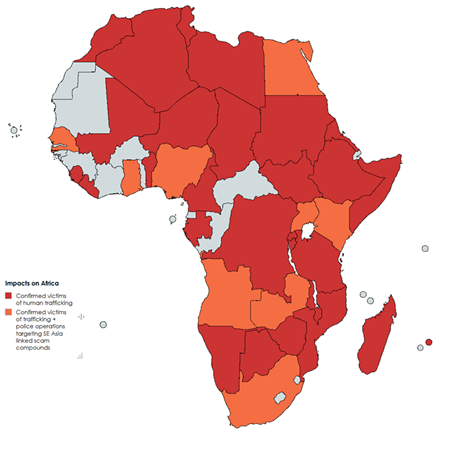
For some time, China-linked scam syndicates have viewed Africa as a source of labour for their industrial-scale operations in Cambodia, Myanmar and Laos. Going back to at least 2022, people from Kenya, Uganda, Nigeria, Ethiopia, South Africa and Zimbabwe have been targeted by job advertisements offering high salaries in the Middle East or South East Asia, only to be trafficked into forced criminality. The focus of recruitment has since expanded to include Francophone countries, including Burundi, Cameroon, Madagascar and the Democratic Republic of the Congo. Conservative estimates suggest that 10 000 to 15 000 Africans from at least 33 countries have been lured into scam centres.
Africa has also long been targeted as a potential hub for the expansion of this form of scamming, mainly because of the established presence of call centre-style scam operations in countries like Nigeria and South Africa. In the early 2020s, a network linked to China attempted to infiltrate Uganda, with several key compound developers known to operate out of Cambodia and Myanmar relocating to the country. The syndicate’s leader, Liu Dawei, was associated with a sanctioned transnational criminal organization run by the notorious Chinese criminal leader Wan Kuok-koi, or ‘Broken Tooth’. Liu was arrested and extradited, however, having fallen foul of authorities in China and Dubai for earlier crimes, including defrauding a large number of people in a complex, cross-border real estate scam.
In 2023, South Africa became a base of operations for a major organized crime group that had played a crucial role in setting up mass scam centres in Myanmar before being targeted by Thai authorities. The alleged head of this operation, Bai Zhaohui, was connected to Wan Kuok-koi’s Hongmen World Historical and Cultural Association, which serves as a front for a serious transnational organized criminal network sanctioned by the US and the UK. Although Bai appears to have relocated to China, Hongmen remains active in South Africa, having most recently surfaced in 2025 through publicly supporting a money transfer company targeting the country’s Chinese-speaking market.
From trafficking to continental operations
Some of these early attempts by China-linked scam syndicates to establish a foothold in Africa were disrupted through effective information sharing between authorities, aided by the fact that several key actors were well known to law enforcement and wanted across various jurisdictions. Despite these initial successes, however, there are growing indications that China-linked networks are now operational in several countries. The development appears to have coincided with a wave of African nationals returning from South East Asia, where they were coerced into scam activities, potentially bringing with them the knowledge and connections that enable local expansion.
The Global Initiative Against Transnational Organized Crime has identified 14 countries that are particularly at risk of industrial-scale scam operations. In all of these locations, China-linked scam syndicates maintain an active presence on various Telegram channels, while associated money laundering and underground banking syndicates advertise jobs in several languages, using tactics similar to those employed in South East Asia. Some groups, including those linked to Madagascar, have attracted over 40 000 participants. In addition, underground payment systems used to launder scam proceeds are operating in at least 10 of these jurisdictions.
Police and media reporting reinforce this assessment. Since late 2024, authorities in Nigeria and Ghana have conducted raids on facilities hosting scam operations involving over 500 people of mixed Chinese and South East Asian origin. Smaller operations have been shut down in Zambia, Uganda, Eswatini, Angola and Egypt.
The methods used to set up such operations vary from country to country, but often mirror those found in South East Asia. Some operate informally out of hotels and resorts, while others present themselves as call centres or business process outsourcing companies, or are embedded within casinos. In Zimbabwe, for instance, around 10 new casinos have reportedly been developed by Chinese investors over the last five years. Several of these in Harare have three-metre-high perimeter walls, raising concerns about the activities that may be taking place inside.
As cyber scam operations in South East Asia face intensifying crackdowns, tens of thousands of people will be looking to return home or relocate, taking their institutional knowledge with them. The syndicates behind these activities, meanwhile, will seek to establish new hubs in locations with weak governance, corruption, and poor oversight of sectors such as gambling, business process outsourcing and cryptocurrency. Given their limited awareness of the warning signs associated with these emerging China-linked scam operations, African nations are acutely vulnerable to this threat.
Steps towards a continental strategy
In March, the African Union’s Continental Operation Centre – a specialized agency dedicated to combating irregular migration and human trafficking – convened for the first time to develop an action plan to address forced criminality in South East Asia, with a particular focus on scam centres. The meeting was productive: a framework for enhanced coordination across African countries was established, alongside a proposal for an Africa–Asia cooperation initiative backed by Thailand.
These are important initial steps, underlining the fact that cyber scams are no longer just a South East Asia problem. However, three further actions should be undertaken immediately to mitigate the impact on Africa and reduce the risk of China-linked scam syndicates scaling up their operations on the continent. First, in order to address the threat of human trafficking, the African Union should focus on establishing strong coordination mechanisms for border management, visas and immigration policies. The Continental Operation Centre could play a leading role here, given the need for effective inter-agency coordination across state lines.
Second, African Union member states must be equipped with the skills necessary to recognize the basic warning signs of this form of fraud. This should be complemented by stronger regulatory oversight of casinos, digital payments and cryptocurrency exchanges. The Association of Southeast Asian Nations (ASEAN) could offer valuable insights here, while recognizing that Africa’s operating environment presents unique challenges.
Finally, the momentum generated by the African Union meeting should be built upon in order to support the development of a global coalition against scam centres. This could be achieved through closer collaboration in joint initiatives, such as the recent EU–ASEAN partnership, as well as the coordinated efforts of the US, UK and South Korea to target criminal actors. The African Union may also wish to engage China on the issue, given that many African nationals are trafficked and repatriated through Chinese territory.
Ultimately, Africa needs prompt action, improved coordination and sustained engagement to avoid becoming a new regional hub for scam centres. How African states respond in the near term will determine whether China-linked scam syndicates remain contained or become further entrenched across the continent.