Posted on 22 Jan 2026
There is widespread academic and policy recognition that climate change is transforming and redefining global security and development. Global efforts to tackle this challenge have occupied national governments and international organizations through diplomacy, mitigation, and policies for sustainability and cutting emissions.
More recently, studies and policy engagement by city-focused organizations such as C40 – a network of local governments in large cities – have shed light on the increasing impact of climate change on cities and their challenges and opportunities in responding to it. Ten large global cities examined by C40 in a 2024 study are expected to receive 8 million climate migrants by 2050. But estimates vary widely – and some go higher. The World Bank estimates that 143 million people could be forced to move within their own countries in sub-Saharan Africa, South Asia and Latin America by 2050. It is highly likely that most of this population will flock to cities in search of jobs, education and family networks. The World Bank specifies that ‘urban and peri-urban areas will need to prepare for an influx of people’.
Climate change and organized crime need to be studied together to achieve a broader understanding of both phenomena and their symbiotic intersections. A few studies – for example, one examining crimes involving waste, wildlife trafficking and fishing, and an article highlighting how illegal logging is linked to land conversion for agricultural use – have looked at how crime contributes to CO2 emissions and broader climate change, but existing studies fail to provide recommendations for what urban and peri-urban areas should do to prepare for the impact of organized crime.
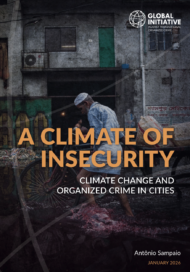
This report examines the intersection of climate change and organized crime in cities. The relationship between these issues is a critical area for policy and programming in governments and multilateral organizations. There is already significant evidence of the central role that cities play as destinations for climate-affected migrants fleeing both rapid- and slow-onset disruptions to their rural livelihoods or moving within cities affected by sea level rises, increased flooding or heat islands. Urbanization is not necessarily a negative or crime-inducing trend, but the rapid movement of people to areas unprepared to cope with service provision and law enforcement demands, coupled with increased pressures on resources such as water and land, can provide opportunities for criminal groups to profit through exploitative, predatory and violent practices. Three such areas require policy and expert attention: human trafficking and modern slavery affecting rural-to-urban migrants; organized crime involvement in water provision in cities; and corruption and the operation of mafia-style groups in urban land and housing.
Key points:
- Cities and towns are particularly vulnerable to organized crime in regions affected by climate change, due to the rapid movement of people migrating or being displaced by disruptive weather patterns – most of whom will move to cities. This increases the risk of migrants falling prey to human trafficking, modern slavery and extortion. Scarcity or increased demand for resources such as water and land also creates opportunities for urban mafias.
- Migrants escaping the disruption to their agricultural lifestyles are at risk of falling into situations of modern slavery. A lack of savings, skills and local social support networks puts them at risk of exploitation, particularly in domestic work and the construction sector. This is compounded by the often inadequate rule of law in many rapidly growing informal settlements, where low-income rural migrants are likely to settle.
- Women and girls are vulnerable to trafficking into domestic or sex work, both of which can lead to debt bondage and intimidation.
- The rapid influx of people fleeing climate-affected areas into large cities puts additional pressure on resources. The issue of water is emblematic, with extremely low supplies already causing alarm in several drought-stricken cities. Water is also a resource that has frequently been exploited by organized crime groups with corrupt connections to public agencies, as in South Asia.
- Perhaps the most profitable criminal enterprise exploiting climate-related shocks in cities is land theft. Rapid rural-to-urban migration encourages price rises and speculation, and predatory mafias or corrupt employees in public agencies can profit greatly from illegally occupying land, falsifying land ownership documents and illegally constructing buildings that are often unsafe. This voracious urban land rush can put further pressure on the climate by degrading the vegetation surrounding cities.