Posted on 19 Oct 2026
A year on from the Louvre heist, Europe is experiencing its worst wave of museum thefts in a decade. But why target items with no clear path to profit?
The sun had not yet risen when two thieves broke into the Renoir Museum in the French Riviera town of Cagnes-sur-Mer on 8 September 2026. The alarm went off at 5:48 a.m., and the police arrived within five minutes. But the suspects had already vanished, taking with them four of the 12 paintings housed there by the French Impressionist – two of which were abandoned in the hasty departure. A month later, six suspects were arrested and the missing paintings recovered.
This was one of seven heists to hit European museums in 2026, three of them in August alone – a wave that made this year the worst in a decade for such crimes. Since 2015, at least 21 high-level thefts have been reported in the European media, a third of which occurred in 2026. This trend points to something other than vulnerabilities in security systems: cultural goods are increasingly being targeted by organized crime, even though the path to profiting from them may not always seem clear. So why are criminal groups becoming involved in the illegal trade of art and antiquities? And, more importantly, how?
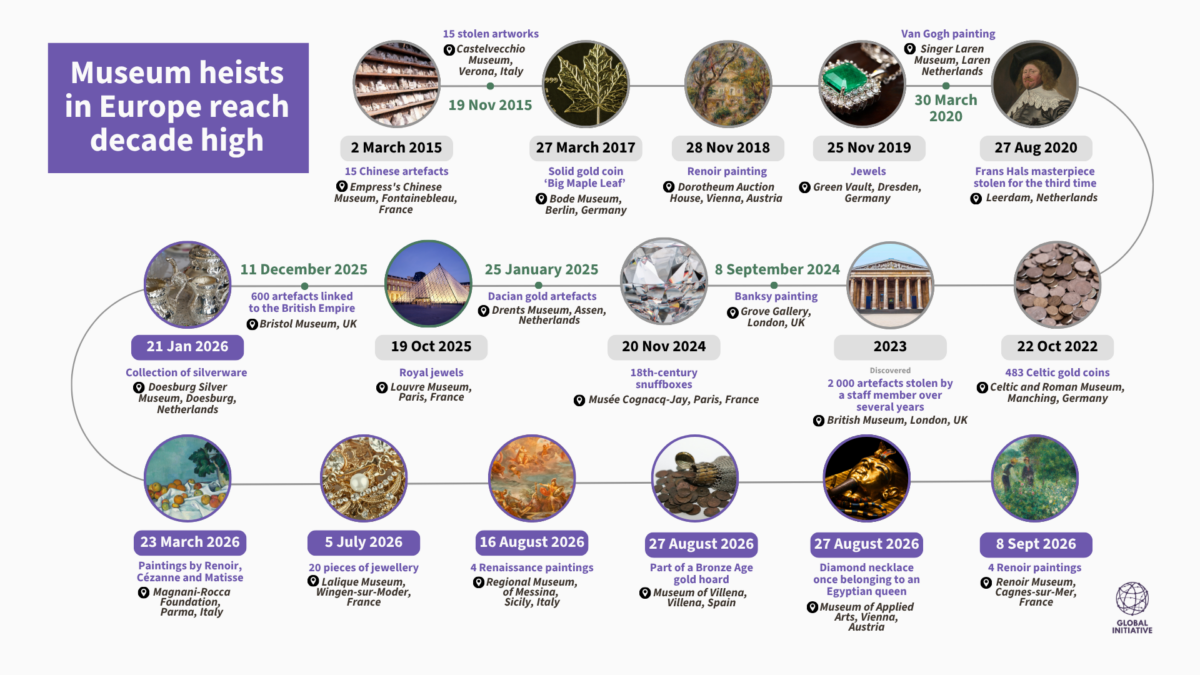
In the past, museum thefts were regarded as discreet operations, but they are now more aggressive and more forceful, a Europol report from August 2026 revealed. In November 2024, for example, thieves entered the Cognacq-Jay museum in Paris wielding baseball bats and axes and made off with seven bejewelled snuffboxes worth an estimated €1 million. This tactic points to the entry of a new kind of perpetrator into the world of art and antiquity crime, one less specialized in stealing cultural goods and more likely to have a background in other illicit economies.
What do you do with an €88 million jewel?
The target has also diversified beyond famous artworks. In a context where precious-metal prices are skyrocketing, thieves are increasingly going after high-value jewellery. However, selling well-known pieces intact is risky, even on the black market. In an article published last year, Sarah Fares, senior analyst at the Global Initiative Against Transnational Organized Crime (GI-TOC), explained that items containing gold, silver and gemstones are often broken down into raw materials or melted, making them almost undetectable when they re-enter the market as bullion or scrap. They are then sold on to refiners or smaller dealers, who ask few questions about where the material came from. The laundering process can be complete within days.
This may have been the fate of the goods stolen in the now infamous heist at the Louvre Museum in Paris a year ago. The suspects made away with royal jewels from the Apollo Gallery estimated at €88 million, but left behind pieces of greater value, such as the iconic Regent Diamond, which would have been easily recognized by collectors.
For art crime detective Arthur Brand, the Louvre heist exposed the museum’s vulnerability and is likely to have inspired copycats. ‘If you are able to hit the Louvre, thieves all around the world are watching,’ Brand told the BBC.
So far this year, four of the seven documented heists have targeted pieces that are likely to be stripped or melted down for resale. In January, two suspects emptied the entire collection of antique silverware at the Silver Museum in Doesburg, the Netherlands, making off with more than 300 pieces. In July, 27 pieces of jewellery worth an estimated €4.5 million were taken from the Lalique Museum in Wingen-sur-Moder, France, in a smash-and-grab that lasted just 10 minutes. On 27 August, part of a Bronze Age gold collection known as the Treasure of Villena was stolen from a museum in Spain in under five minutes. On the same day, a diamond necklace worth an estimated US$4.3 million was taken from the Museum of Applied Arts in Vienna.
When the art itself becomes currency
Despite the high value of some of these pieces, financial gain is not the only motive behind the robberies. In addition to the French Riviera heist, two high-profile robberies have taken place at Italian museums this year – one at the Regional Museum of Messina and another at the Magnani-Rocca Foundation – leading to the loss of several Renaissance and Impressionist masterpieces. Like the Louvre crown jewels, these paintings – among them works by Renoir, Cézanne and Matisse – are too recognizable to sell on without being detected.
So why would criminals want to steal them? According to Fares, stolen art can also function as collateral, leverage or currency within the criminal underworld – a way to move value without ever putting it on the open market. This was the case with two stolen Van Gogh paintings bought by Raffaele Imperiale, a high-ranking member of the Camorra mafia and a leading figure in the so-called European super cartel.
The paintings were found on a farm owned by Imperiale after being considered lost for 14 years. Imperiale’s legal team claimed that he purchased them because of his love of art. However, in August 2016, Imperiale had sent a letter to a public prosecutor in Naples confessing that he had the paintings, apparently in an attempt to negotiate a more lenient sentence for himself during Italy’s investigations into the Camorra. Similarly, in 2020, a Belgian drug lord bought a stolen Frans Hals painting on the black market, reportedly to use as a bargaining chip to negotiate his partner’s release from prison if needed.
A heist for hire
Another motive is when art is stolen on commission. This was the case with Vjeran Tomic, the ‘Spiderman’ burglar, who was known for his ability to scale buildings. Tomic was commissioned by an antiques dealer to steal a Fernand Léger painting from the Modern Art Museum in Paris for US$43 000. He ended up taking five paintings, seizing the opportunity when the alarm failed to go off. The robbery included works by Picasso and Matisse, bringing the total value of the haul to more than €100 million.
There has also been a discernable change in how these thieves are hired. Heists have traditionally involved an organized group with a defined leader, but the recent Europol report points to a rise in recruitment through social media, often for a single job. Perpetrators are increasingly low-level criminals with experience in other, unrelated crimes. Europol says it needs more intelligence to map the trend fully, but its early assessment is that criminal organizations already active in other illegal markets are starting to see museum heists as low-risk and high-reward.
As museums scramble to reinforce security, and law enforcement agencies across Europe begin sharing intelligence on these networks, the current wave of heists may ultimately represent a fleeting opportunity for criminals rather than a more permanent threat to the continent’s cultural heritage. Whether this gap closes or not will depend on how quickly Europe’s museums catch up – and how easily organized crime adapts. Criminal organizations often find alternative ways to keep their business going when one door closes. If the benefits of stealing cultural artefacts continue to outweigh the risks, we may see new tactics implemented in the future.
Although the Renoir paintings were quickly found, this is not the usual outcome of thefts from Europe’s museums, with only an estimated 5 to 10 per cent of stolen art ever recovered. Beyond the criminal dimensions, every one of these heists chips away at the continent’s cultural heritage. Once melted down, recut or dispersed into private hands, the stolen pieces are gone – in most cases, for good.