On 23 August, after weeks of planning, armed men attacked the rural community of Kenscoff, outside the Haitian capital of Port-au-Prince. The assault left at least 47 people dead and culminated in one of the largest mass kidnappings in the country’s history.
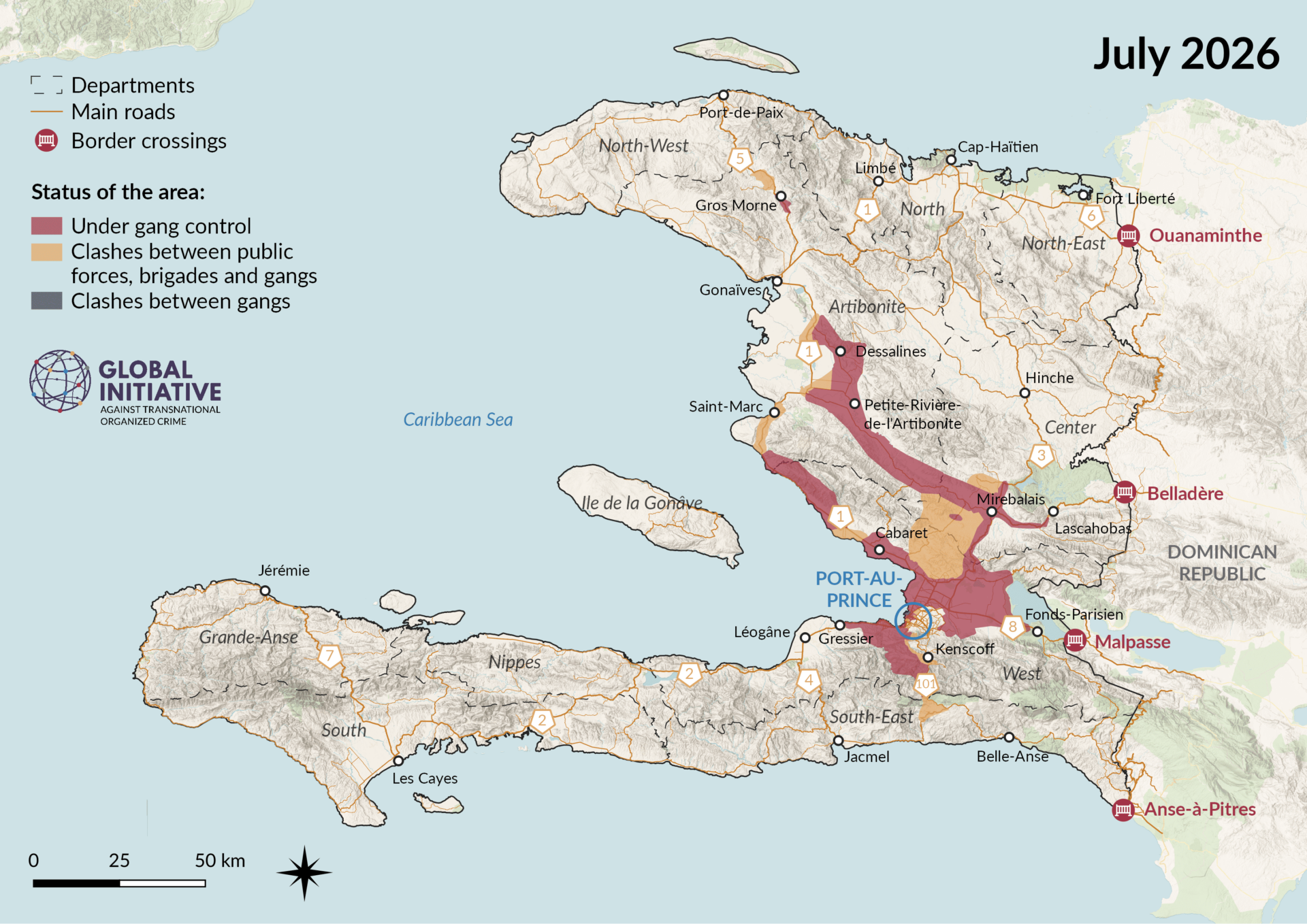
Since February 2024, when Haiti’s principal gangs joined forces under the Viv Ansanm coalition, security efforts have remained focused almost entirely on Port-au-Prince, while gang violence has increasingly become rural and centrifugal, extending far beyond the capital. The gangs’ expansion has been enabled by a structural weakness in the response: forces lack the numbers, training and equipment to confront dispersed, highly mobile armed actors across rural and mountainous terrain.
Gang expansion in Haiti, July 2026
Two case studies in rural gang expansion
Since 2024, the Artibonite department, north of Port-au-Prince and home to much of Haiti’s agricultural production, has become one of the country’s most volatile conflict zones. The violence is perpetrated both by local criminal groups, mainly Gran Grif and Kokorat San Ras, which announced an alliance in April 2026, and gangs from the capital, particularly the Taliban and 5 Segond. In 2025, 456 people were killed in the region, accounting for 16% of all victims nationwide, and tens of thousands were displaced. These levels of violence have continued into 2026.
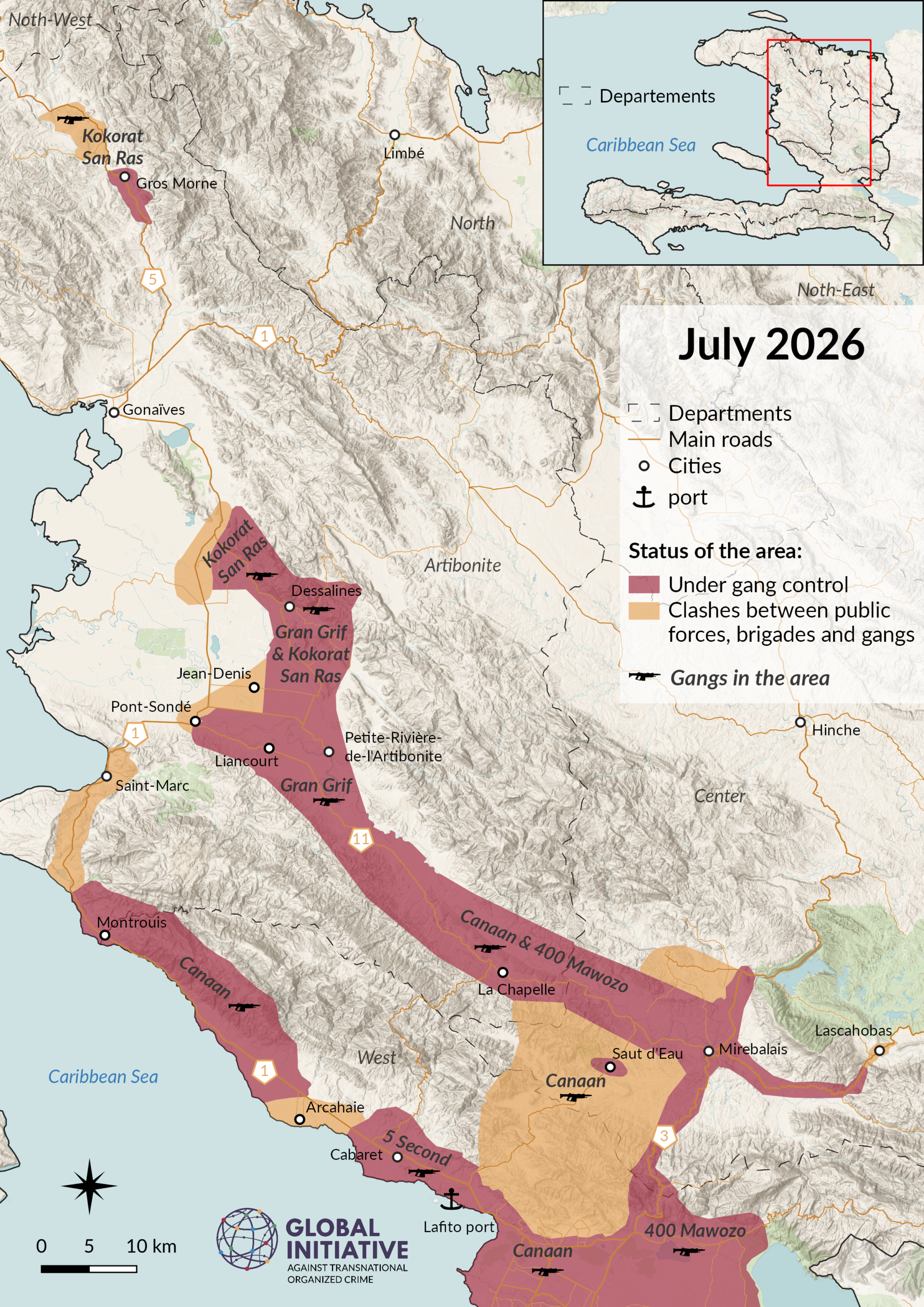
The latest massacre in Artibonite occurred at the end of March, when Gran Grif attacked Petite Rivière and Dessalines, killing over 70 people and displacing more than 13 500. Advance warnings had circulated on WhatsApp, and the operation was meticulously planned. Roads and bridges were blocked, preventing law enforcement and self-defence brigades from intervening and limiting residents’ ability to escape. Homes were set alight with occupants trapped inside. Those attempting to flee were shot. The massacre was followed by territorial expansion, and Gran Grif and Kokorat San Ras now control vast portions of the Artibonite’s fertile lands and key roads.
Gang expansion in Artibonite, July 2026.
The mountainous commune of Kenscoff, which overlooks the Port-au-Prince metropolitan area, was invaded by gangs from the capital in January 2025. Over time, a group led by an individual known as ‘Didi’ or ‘Izo 2’ has become familiar with the terrain, giving them a tactical advantage in operations launched from ravines and high ground. They maintain dispersed cells of roughly a dozen men, capable of acting at short notice. While security forces hold fixed positions in the town centre, the criminal groups move around them, harassing isolated communities, blocking roads and increasing their territorial hold.
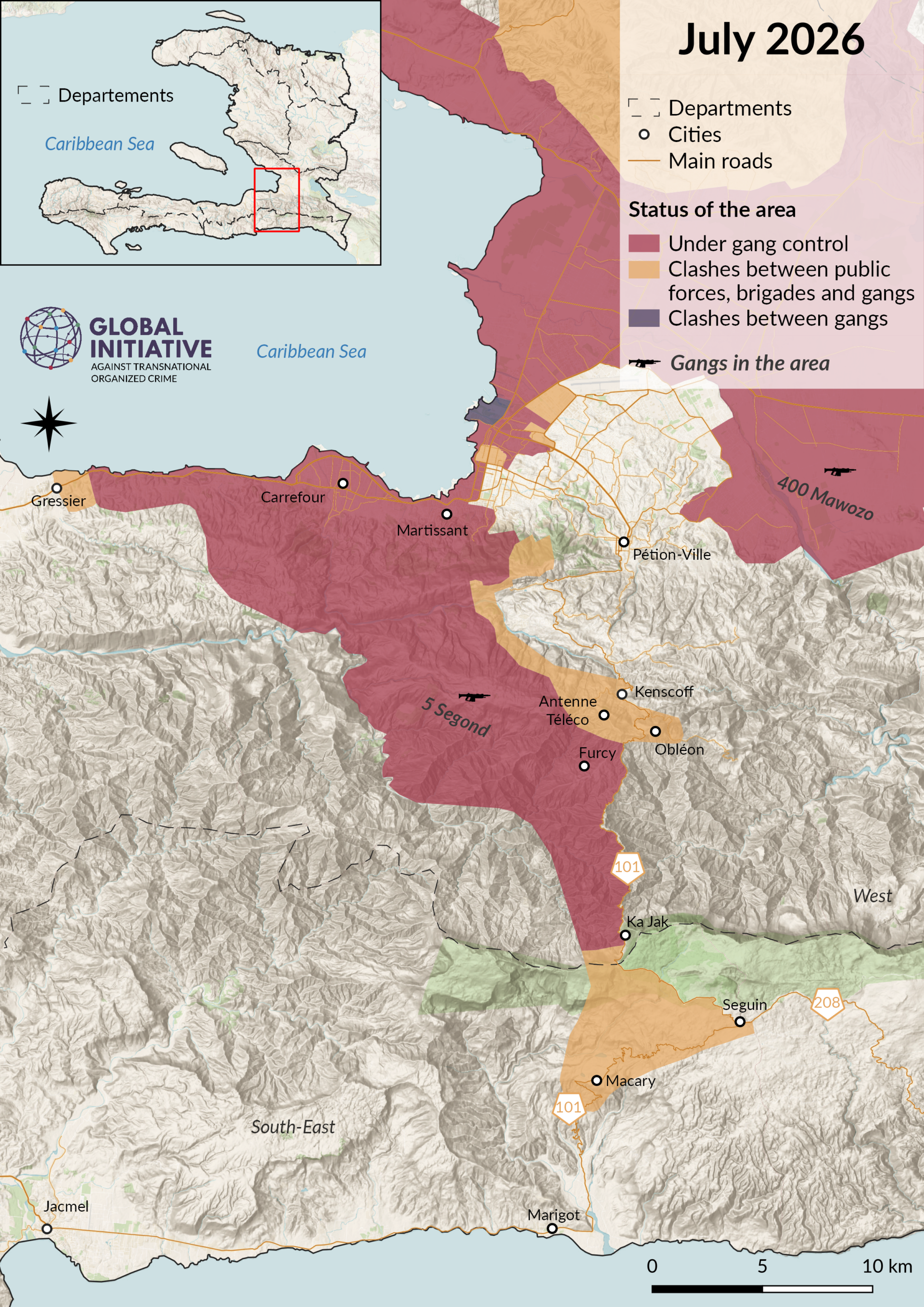
Between 4 and 9 July, the gang stormed the locality of Robin, killing between 61 and 105 people. They raped civilians in their homes and forced almost 6 000 people – nearly a tenth of the commune’s population – to flee. Six weeks later, on 23 August, the gang targeted the centre of Kenscoff. Preparations for the operation included the use of drones for reconnaissance. Starting at about 9 p.m., gang members struck a displacement camp inside a church, set fire to houses and killed dozens of civilians just metres from the police station. At least 50 people were kidnapped. In a video posted on social media, Didi threatened to execute the hostages, including the children, if security forces hit back, saying: ‘If any of our soldiers are hurt, I will kill all of them.’
Gang presence in Kenscoff and surrounds, July 2026.
Criminal governance and guerrilla tactics in rural Haiti
The ruralization of Haitian gangs represents more than the extension of urban criminal practices to backcountry areas. It has prompted these groups to adopt new operational strategies that go beyond the invasion of territory, and has enhanced their capacity for criminal governance. Guerrilla-type tactics such as lightning raids, harassment, looting, cattle theft, rape and kidnapping are common, alongside rapid movement between sanctuary zones and areas of attack.
Hostages can also serve as a substitute for large-scale territorial occupation. While fixed positions require personnel and resources, and are vulnerable to attack, holding captives requires far less operational investment, while providing leverage for ransom negotiations. Furthermore, public threats, such as those made by Didi on 23 August, are designed to put the authorities in a no-win situation: inaction would demonstrate the state’s inability to protect its population, whereas intervention could enable the gang to blame the police for any subsequent fatalities.
The situation in Artibonite and Kenscoff therefore shows that Haiti’s gangs do not necessarily need to fully occupy an area to increase their influence. Even if gangs are forced, or choose, to withdraw, police forces are often unable to maintain a lasting presence, allowing them to return on their own terms. Each incursion broadens the space in which criminal groups can operate freely. This explains why the recent efforts of the Haitian National Police and the anti-gang task force, supported by private military contractor Vectus Global, have struggled to produce lasting results. In May, for instance, the police dismantled several gang checkpoints near L’Estère and La Croix-Périsse in the Artibonite. Within days they were reinstalled, slightly further away.
Implications
The situation has three main implications. The first concerns how criminal power is measured by security actors and policymakers. In Haiti, assessments tend to focus on the territory gangs hold. But rural expansion suggests that freedom of movement may matter just as much. A group does not need to occupy a town permanently to shape governance, disrupt daily life or project power. The ability to strike repeatedly may be as significant as holding territory outright.
The second relates to force design, and is as much a problem of numbers as of strategy, doctrine and training. Despite announcements of a surge in police and army manpower and the desperate use of armed drones, Haiti’s security forces lack the human resources to respond to the current challenge. Meanwhile, the Gang Suppression Force (GSF), whose deployment began in May 2026, has not yet reached full capacity, standing at 1 083 troops, well short of the 5 500 envisaged by December 2026.
More fundamentally, Haitian National Police personnel are not trained to operate in rural or mountainous areas. On 12 August, the GSF announced the arrival of a Sri Lankan contingent in the Artibonite, reportedly trained for this type of terrain. However, its integration into operations will take time, and must contend with the gangs’ entrenchment and detailed knowledge of the region and communities. Finally, the latest GSF strategic plan, presented in July, did not identify Kenscoff as a deployment site. Recent events may force a rethink. However, for both the Haitian National Police and the GSF, every reinforcement results in a thinning of resources elsewhere, a challenge made more acute by the effectiveness of the gangs’ highly mobile operating model.
The third implication concerns what security measures alone cannot deliver. The Artibonite and Kenscoff regions require a political strategy that must go hand in hand with the security response. This should include protection and support for farmers, and an immediate agenda for economic and social recovery. Such a framework would also need to be accompanied by disarmament, demobilization and reintegration programmes, alongside reconciliation efforts to address the long-standing inter-communal and land conflicts in these areas.
Without an integrated approach, beginning with a security response capable of matching gangs’ shifting methods, episodes of mass violence like those seen in Kenscoff in August will continue to be a recurring feature of Haiti’s conflict landscape.
De Port-au-Prince à la périphérie
La ruralisation de la violence des gangs en Haïti
Le 23 août, après une longue préparation, des hommes armés ont attaqué la communauté rurale de Kenscoff, aux abords de Port-au-Prince, la capitale haïtienne. Cette attaque a fait au moins 47 morts et a débouché sur l’un des plus grands enlèvements collectifs de l’histoire du pays.
Cette attaque a mis en lumière un défi de longue date : malgré le renforcement des forces de sécurité haïtiennes, les groupes criminels conservent la capacité de frapper à leur guise. Elle reflète également une évolution plus large de la crise que traverse le pays, à laquelle les décideurs politiques n’ont jusqu’à présent pas accordé suffisamment d’attention.
Depuis février 2024, date à laquelle les principaux gangs haïtiens ont uni leurs forces au sein de la coalition « Viv Ansanm », les analyses et les efforts en matière de sécurité sont restés presque exclusivement concentrés sur Port-au-Prince, tandis que la violence des gangs s’est de plus en plus déplacée vers les zones rurales et s’est étendue bien au-delà de la capitale. La ruralisation des gangs a été favorisée par une faiblesse structurelle de la riposte : les forces de sécurité manquent d’effectifs, de formation et d’équipement pour faire face à des acteurs armés dispersés et très mobiles sur des terrains ruraux et montagneux.
Carte nationale de l’expansion des gangs en Haïti, juillet 2026.
Deux cas d’expansion des gangs en milieu rural
Depuis 2024, le département de l’Artibonite, situé au nord de Port-au-Prince et où se concentre la majeure partie de la production agricole haïtienne, est devenu l’une des zones de conflit les plus instables du pays. La violence est le fait de groupes criminels locaux, principalement Gran Grif et Kokorat San Ras, qui ont annoncé une alliance en avril 2026, et de gangs venus de la capitale, notamment les Taliban et 5 Segond. En 2025, 456 personnes ont été tuées dans la région, soit 16 % de l’ensemble des victimes à l’échelle nationale, et des dizaines de milliers d’autres ont été déplacées. Ces niveaux de violence se sont poursuivis en 2026.
Le dernier massacre en date dans l’Artibonite s’est produit fin mars, lorsque Gran Grif a attaqué Petite Rivière et Dessalines, tuant plus de 70 personnes et provoquant le déplacement de plus de 13 500 autres. Des avertissements préalables avaient circulé sur WhatsApp, et l’opération avait été planifiée. Les routes et les ponts ont été bloqués, empêchant les forces de l’ordre et les brigades d’autodéfense d’intervenir et limitant la capacité des habitants à s’échapper. Des maisons ont été incendiées avec leurs occupants piégés à l’intérieur. Ceux qui tentaient de fuir ont été abattus. Ce massacre a été suivi d’une expansion territoriale, et Gran Grif et Kokorat San Ras contrôlent désormais de vastes portions des terres fertiles de l’Artibonite ainsi que des axes routiers clés.
Expansion des gangs dans l’Artibonite, juillet 2026.
La commune montagneuse de Kenscoff, qui surplombe la zone métropolitaine de Port-au-Prince, a été envahie par des gangs venus de la capitale en janvier 2025. Au fil du temps, un groupe dirigé par un individu connu sous le nom de « Didi » ou « Izo 2 » s’est familiarisé avec le terrain, ce qui lui confère un avantage tactique lors des opérations lancées depuis les vallées et les hauteurs. Il dispose de cellules mobiles, d’une douzaine d’hommes environ, capables d’intervenir à tout moment. Tandis que les forces de sécurité tiennent des positions fixes dans le centre-ville de Kenscoff, les groupes criminels se déplacent autour d’elles, harcelant les communautés isolées, bloquant les routes et renforçant leur emprise territoriale.
Entre le 4 et le 9 juillet, le gang a pris d’assaut la localité de Robin, tuant entre 61 et 105 personnes. Ses membres ont violé des habitants dans leurs maisons et contraint près de 6 000 personnes – soit près d’un dixième de la population de la commune – à fuir. Six semaines plus tard, le 23 août, le gang a pris pour cible le centre de Kenscoff. Les préparatifs de l’opération comprenaient l’utilisation de drones à des fins de reconnaissance. À partir de 21 heures environ, les membres du gang ont attaqué un camp de déplacés installé dans une église, incendié des maisons et tué des dizaines de civils à proximité du commissariat de police. Au moins 50 personnes ont été enlevées. Dans une vidéo publiée sur les réseaux sociaux, Didi a menacé d’exécuter les otages, y compris les enfants, si les forces de sécurité ripostaient, déclarant : « Si l’un de nos soldats est blessé, je les tuerai tous. »
Présence des gangs à Kenscoff, juillet 2026.
Gouvernance criminelle et tactiques de guérilla dans les zones rurales d’Haïti
La ruralisation des gangs haïtiens représente plus que la simple extension des pratiques criminelles urbaines aux zones rurales. Elle a poussé ces groupes à adopter de nouvelles tactiques opérationnelles qui vont au-delà de l’invasion de territoires, et a renforcé leur capacité de gouvernance criminelle. Les tactiques de type guérilla, telles que les raids éclair, le harcèlement des communes, le pillage, le vol de bétail, les viols systématiques et l’enlèvement font partie du repertoire d’action, tout comme leurs capacités de déplacements rapides entre les zones de refuge et les zones d’attaque.
Les otages peuvent également servir de substitut à une occupation territoriale à grande échelle. Alors que les positions fixes nécessitent du personnel et des ressources, et sont vulnérables aux attaques, la détention d’otages requiert un investissement opérationnel moindre, tout en offrant un moyen de pression pour les négociations de rançon. De plus, les menaces publiques, telles que celles proférées par Didi le 23 août, visent à placer les autorités dans un piège politique : l’inaction démontrerait l’incapacité de l’État à protéger sa population, tandis qu’une intervention permettrait au gang d’imputer à la police la responsabilité de tout décès ultérieur.
La situation en Artibonite et à Kenscoff montre donc que les gangs haïtiens n’ont pas nécessairement besoin d’occuper entièrement une zone pour accroître leur influence. Même si les gangs sont contraints, ou choisissent, de se retirer, les forces de police sont souvent incapables de maintenir une présence durable, ce qui permet aux groupes criminels de revenir selon leurs propres conditions. Chaque incursion élargit l’espace dans lequel les groupes criminels peuvent opérer librement. Cela explique pourquoi les efforts récents de la Police Nationale d’Haiti (PNH) et la Task Force, soutenus par la société militaire privée Vectus Global, peinent à produire des résultats durables. En mai, par exemple, la police a démantelé plusieurs checkpoints tenus par des gangs près de L’Estère et de La Croix-Périsse, dans l’Artibonite. Ceux-ci ont été réinstallés, un peu plus loin, en l’espace de quelques jours.
Trois implications
Cette situation a trois implications principales.
La première concerne la manière dont le pouvoir criminel est évalué par les acteurs de la sécurité et les décideurs politiques. En Haïti, les évaluations ont tendance à se concentrer sur le territoire contrôlé par les gangs. Or, l’expansion vers les zones rurales suggère que la liberté de mouvement pourrait être tout aussi importante. Un groupe n’a pas besoin d’occuper une ville en permanence pour influencer la gouvernance, perturber la vie quotidienne ou projeter son pouvoir. La capacité à frapper à plusieurs reprises peut être aussi importante que la possession effective d’un territoire.
La deuxième conséquence concerne les capacités des forces de sécurité, et relève autant d’un problème d’effectifs que de stratégie, de doctrine et de formation. Malgré les annonces d’une augmentation des effectifs de la police et de l’armée et le recours désespéré à des drones armés, les forces de sécurité haïtiennes manquent de ressources humaines pour relever le défi actuel. Par ailleurs, la Force de répression des gangs (FRG), dont le déploiement a débuté en mai 2026, n’a pas encore atteint sa pleine capacité, avec un effectif de 1 083 soldats, bien en deçà des 5 500 prévus d’ici décembre 2026.
Plus fondamentalement, le personnel de la PNH n’est pas formé pour opérer dans les zones rurales ou montagneuses. Le 12 août, la FRG a annoncé l’arrivée dans l’Artibonite d’un contingent sri-lankais formé pour ce type de terrain. Cependant, son intégration dans les opérations prendra du temps et devra faire face à l’enracinement des gangs ainsi qu’à leur connaissance approfondie de la région et des communautés. Enfin, le plan stratégique de la FRG, présenté en juillet, n’identifiait pas Kenscoff comme site de déploiement. Les événements récents pourraient l’obliger à revoir cette position. Toutefois, tant pour la PNH que pour la FRG, chaque envoi de renforts entraîne une diminution des effectifs ailleurs, un problème rendu encore plus aigu par l’efficacité du modèle opérationnel des gangs dans les zones rurales.
La troisième implication concerne ce que les stratégies de sécurité ne peuvent à elles seules apporter. Les régions de l’Artibonite et de Kenscoff nécessitent une stratégie politique qui doit aller de pair avec la réponse sécuritaire. Celle-ci devrait inclure la protection et le soutien aux agriculteurs, ainsi qu’un programme immédiat de relance économique et sociale. Un tel cadre devrait également s’accompagner de processus de désarmement, de démobilisation et de réintégration, ainsi que d’efforts de réconciliation visant à répondre aux conflits intercommunautaires et fonciers de longue date dans ces zones.
Sans une approche intégrée, commençant par une réponse sécuritaire capable de s’adapter aux tactiques nouvelles des gangs, les épisodes de violence de masse comme ceux observés à Kenscoff en août continueront d’être une caractéristique récurrente de la crise haïtienne.