Posted on 22 Jul 2026
The report examines the security challenges affecting the Somali community in Eastleigh, Nairobi. Known as “Little Mogadishu,” Eastleigh is a major commercial centre but also contains a large low-income population and many refugees and recent migrants. The research draws on interviews and Shared Security Dialogues held between November 2025 and February 2026 with residents, civil society groups, businesspeople, government officials and law-enforcement representatives.
Its central finding is that Eastleigh’s illegal markets are interconnected. Document fraud supports migrant smuggling and human trafficking. Corrupt officials protect or participate in these activities. Gangs facilitate forced evictions and extract money from transport and waste-collection services. Unregulated construction and hotels can provide spaces in which trafficked people are concealed and exploited.
Climate change acts as a risk multiplier. Drought and the loss of rural livelihoods in Somalia and northern Kenya push people towards Nairobi. New arrivals often lack documents, safe accommodation, formal employment and social support, making them particularly vulnerable to bribery, forced labour, sexual exploitation and smuggling networks.
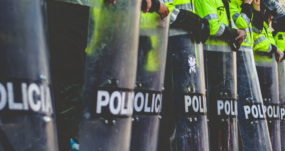
Relations between the Somali community and the police remain strained. Although additional police stations, community forums and the Nyumba Kumi community-policing programme have produced some improvements, residents continue to report ethnic profiling, arbitrary arrests, harassment and demands for bribes. This mistrust encourages some residents to use the Somali customary dispute-resolution practice known as maslaha. The report considers it useful for minor disputes but unsuitable for trafficking, violence and other serious crimes, which require formal investigation and accountability.
Eastleigh has long been associated with money laundering, especially through its real-estate sector and the hawala transfer system. Recent international fraud cases have revived these allegations. The report warns that evidence remains limited and that generalized accusations reinforce the stigmatization of Somali businesses and residents. It calls for deeper investigation of specific transactions and networks rather than assumptions based on ethnicity or the neighbourhood’s construction boom.
Eastleigh is both a destination and transit point for migrant smuggling. Networks move people from Somalia, Ethiopia and refugee camps such as Dadaab through Nairobi, often towards South Africa, Europe or Canada. Their operations depend on forged identity papers, accommodation providers, recruiters and allegedly corrupt police officers and administrators. Trafficking for labour and sexual exploitation is also significant. Women and girls may be recruited with false offers of employment or education and then confined and abused in hotels or apartments. The report also documents Somali young people being lured towards Libya with promises of reaching Europe, then kidnapped, tortured and held for ransom.
Document fraud is a crucial enabling market. Forgers produce identity cards, passports, refugee papers and certificates. Investigations have implicated not only private brokers but also registrars, clerks, technicians, police chiefs, local administrators and businesspeople. Refugees’ difficulties in obtaining legitimate documents increase demand for these services and expose them to exploitation.
Demand for housing and the profitability of Eastleigh’s property market have contributed to land grabbing, unauthorized construction and violent evictions. Developers and politically connected actors may use forged ownership papers, corrupt approvals, police uniforms or hired gangs to remove low-income tenants. The consequences extend beyond displaced residents: illegal development has also affected public land, hospital accommodation, water-company property and the security perimeter around Moi Air Base.
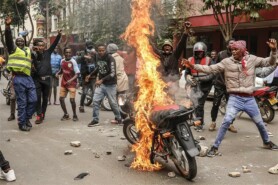
Gang activity is connected to politics, property, drugs and gaps in public services. Eastleigh’s most prominent gang, Super Power, is accused of robbery, drug dealing, protection rackets and control over parts of the matatu, boda boda and waste-collection sectors. A newer group, Only the Family, is increasingly visible but less well understood. Politicians and property developers have also reportedly employed gangs to intimidate opponents or enforce evictions.
The report recommends permanent community-government liaison officers, local steering committees and regular security forums. It proposes digitizing licences and identity-document processes while retaining strong physical and biometric checks; introducing verifiable digital permits and land records; improving investigations, patrol capacity and CCTV coverage; and connecting police verification tools with immigration and international databases.
It also calls for cultural-awareness and refugee-rights training for police, stronger oversight of Nyumba Kumi, confidential reporting channels in Somali and Swahili, and better protection for victims, whistleblowers and civil society activists. For migrants displaced by climate pressures, it recommends safe referral pathways, emergency accommodation and longer-term access to documentation, housing, legal assistance, childcare, mental-health services and livelihood training.
Overall, the report argues that Eastleigh’s insecurity cannot be addressed through police crackdowns or by treating the Somali community as a source of crime. Organized crime grows through corruption, weak services, administrative barriers and the vulnerability of migrants. A credible response therefore requires coordinated action by government, law enforcement, civil society and the community itself.