Posted on 18 Jun 2026
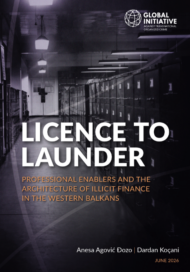
Across the Western Balkans, illicit money rarely moves on its own. It travels through notarized contracts, property deeds, loan agreements, invoices and audited financial statements — paperwork that needs someone with a license to sign, certify or stamp it before it can pass as legitimate.
This report looks at the professionals who provide that signature: notaries, lawyers, accountants, auditors and real estate brokers. Drawing on 89 interviews across Albania, Bosnia and Herzegovina, Kosovo, Montenegro, North Macedonia and Serbia, conducted between December 2024 and January 2026, alongside court records, national risk assessments and MONEYVAL evaluations, it traces how these gatekeepers can stop illicit finance at the door, or hold it open.
Real estate remains the primary channel. Undervalued or inflated property contracts, rapid resales among related parties, notarized loans with no plausible source of funds, and nominee buyers standing in for the real owner recur across all six countries. Shell companies, fictitious invoices and cross-border corporate structures add further layers, usually moved along by the same small circle of notaries, lawyers and accountants rather than handled by a single operator. One Italian accountant, recorded discussing funds moved through Albania and Montenegro, described his approach without much subtlety: “We will first make them disappear, then transfer them to Hong Kong or somewhere else.”
Western Balkan countries have largely brought their AML legislation into line with FATF and EU standards. Supervision is the weak link. Professional associations rarely have the authority or the staff to inspect their own members, and professional secrecy is often stretched to cover transactions that should have triggered a report. In 2024, Montenegrin notaries processed close to 19,857 property sales worth an estimated €1.6 billion and filed two suspicious transaction reports.
The report sets out what a functioning system would need — clearer limits on professional secrecy, background checks for notaries and accountants, standardized reporting templates, and real feedback between financial intelligence units and the professionals who file the reports. The full findings, country-by-country analysis and case studies follow below.