Posted on 28 Apr 2026
Illicit gold has become a strategic financial vehicle for organized crime, sanctions evasion, corruption and political control. Its high value, portability and suitability for money laundering allow criminal actors embedded in gold supply chains to generate and move illicit proceeds through the global financial system. At the same time, illicit gold mining, processing and trade are linked to serious environmental, human rights and security harms, including river pollution, forest destruction, conflict financing and grave abuses against affected communities.
The UK is significantly exposed to these risks, but also uniquely positioned to address them. London is the world’s leading hub for over-the-counter gold trading, and illicit gold entering the global system may ultimately flow through London, including via third-country refineries. As a major financial centre and home to key gold industry institutions, the UK has both the responsibility and the leverage to strengthen standards on financial integrity, transparency, responsible sourcing and due diligence.
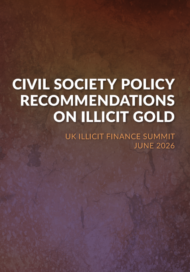
Prepared by 34 non-governmental organizations ahead of the UK Illicit Finance Summit in June 2026, this briefing paper sets out policy recommendations to confront illicit gold flows and the financial systems that enable them. It calls for stronger anti-money laundering rules, updated financial sector guidance, improved beneficial ownership transparency, mandatory due diligence across gold supply chains and financial markets, and more effective international cooperation between source, transit and hub countries.
The report argues that Summit commitments must move beyond broad statements. Effective action requires clearly defined deliverables, incorporation into national regulations, set timelines, robust follow-up mechanisms and inclusive approaches that place affected communities, local civil society and human rights defenders at the centre of policy responses.