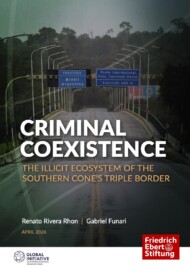
The Southern Cone tri-border area —comprising Ciudad del Este (Paraguay), Foz do Iguaçu (Brazil) and Puerto Iguazú (Argentina)— constitutes one of the most distinctive cross-border spaces in South America. Its particular geographical configuration combines densely populated urban areas with strategic riverine zones that facilitate intense cross-border circulation. More than 650,000 inhabitants coexist in an integrated social space marked by intense movement of people and one of the most heavily used commercial routes on the continent.
Within this environment of high mobility and commercial dynamism, smuggling has consolidated itself as the principal structuring axis of illicit economies. Since the creation of the free trade zone in Ciudad del Este in 1995, the region became a re-export centre for products destined mainly for the Brazilian market. Cigarettes, electronic products and alcoholic beverages enter Brazil as contraband, mobilized by local family clans and transnational illicit networks.
The report identifies a criminal ecosystem of coexistence characterized by interdependence, profitability and the historical continuity of illicit markets, sustained by commercial free movement, corruption and institutional fragility. Unlike other border areas in South America, the tri-border area presents high levels of criminal activity but low levels of violence, without armed disputes over territorial control or manifestations of criminal governance based on extortion or systematic coercion.
The report analyses the evolution of organized crime in the region, from the era of the “comboios” to the specialization of riverine routes and the “ant smuggling” model. It also examines the presence of the Primeiro Comando da Capital (PCC), which has consolidated control over clandestine ports in specific sectors of the Paraná River, without exercising generalized authority over the regional population.
Beyond smuggling, the report addresses cannabis trafficking produced in Paraguay, cocaine trafficking, arms trafficking and money laundering. Ciudad del Este emerges as a strategic financial node where commercial companies, real estate businesses, gambling houses and crypto-asset operations proliferate, facilitating the movement of illicit capital. The study also finds that the Argentinian side of the tri-border area has emerged as an increasingly prevalent smuggling hub over the past five years, generating new contraband routes and new security threats in the region.
The study is based on fieldwork and direct observation conducted in Ciudad del Este, Foz do Iguaçu and Puerto Iguazú, including interviews with members and former members of security forces, customs officials, judicial officials, academics and journalists specialized in the criminal dynamics of the tri-border area.
The Southern Cone tri-border area thus reveals a highly collaborative and adaptable criminal ecosystem, where smuggling functions as a base economy connecting flows, actors and routes used for drug trafficking, arms trafficking and other illegal goods. Its persistence is explained by its relatively non-violent character, informal regulation sustained by family clans and limited state capacities in the face of complex transnational dynamics.
Convivencia criminal: el ecosistema ilícito de la triple frontera del Cono Sur
La región de la triple frontera del Cono Sur —conformada por Ciudad del Este (Paraguay), Foz do Iguaçu (Brasil) y Puerto Iguazú (Argentina)— constituye uno de los espacios transfronterizos más singulares de América del Sur. Su particular configuración geográfica combina áreas urbanas densamente pobladas con zonas fluviales estratégicas que facilitan una intensa circulación transfronteriza. Más de 650 000 habitantes coexisten en un espacio social integrado, marcado por un alto movimiento de personas y una de las rutas comerciales más utilizadas del continente.
En este entorno de elevada movilidad y dinamismo comercial, el contrabando se ha consolidado como el principal eje estructurante de las economías ilícitas. Desde la creación de la zona franca de Ciudad del Este en 1995, la región se convirtió en un centro de reexportación de productos destinados principalmente al mercado brasileño. Cigarrillos, productos electrónicos y bebidas alcohólicas ingresan a Brasil como contrabando, movilizados por clanes familiares locales y redes ilícitas transnacionales.
El informe identifica un ecosistema criminal de convivencia caracterizado por la interdependencia, la rentabilidad y la continuidad histórica de los mercados ilícitos, sostenido por la libre circulación comercial, la corrupción y la fragilidad institucional. A diferencia de otras zonas fronterizas de América del Sur, la triple frontera presenta altos niveles de actividad criminal pero bajos niveles de violencia, sin disputas armadas por el control territorial ni manifestaciones de gobernanza criminal basadas en la extorsión o la coerción sistemática.
El informe analiza la evolución del crimen organizado en la región, desde la era de los «comboios» hasta la especialización de las rutas fluviales y el modelo de contrabando «hormiga». También examina la presencia del Primeiro Comando da Capital (PCC), que ha consolidado el control sobre puertos clandestinos en sectores específicos del río Paraná, sin ejercer una autoridad generalizada sobre la población regional.
Más allá del contrabando, el informe aborda el tráfico de cannabis producido en Paraguay, el tráfico de cocaína, el tráfico de armas y el lavado de activos. Ciudad del Este emerge como un nodo financiero estratégico donde proliferan empresas comerciales, negocios inmobiliarios, casas de juego y operaciones con criptoactivos, facilitando la circulación de capitales ilícitos. El estudio también concluye que el lado argentino de la triple frontera ha emergido como un centro de contrabando cada vez más relevante en los últimos cinco años, generando nuevas rutas ilícitas y nuevas amenazas de seguridad en la región.
El estudio se basa en trabajo de campo y observación directa realizados en Ciudad del Este, Foz do Iguaçu y Puerto Iguazú, incluyendo entrevistas con miembros y exmiembros de fuerzas de seguridad, funcionarios de aduanas, operadores judiciales, académicos y periodistas especializados en las dinámicas criminales de la triple frontera.
La región de la triple frontera del Cono Sur revela así un ecosistema criminal altamente colaborativo y adaptable, donde el contrabando funciona como una economía base que conecta flujos, actores y rutas utilizadas para el tráfico de drogas, armas y otros bienes ilegales. Su persistencia se explica por su carácter relativamente no violento, la regulación informal sostenida por clanes familiares y las capacidades estatales limitadas frente a dinámicas transnacionales complejas.