Posted on 23 Jan 2026
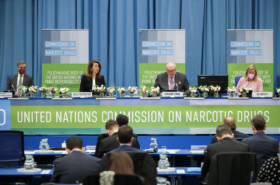
January is not yet over and 2026 is already shaping up to be a remarkable year in geopolitics. The multilateral system is facing spiralling political and financial crises, and the UN in Vienna is no exception. Its Office on Drugs and Crime (UNODC) has been hit by major budget pressure while still absent an executive director since the departure of Ghada Waly in November. Nevertheless, the UNODC has an unrelenting agenda over the coming months, with major policy decisions, political declarations and ongoing processes to be agreed upon, financed and implemented.
The show stays on the road in Doha
The outcomes of the 11th Conference of States Parties to the UN Convention against Corruption, which took place in Doha in December, bode well for the UNODC’s policy agenda in 2026. Despite the controversies that occurred in Vienna throughout 2025 – including US-instigated voting on the resolutions at the Commission on Narcotic Drugs (CND) – the last major UNODC event of the year culminated in 11 resolutions adopted by consensus. This was by no means expected, given that rumours of votes were still circulating in the conference venue the evening before it concluded.
The conference adopted a progressive resolution on political financing transparency, led by Norway, Ghana, Mongolia and Albania. The convention’s review mechanism was renewed, with improvements to transparency and civil society engagement, following protracted and determined campaigning by civil society organizations. Environmental crime was also once again identified as a priority, through a resolution tabled by Brazil and Namibia.
Despite the geopolitical headwinds, a lively programme of side events, including on organized crime and corruption, gave delegates a sense of continuity and familiarity. Although the US did not call for votes on the resolutions and therefore further undermine the consensus-based decision making known as the ‘Vienna spirit’, it instead issued statements distancing itself from specific parts of the resolutions without disrupting the process as a whole. Saudi Arabia and some others followed the same tactic on the environmental resolution.
Underneath the apparent consensus in Doha, the political and financial challenges were bubbling very close to the surface. At the reconvened sessions of the CND and the Commission on Crime Prevention and Criminal Justice (CCPCJ) in December, the UNODC announced planned budget cuts totalling US$130 million for 2026/27, due to US funding cutbacks and overall UN budget reduction measures. In the new year, the US once again drew attention to its revised policy positions by withdrawing from 66 multilateral organizations, though notably not from any UNODC-centred treaties or organizations.
Against this backdrop, here’s what to look out for in in 2026.
January: Cybercrime convention back in focus – what role for ‘multistakeholders’?
From 26 to 31 January, states will regroup in Vienna to discuss the new UN Convention against Cybercrime, following the subdued excitement of the signing ceremony in Hanoi in October. On the agenda is a decision on the rules of procedure for the convention’s new Conference of the Parties (COP). With a depleted budget, the secretariat has its work cut out for it in implementing whatever is agreed.
Most importantly for the Global Initiative Against Transnational Organized Crime (GI-TOC), member states will decide on the role of ‘multistakeholders’ (NGOs, the private sector and academia) in the new conference’s proceedings. On this, the GI-TOC agrees with civil society submissions that endorse an open set of rules for participation and engagement, similar to the convention’s negotiating committee. For this newest of UN conventions to instead begin with a closed and opaque process would severely weaken its potential impact on criminal markets and heighten its human rights risks.
February: A new UNTOC protocol on environmental crimes?
From 24 to 26 February, the second and final meeting of the Intergovernmental Expert Group examining the use of the UNTOC to address crimes environmental crimes will convene to agree its recommendations to the UNTOC COP. The GI-TOC believes that a protocol to the UNTOC would strengthen the international legal response to crimes that affect the environment, not as a silver bullet but as part of a more holistic international response. Although there has been opposition to enhanced multilateral action to counter these threats, momentum to adopt such a protocol is growing, based on the realization that the status quo is ineffective.
March: Drug policy and fraud
The great hope of drug policy reformers is a new independent expert panel created through a resolution tabled by Colombia and adopted by vote at the CND in 2025. However, a year later, the panel has yet to convene due to disagreements within regional groups about its composition. An inability to secure the funding needed from supportive governments has also been an issue for the panel. Meanwhile, a major reform effort led by Colombia and Bolivia through the UN to reclassify coca leaf as a less harmful substance under the UN drug conventions was rejected by the World Health Organization expert committee at the end of 2025.
Given the rollback of decriminalization and legalization policies in North America, and the growth and transformation of drug trafficking (especially synthetics and cocaine) worldwide, major policy changes will be off the agenda at the CND in March. However, drug trafficking, and how to disrupt it, will certainly be discussed. The intersection of drug trafficking issues with some of the world’s major flashpoints – especially the US–Venezuela crisis – will undoubtedly feature.
Directly after the CND, the UNODC and INTERPOL will host the second Global Fraud Summit from 9 to 13 March. There, ministerial-level attendees and others from government, law enforcement, the private sector and civil society will gather for two days of discussions on this expanding and increasingly global criminal threat.
April: The 15th Crime Congress in Abu Dhabi
As if the first three months of the year were not busy enough, April will see the first in-person UN Crime Congress since the 13th meeting in Doha in 2015. Member states are already negotiating the outcome document behind closed doors in Vienna, with the aim of reaching an agreement before the congress opens in the UAE on 25 April. However, this conclusion is far from certain, and delegates in Vienna face many hours of negotiations. Along with other stakeholders, the GI-TOC has submitted its priorities for the declaration, and hopes that it will provide a realistic overview of the current state of organized crime, as outlined in the latest Global Organized Crime Index. In addition, the role of civil society must be adequately reflected, given the record numbers of organizations registered to attend.
More to come in the second half of the year
The quinquennial Crime Congress does not relieve delegates from attending the annual CCPCJ, which takes place in the first week of June. In addition, the thematic working groups of the UNTOC COP will meet in the period between April and July. The only events involving civil society (the ‘constructive dialogues’) have been downgraded to online meetings, following withdrawal of funding by the US government.
The 13th UNTOC COP will take place in October, even with a review mechanism still struggling to make progress since its launch in 2020.
A troubling in-tray for a new executive director
The complex array of issues on the policy agenda will be compounded by the political, financial and administrative challenges awaiting the UNODC’s new executive director when the position is confirmed. They will have to act swiftly to steady the ship and chart a new course in this transformed and developing context, with the political backing of member states, and by making the best use of the knowledge held by civil society.